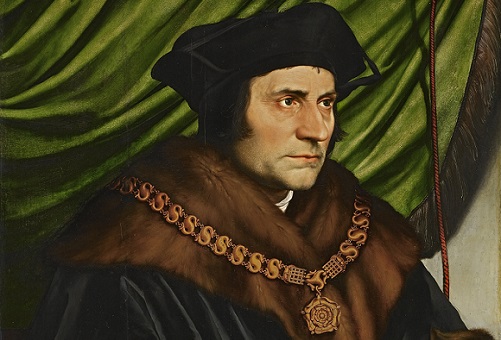
Thomas More is one of the most important figures of the Tudor period. A prominent lawyer, philosopher, MP, and Lord Chancellor of England from 1529 until 1532, More was a man of many talents. But should the title of “communist thinker” be added to that list?
The only reason such a debate exists at all is due to More’s satire Utopia, originally published in 1516. Initially released in Latin, the book was translated into various languages before an English translation was finally released in 1551 by Ralph Robinson. Utopia reflects More’s humanist qualities and, according to historian Quentin Skinner, reflects More’s opinion on the idea of ‘true nobility’. However, in more recent years, there have been those who have gone a step further in arguing that the values for which More argues (through the characters in his book) are communist values. Perhaps most notably, More’s name is among those of revolutionary inscribed on the Alexander Garden Obelisk in Moscow.
Calling More a ‘communist’ would be a little misleading, even if it were discovered that Karl Marx and Friedrich Engels had written The Communist Manifesto with Utopia as their primary source. The term ‘communism’ was coined around 1785 by French philosopher Victor d’Hupay and the kind of communism imagined by Marx, Engels, and political thinkers of the nineteenth century simply did not exist as an idea when Thomas More was alive. The real question is if More was a proto-communist and would be something along the lines of: “Would Thomas More identify as a communist if he were alive today?”
Although it is impossible to deduce the exact private beliefs of any historical figure—or, indeed, of any other living person—we might be able to at least establish the possibility that More was a proto-communist. The question is not a simple one and largely hinges on solving three puzzles, which elude easy answers:
- Does the imaginary society in Utopia contain the correct values—and enough of them—to be labelled ‘communist’?
- Does Utopia, as a fictional satire, actually aim to argue in favour of such a society or does it aim to ridicule it?
- Is Utopia‘s message a reflection of Thomas More’s actual beliefs?
All three questions must be taken into account. If the titular island of Utopia does not actually embody communist ideals then More’s approval of it would not indicate any communist beliefs; If Utopia is a communist society but Utopia‘s purpose is to mock it (and this mocking reflects More’s sincere beliefs) then the book would actually show More to be anti-communist.
The argument for Utopia as a communist society
What most historians do not debate is whether there are at least some aspects of Utopia—as a society—which can be viewed as either ‘communist’ or at the very least ‘anti-capitalist’. The most obvious example of this is the society’s view of private property.
Quentin Skinner notes that the people of Utopia, who dine and worship in public, view private property as an obstacle which prevents a community from reaching its best state. Indeed, Utopia‘s main narrator for Book II, Raphael Hythloday, argues that in Utopia ‘every man has a right to everything, they all know that if care is taken to keep the public stores full no private man can want anything; for among them there is no unequal distribution’ in addition to opining that ‘as long as there is any property, and while money is the standard of all things, I cannot think that a nation can be governed either justly or happily’. In fact, Skinner translates Raphael’s argument as: ‘I am fully persuaded that no just and equal distribution of goods will ever be possible, nor will happiness ever be found in mortal affairs, until the institution of private property is totally overthrown‘. What More’s narrator is getting at here is not merely that money can lead to, or permit, evil but rather that there is an inherent contradiction between a fair society and a capitalist society.

Were the point simply that money can be the root of evil, More’s work wouldn’t be any more radical than a plethora of other 16th-century thinkers’. Robert Crowley, in The Way to Wealth (1550), argues that the ‘poore man’ in England is ‘oppressed of them by whom thou shouldest be defended from oppression’ and Shakespeare’s Hamlet (1599) features its main villain, Claudius, state that ‘Offense’s gilded hand may shove by justice.’ The difference between what More’s narrator is arguing and what Crowley & Shakespeare are contending is that the latter two are essentially noting specific flaws within a capitalist economy—at best. Crowley believed in the idea of the ‘body politic’ so his criticism was not with the existence of the ultra-wealthy but rather of their neglect of the poor. Shakespeare (if he believes in what Claudius is saying) is merely noting the ability of criminals to bribe judges. Contrastingly, Raphael’s criticism is a general criticism of the very nature of a capitalist society, making it much more radical.
Utopia also features a lot of criticism, by Raphael, of the wealthy. At one point, he observes that in many countries, ‘the richer sort are often endeavouring to bring the hire of labourers lower, not only by their fraudulent practices, but by the laws which they procure to be made to that effect’ and rants about what we might today call ‘wage slavery’. Any nation which engages in such practices—so, by definition, any capitalist country—is nothing more than ‘a conspiracy of the rich’ who are only out for themselves.
The argument against Utopia as a communist society
Unfortunately for anyone thinking of packing their bags and trying to find this mysterious island, the people of Utopia do practise some rather unpleasant customs. For a start, slavery is a thing. Although Raphael argues that ‘for the most part slavery is the punishment even of the greatest crimes’, offences such as travelling to another city without a passport, trying to free a slave, and adultery all result in being condemned to slavery (although the Utopians’ decision to punish both the adulterer and adulteress equally—not yet the English legal custom—is an example of gender equality, I guess). Moreover, premarital sex is still a crime and in many instances women are still inferior to men and so those expecting some kind of, well, utopia will probably be disappointed.
Did Thomas More actually approve of Utopia?
Crucial to understanding if Thomas More was even remotely proto-communist is to discover his intentions. Did he intend to mock the fictional Utopia or did he actually approve of it?
The classic argument from those who do not see More as a 16th-century Karl Marx is that Utopia was a satire and many of the names have their roots in Greek words. For example, the island’s main river is Anider, which translates to ‘no water’ and Raphael Hythloday’s surname translates to ‘peddler of nonsense.’ Surely, then, More is merely making fun of this absurd society? Not necessarily. For a start, satires nearly always made serious points and the elements of satire in the book apply just as much to criticising capitalist countries as they do to the description of Utopia. Moreover, there are two things to consider with regard to the names. Firstly, the humorous translations may simply be jokes which readers with a knowledge of the Greek language would get, rather than serious repudiations of the society’s ideals. Secondly, More—at the end of the book—reveals that he ‘readily confess[es] that there are very many features of the Utopians’ commonwealth which, although I cannot have any hope of seeing, I should like to see, realised in our own communities’. If everything Raphael said was believed by More to be ‘nonsense’ then he simply could not hold this position. It’s even possible that More is deliberately allowing himself to have some plausible deniability when it comes to his actual beliefs, especially since the ideals of Utopia and those of Tudor England could not be further apart.
Perhaps the biggest problem with asserting that More genuinely approved of the Utopians’ society is that it seems to conflict with his real-life actions and beliefs. The Utopians did not approve of lawyers yet More was a lawyer by trade for much of his life; The Utopians practised religious freedom of choice and tolerance yet More had no objections to torturing Protestants; The Utopians approve of divorce and female priests but More was a staunch member of the Catholic Church, which held opposite views. After all, Thomas More was certainly no saint—well, he was canonised, but you get the point—and it’s hard to believe that such an austere statesman could truly believe in everything Utopia contained.
There’s no easy way around this apparent paradox. Perhaps More did secretly hold these rather anti-Catholic views (which he may have developed shortly before writing Utopia) or perhaps these values (without which one could still argue Utopia is fairly communist in its values) are inserted to allow More to distance himself from the other radical customs of the Utopians. We simply cannot know for sure.
So, was Thomas More a communist?
If nothing else, I hope that it’s evident how difficult it is to even come to a conclusion on Thomas More’s beliefs. I feel confident in arguing that the island of Utopia fulfils the necessary requirements of a communist society and although it has elements which most communists (and the vast majority of non-communists) would disapprove of, it is at the very least a thoroughly anti-capitalist society.

More’s comment at the end of Utopia makes it reasonable to assert that he believed in at least some of these elements, although precisely which ones remains up for debate. All in all, More certainly illuminated many communist ideas well before anyone else and although it’s hard to know how he really felt, labelling him a ‘proto-communist’ is definitely possible to justify.