When the bubonic plague erupted into an epidemic in the summer of 1625 it killed 40,000 Londoners, about one-fifth of the city’s population, before rippling out across England. This was, in raw terms, the deadliest outbreak yet of pestilence in the capital, but its mortality was rivalled or exceeded in proportion by a number of other episodes which punctuated the country’s history at depressingly regular intervals from the Black Death’s arrival in 1348 to 1665, when the Yersinia pestis bacterium launched its last significant attack.
Those two bookends are without doubt England’s most famous plagues. One its first and most deadly, killing about half of the total population; the other freshest in our memory, immortalised by Daniel Defoe’s historical novel A Journal of the Plague Year (1722), and shortly followed — though not, as a popular myth holds, curtailed — by the devastating Great Fire of London. The outbreaks in 1593, 1603, and 1608 are at least passingly relevant because they shuttered London’s theatres, disturbing the literary and theatrical activities of William Shakespeare. That a plague ravaged England exactly 400 years ago, killing so quickly that its victims often did not have time to develop the disease’s trademark buboes, has all but been forgotten.
Thomas Dekker could easily recall the “many dreadfull Examples of sudden Death” inflicted by the 1625 plague, for the writer could not bear to leave his cherished London at its outbreak and instead chronicled the terrors; of the sick staggering and dropping dead in the streets; of young children falling limp in their mothers’ arms; of mass burial pits crammed anonymously with bodies denied a headstone or any individual marker. His pamphlet A Rod for Run-awayes (1625) proves so gruesome a journalistic account of the epidemic that it is hard not to sympathise with those he scolds for deserting the city under the vain pretence that they could outrun God’s wrath.

A veteran and versatile dramatist, Dekker had seen London at its most dazzlingly spectacular. In 1612, he devised a Lord Mayor’s Show crowned by the majestic appearance of Neptune’s horse-drawn “sea chariot” (the mythological god brandishing a silver trident) and a mock battle between the forces of Virtue and Envy at “Forlorne Castle” in Cheapside, specially built for the ocassion. With Ben Jonson he had been pageant-writer of King James I’s royal procession through London in 1604, wherein the monarch passed through a number of stunningly ornate arches. These ceremonies had been postponed by a plague outbreak the previous year.
Dekker’s dramatic, poetic, and prose works confess an almost unbounded fondness for London, which he once called the “Mother of my life, Nurse of my being”, and he dedicated much of his writing to the uncovering of its idiosyncrasies and characters. He wrote a play with Thomas Middleton about the eccentric, gender-bending pickpocket Moll Cutpurse and later one about an alleged witch in Edmonton. A number of “cony-catching” pamphlets, detailing the supposed exploits of criminals in the metropolis, also flowed from his restless pen.
Of the frustratingly few facts about Dekker’s life which are known, however, many relate to hardship. Writing being an unlucrative trade, he lived probably in the inauspicious suburb of Clerkenwell, near the notoriously rowdy Red Bull Theatre where many of his plays were performed, and was almost perpetually in debt. For this he suffered occasional stints of imprisonment and was languishing in the King’s Bench Prison when his wife Mary died in 1616.
Dekker had always been an emotionally sensitive man by nature — so much so that one 20th-century scholar branded him “something of a moral sloven” — and treated the raucousness and depravity common in his works with remarkable delicacy. His first foray into pamphleteering had been a booklet published in 1603, during the violent plague outbreak which delayed his royal pageant and shut down the playhouses for which he wrote, under the title of The Wonderfull yeare (incorporating that adjective in its more antiquated, less cheerful sense).
Here he tempered descriptions of the pestilence’s devastation with occasional humour — in one passage, which imbues this article with serendipitous seasonal relevance, comparing health-conscious Londoners who walked the streets with fragrant herbs stuffed into their ears and nostrils to the boar’s head served with rosemary at Christmas feasts. It was Dekker’s desire that his readers laugh at his account, “because mirth is both Phisicall, and wholesome against the Plague”.
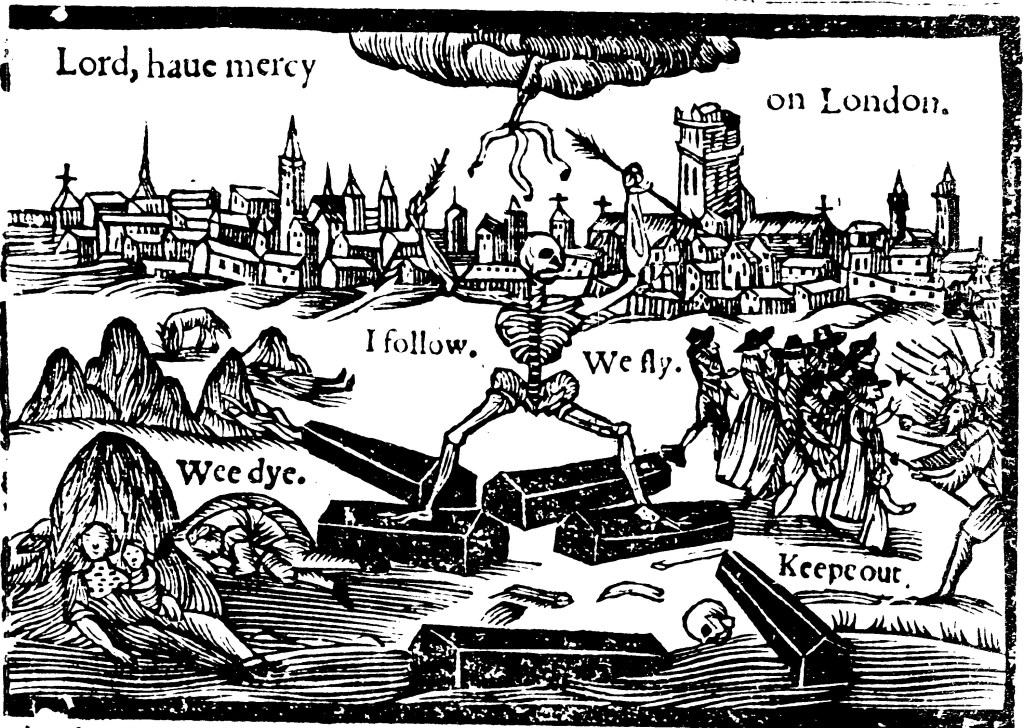
Now about 53 and a widower who was living through his fourth plague epidemic, Dekker was much sterner in A Rod for Run-awayes (1625), which was probably published towards the end of the outbreak. Its title page woodcut is striking: Death stands triumphant atop the coffins of his victims, wielding the arrows of pestilence with which he would take more. To the left, people lie by heaps of hay — one bearing the terrible mark of the plague in the form of buboes. To the right, Londoners attempt to flee into the countryside but are told to “keepe out” by a pike-wielding mob of those who live there. Behind them God’s hand can be seen descending from the heavens, bearing a three-tailed whip, to punish London, on whose behalf mercy is begged.
Deaths had been bubbling up since May, but began to increase exponentially between mid-June and late July, weekly fatalities jumping from about 600 to 3,500. At its most virulent in August the sickness claimed more than 5,000 deaths in a week. The sweltering summer months were always ripe for plague to spread and the cramped, unhygienic conditions of many London parishes made their inhabitants easy pickings. Those who could afford to flee, and had family or friends in the countryside willing to accommodate them, did. Others blindly fled the city in hopes of finding generous countrymen who would take them in, to apparently limited success, since Dekker and other writers made regular mention of the unwillingness of rural inhabitants to offer city-dwellers refuge. Of the open hostility exhibited by country folk Dekker writes:
“…they stand (within thirty and forty miles from London) at their Townes ends, forbidding any Horse, carrying a London load on his back, to passe that way, but to goe about on paine of having his braines beaten out: and, if they spy but a foot-man (not having a Russet [low-quality cloth] Sute on, their owne Country livery) they cry, Arme, charge their Pike-Staves, before he comes neere them the length of a furlong [220 yards]; and, stopping their noses, make signes that he must be gone.”
Fleeing the city seemed to Dekker little short of an act of treachery, for only a few of London’s “run-awayes” left any money behind for the poor of their parish and many not only left their neighbours empty-handed but, in ceasing their business, hurt urban commerce. “None thrive,” lamented Dekker, “but Apothecaries, Butchers, Cookes, and Coffin-makers”. The former was a dispenser of all kinds of (almost always useless) medication and fragrances which could supposedly ward off the pestilence. Butchers and cooks remained in business because hunger did not cease during epidemics. One can imagine quite easily the reason for the coffin-makers’ prosperity.
Dekker had neglected to mention that bookshops — from which readers could purchase journalistic tracts like his, alongside rousing sermons to fortify one’s soul and medical pamphlets full of plague remedies and preventatives — were also open for business. Perhaps he didn’t wish to draw attention to how he was profiting, even if not very fruitfully, from the ravaging sickness.
Orders given out by the King, his Privy Council, and London’s Lord Mayor mandated that the infected and their family be quarantined in their house for 28 days, under the watch of designated “surveyors” appointed from among their neighbours. Red crosses painted on doors identified which households had been affected and printed bills of mortality pasted onto walls dutifully informed onlookers of the climbing death toll.
But Londoners could not want for evidence of the plague’s devastation if only they looked around them. Dekker includes in his account a number of grisly anecdotes. One woman who fell sick with the plague while walking along the Barbican was denied water by a nearby alehouse proprietor who refused to give her a tankard. Though she was kept far away from by onlookers as she languished, the moment she died “some (like ravens) seized upon her body” and took her clothes for themselves. In Fleet Street, a woman’s young infant died suddenly in her arms mere minutes before its mother also succumbed to the sickness. In another parish a coffin was opened only for the plague victim inside to open his eyes and breath, but no sooner had help been sought than the man was “full dead” again.

England was, Dekker declared at the beginning of his pamphlet, a battlefield on which the forces of God were fighting the “innumerable sinnes” of humanity. Plague was the means of divine correction.
We find amongst this mortal combat a number of London’s most wretched souls caught in the crossfire. There were the city’s poor and its physically disabled, who risked starvation now that many of those who might have been most capable of donating alms had fled. Particular sympathy is extended to its prisoners, amongst whom Dekker had not too many years ago been companion and on whose behalf he now petitioned.
The suffering of “the distressed in Ludgate, the miserable soules in the Holes of the two Counters, the afflicted in the Marshallseas, the Cryers-out for Bread in the Kings Bench, and White Lyon” should, Dekker posited, be to the concern of those who declined to help them. Their agony could be taken as evidence “in the open Court of God and Angels, against you”. During plague times, divine judgement could come quicker than one would hope — “no man at any time is assured of life, yet no man (within the memory of man) was euer so neere death as now”.
Dekker had seven years. Dying in 1632, aged about 60, the writer left behind him some 40 plays (most collaborations) and more than 18 pamphlets. He, like the pestilence he’d chronicled, has largely been forgotten. But for as bleak a picture as A Rod for Run-awayes paints, Dekker’s “compassionate complaynings” seem sincere attempts to both faithfully document and ameliorate London’s misery. No wonder the scholar F. P Wilson spoke of his “incorrigible optimism”, misted over not even by the misery of plague — such was the generosity and good-heartedness of the man William Hazlitt affectionately called “old honest Dekker”.


