From mythical dragons which once roamed the British Isles to the elusive Beast of Exmoor, tales of terrifying monsters have long been conjured up to warn children against naughty deeds, sell books, and encourage tourism. Early modern England was no exception and some of the monsters were very much real.
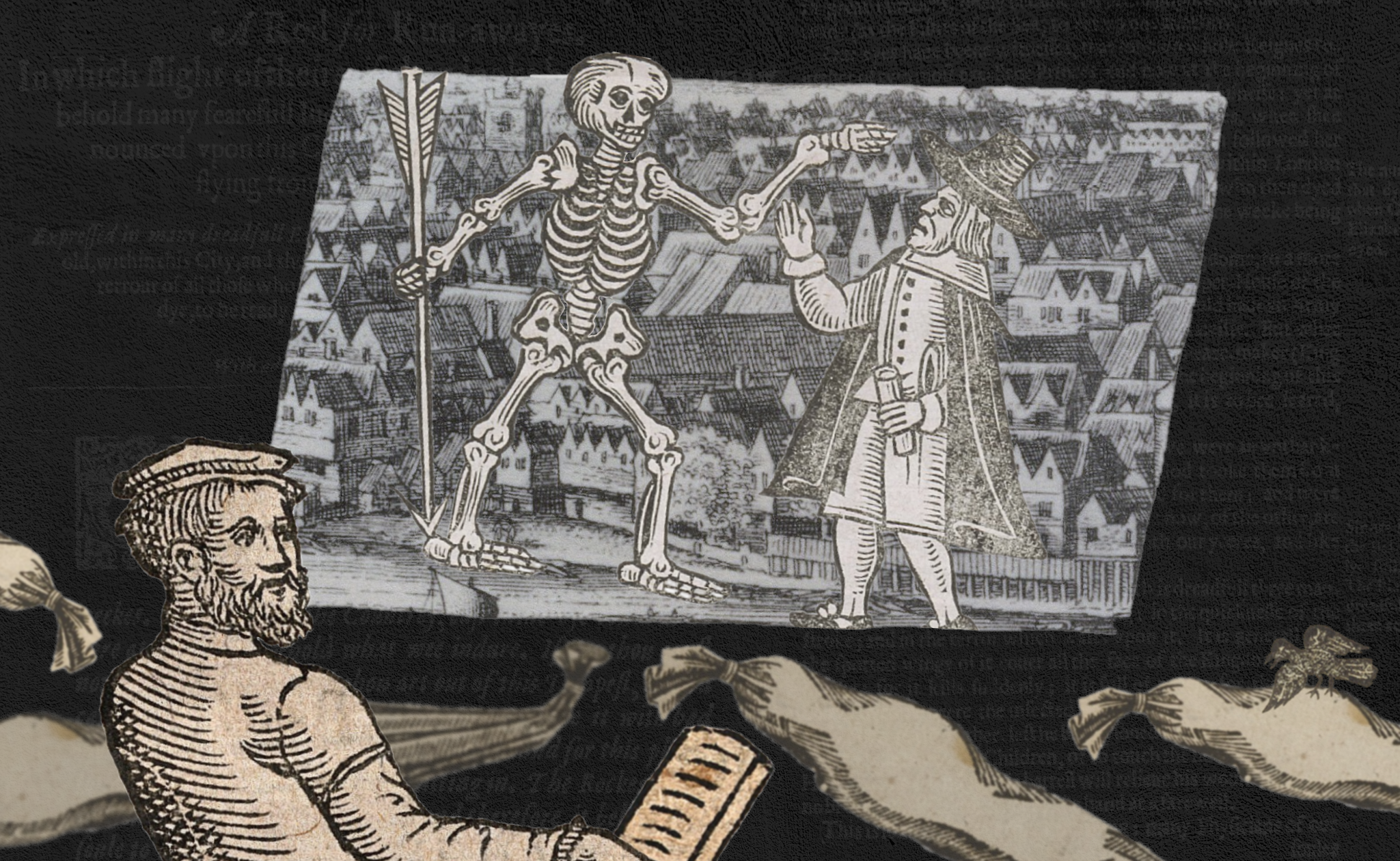
Although fantastical reports of monstrous creatures roaming all throughout England tended to focus on fictitious beasts such as the Black Dog of Newgate (pictured above in a 1638 woodcut), there was often little need to fabricate creatures because reality was just as scary.
One popular genre of ballad was that of ‘strange but true’ news from both abroad and England itself. Included in this genre were reports of alleged ‘monsters’ which were so unfamiliar to the people of England that they drew significant attention. Take the discovery in 1586 of a worm in the heart of a horse or ‘dans le coeur d’un Cheval’ as one illustrated ballad written in French (though published in London) puts it. The worm (pictured below) certainly draws the reader’s attention at first glance. Apparently discovered after the horse of gentleman pensioner ‘Mr. Dorrington’ had died unexpectedly, the worm’s reported length of some 17 inches is similar to that of various worms commonly found in horses, such as the roundworm. Which precise type of worm this is was never discovered, and I have been unable to find a reliable source which comes to a conclusion in this regard. The root-like structure of its body resembles the branching species of polychaete worm, however this is generally a marine worm and (as far as I can tell) is not particularly common to find in England. The ‘red water’ emitted by the worm according to the illustration, and reiterated by a 1779 book which references the event, resembles the redworm’s production of coelomic fluid when threatened but this liquid is usually yellow and the physical structure of the illustrated worm is very different from that of the redworm—and most other common worms.

According to the 18th century account, the worm was stabbed, stuffed, and presented to Queen Elizabeth I. Clearly the creature was considered a spectacle and to such an extent that the ballad printed by Jean Wolfe includes the names of various reputable witnesses to support its claims. The woodcut takes up the majority of this ballad and is sufficiently unsettling as to make even a modern reader cringe. Notably, the woodcut is clearly an original and not one which has simply been recycled to save money. The ballad ends with the typical moralising that should be expected of a 17th century piece of cheap print, deeming the worm evidence of God’s intricate design, but the clear emphasis is on the physical reality of the titular ‘Monstreux’ (monster) rather than any moral, religious, or political message.
It was a similar story 18 years earlier, in 1568, when Timothy Granger authored ‘A Most true and marveilous straunge wonder…’ about some ‘Monstrouss fisshes’ that had been caught in Suffolk. Of the 17 caught, two of the ‘fyshes’ are notably ‘more howge and monstrous then the other[s]’ and an illustration is provided (pictured below). A modern reader would probably not express too much shock at the beast itself, although the illustration is a little strange, and some might correctly conclude that what had been caught was no less than a killer whale—multiple, in fact.

The whales are reportedly 27 feet long, which would be an accurate measurement of a fairly large male killer whale, and were ‘as bigge in the middle […] as [three] Buttes of Malmezie’, incorporating a measurement of wine (in this case Malmsey) to show the extent of their size. The story goes that one of the boats had a whale (alive) tied to it but the whale swam away, taking the boat with it and nearly causing it to sink. Although it’s unclear if it is a killer whale being referred to, it’s alleged that ‘Som of them laye upon the wharfe [two] days and a nyght before they were dead’ and even then they had to be killed using axes. It’s very unlikely this could be a true of any whale and certainly not of a killer whale, which can only really survive a few hours when beached. Once again, the end of the ballad includes a references to the ‘straung and marveylous handye workes of the Lord.’
A reference to God is much more apparent in a ballad released two years prior which records the sighting of a ‘most monstrous fishe’ found in Holland. The illustration (provided below) makes it clear that the animal is in fact a giant squid.

Most modern readers probably shudder a little when beholding the animal so the impact it would have on an early modern reader is clear. A secondary title of this specific ballad reads: ‘The workes of God how great and straunge they be.’ As with the previously mentioned ballad (and likely the ballad published in English about the worm in 1586, which I’ve not been able to locate), the font used is blackletter.

This indicates that the ballad was—unsurprisingly—intended to be read by members of the middling class and even some literate members of the lower classes (as this was the font that was legible to them), although the illustration would have made a stark impression on anyone who saw it, literate or not.
None of the three of the examples I’ve provided is supernatural but that didn’t mean that the ‘monsters’ were not viewed as marvellous, frightening creatures. Although religious moralising inevitably occurs when any strange animals are spoken about at this time, the real reason behind the success of these ballads is simple: They were a spectacle. It’s easy to look back condescendingly on the wonder of these people because we are familiar with the animals they are beholding but in reality we would all react the same way. These ballads are a reminder that for all the time which has passed, one thing which links us with our early modern ancestors is our fascination with the discovery of mesmerising sea monsters, disturbing creepy-crawlies, and other wonders of the natural world.