Most newspapers today feature images on their front pages in order to attract the attention of a potential reader, so it should come as no surprise that early modern broadside ballads and pamphlets were no different. But at a time when photography had yet to be invented, the role of images was much larger than simply reflecting reality.
Woodcuts are useful for a variety of reasons. On a practical level, woodcuts allow for the meaning of a piece of text to be reflected visually. During the early modern period, this would have meant they had at least some value for any illiterate members of society who stumbled upon them and even today it can help give us an idea as to what the intended message of a ballad/pamphlet was.
Although woodcuts were selected by printers rather than authors, and most woodcuts were simply recycled illustrations rather than purpose-built for a specific text, this doesn’t make them any less useful — it just changes what they tell us.

In a 2018 article, Katie Sisneros considers the reuse and recycling of early modern woodcuts as ‘a parallel to meme culture’ which is popular today. In the same way that contemporary internet forums are full of images which are nearly identical save for a different caption, early modern printers would often repurpose woodcuts to save time and money.
Sisneros’ prime example is the woodcut above, which features in a bunch of broadside ballads during the late seventeenth century and features cupid accompanied by an empty speech bubble. The printer could put whatever text they desired into the bubble and instantly make the woodcut more relevant to whichever specific story was being told.

What about the three woodcuts above, seen in a ballad from 1693? With no other information, we can see some people decrying a ‘wicked woman’, a figure who is presumably the woman in question, and a devil-like figure.
The devil’s presence alone would tell an early modern reader that the ballad in question featured evil-doing but this would have already been obvious from the monstrous nature of the middle figure, whose superficial ugliness is intended to mirror her moral ugliness. Since the title is The Injured Children, or, The Bloudy Midwife and the ballad is about a woman who allegedly killed several children (hiding their bodies in a cellar), it’s understandable that the woodcuts in question have been chosen.
Although it’s not so obvious in this case, woodcuts can also be used to date ballads and/or pamphlets which have no clear origin. If a ballad features a woodcut which features in another print for which a date of origin is known and for which the woodcut seems to have been specifically produced, it’s reasonable to assume the undated ballad was produced after this date.
Moreover, if a woodcut features a person, it’s possible to look at their clothing and work out a date before which the woodcut could not have been produced; if a woodcut features a man in mid-17th century attire, it cannot have been produced in the late 16th century.

The woodcut above comes from a late 17th-century ballad about the murder of Mary Cox. It shows a violent scene wherein a woman is violently beaten by a group of women. Except, does it? The woodcut also appears in another, possible earlier, ballad entitled The Norfolk Lass which is about a woman who unexpectedly gives birth to a child. In that context, the scene is a less violent one, featuring a woman giving birth with several midwives present.
Both interpretations could be correct and the woodcut was not made with either ballad in mind, since both of them don’t feature enough people. I’m tempted to choose the Norfolk Lass option because the women resemble midwives (or at least aren’t obviously not midwives) and there is no devil present or any clear indication that anyone is being harmed.
But whether it’s a murder scene being used to portray someone giving birth or vice versa, the fact remains: woodcuts would often be reused even when the context was very different.

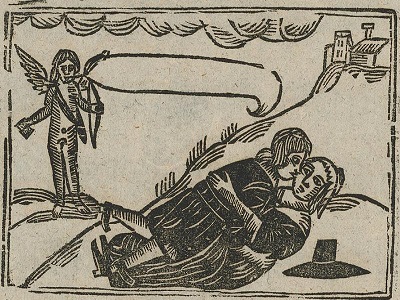
What about the woodcut above? According to Laura Gowing and Patricia Crawford, this shows ‘two women in bed together’ who might be ‘a mistress and a servant, or two friends sharing a bed’ and who are ‘apparently embracing.’ This description became somewhat controversial online last year, after a semi-viral tweet sought to make fun of the apparent historical erasure of lesbian relationships at play. Gowing herself pointed out that the description was meant to make the reader think and that the image itself was indexed under ‘lesbianism’.
Ignoring the fact that it wasn’t uncommon for two women, or two men, to share a bed in a platonic capacity (although the ’embrace’ is harder to explain), the woodcut probably doesn’t even feature two women. The ballad that Gowing and Crawford reference, The Bloody Battle at Billingsgate, centres around a conflict which stems from a woman sleeping with another woman’s husband. So the woodcut, which is fairly low quality anyway, probably shows a man and a woman in bed (this is also supported by the context of other ballads it features in).
Although ballads could avoid censorship with greater ease than pamphlets or books, its nonetheless also worth questioning if such a woodcut (containing a lesbian act) would be produced, and then published, in the first place.

Finally, the above woodcut might be my favourite of them all. It’s from a 1647 pamphlet entitled The World turn’d upside down and laments the state of England at the time, specifically protesting the Royalist toppling of Charles I and what the author sees as a decline in religiosity. The woodcut itself is interesting, featuring numerous scenes which are all nonsensical. Moreover, the text itself references the woodcut frequently, indicating that the author is writing with it in mind (and it was possibly made specifically for this pamphlet). This is how he chooses to describe it:
‘The Picture that is printed in the front
Is like the Kingdom, if you look upon’t:
[…]
This Land (quite out of order) out of square:
His breeches on his shoulders do appeare,
His doublet on his lower parts doth weare;
his boots and spurs upon his armes and hands,
His gloves upon his feet, (whereon he stands)
The Church o’re-turn’d, (a lamentable show)
The Candlestick above, the light below;
The Cony hunts the Dogge, the Rat the Cat,
The Horse doth whip the Cart, (I pray marke that)
The Wheelbarrow doth drive the man (oh base)
And Eeles and gudgeons flie a mighty pace.’