[This post includes references to child death, specifically infanticide]
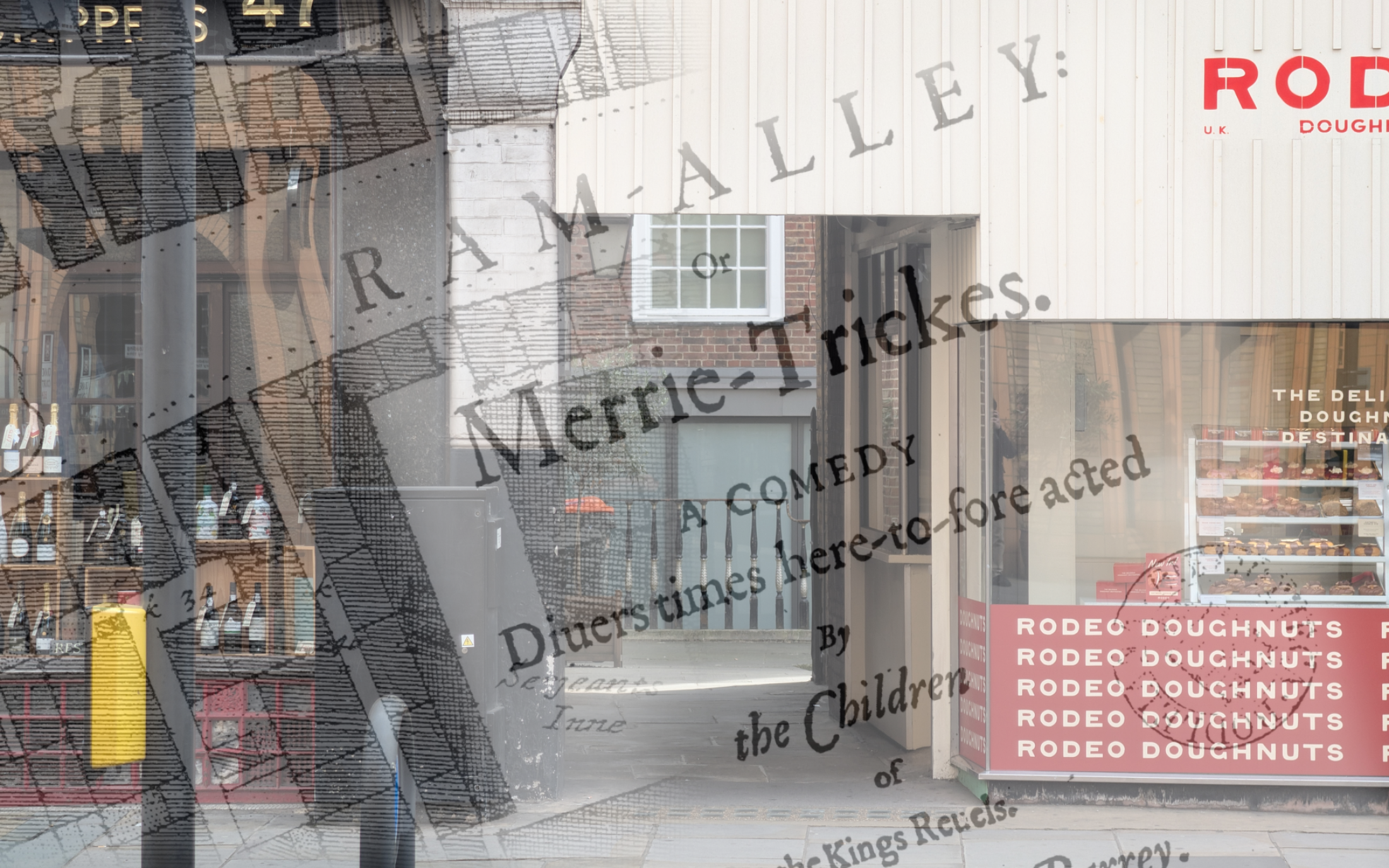
In March 1680, the inhabitants of Rotten Row in Holborn could not sleep soundly in their beds. Strange noises and groans echoed through the dark streets in the dead of night; some people claimed to see a dark figure shifting around in the shadows. Eventually the apparition revealed itself to a maid and revealed to her the locations of two sets of children’s bones, murdered some years prior.
Okay, it’s a good story—and one which is horrible yet appealing to an early modern and modern audience alike—but how much of it is actually true?
The question might seem absurd. If ghosts don’t exist (which I’m apt to believe they don’t) then it must all be made up, surely? Well, maybe. This tale in particular, which relays the story of a midwife’s ghost appearing to a maid to instruct her to search under two tiles in the said ghost’s former home in order to discover the bones of two murder infants, is difficult to dismiss altogether as a fiction.
Some 17th-century ghost stories were just entirely made up; The fictitious invention of an imaginative author who, seeking to cash in on popular credulity and superstition, could invent a ghost story compelling enough to sell but sufficiently mysterious and vague that it would be easier to believe than debunk. Alternatively, the author could be relaying the account of an alleged witness but might add some details to make the story more interesting or omit some of the more uninteresting elements. Even if an author accurately conveyed the witness’ story in full, there’s the possibility that the original witness was lying, in whole or in part. Occasionally a ghost pamphlet could be nearly entirely true. After all, many ghost accounts which consist merely of ominous weather, strange noises, and shadowy movements can be easily explained away as a culmination of coincidence, animals, and the mind playing tricks. It is only when a ghost explicitly appears and announces its intentions that some trickery must be afoot (although it is possible that the said trickery is on the part of the ‘ghost’ rather than its witness).

The ghost which terrorised Holborn residents in 1680 was one such case. It is recorded (to my knowledge) in two contemporary publications of that year: a short pamphlet entitled Great News from Middle-Row and a ballad entitled A New Ballad of The Midwives Ghost. It is difficult to determine which one came first or is more credible. The ballad explicitly accuses the midwife (who died some six months prior and in whose house the children’s bones are uncovered) of murder, whereas the pamphlet is much less explicit, though it does still ultimately imply her guilt. I’m tempted to place the pamphlet as the earlier publication because:
(1) It includes details which the ballad does not reference, whereas the ballad does not include any facts which the pamphlet omits. This suggests that the balladeer probably got his information from the pamphlet (in addition to any circulating gossip or any other publications which are no longer extant).
(2) The ballad explicitly presents Mrs. Atkins as the murderer. In my view, this is because the writer read the pamphlet and either concluded himself that the midwife was guilty or believed the pamphlet to be indicting her and simply parroted the accusation. For the ballad to have been published first (and inspired the pamphlet), the author of the pamphlet would have need to make an active choice to omit the explicit reference to Atkins as the murderer, which doesn’t seem especially likely given the nature of the work (17th-century clickbait).
In any case, I have little doubt that the later author (be they the pamphleteer or the balladeer) was informed either directly by the other writer or by an author who had himself been informed by that writer. This is simply because the wording of both texts is identical in parts and neither publication contains any factual information which contradicts the other, even slightly. On first glance I was almost tempted to posit that the author may be the same individual but whilst this could technically be the case, the different levels of guilt assigned to Atkins is probably sufficient to conclude that there are two separate authors.

One similarity, which is of relevance to a discussion of the story’s legitimacy, is that both writers make it clear that the story can be partially verified. Mrs Atkins’ ghost appears to a maid who is fetching her mistress’ ‘Night Cloaths’ upstairs in Atkins’ old house. The ghost ‘seemed to belch flames of Fire’ and greatly frightened the maid. The ghost told her that if she dug up two tiles next to the hearth, she would find something which she should then bury. And sure enough, two sets of bones—belonging to two ‘Bastard-Children’—were uncovered. The pamphlet notes that ‘the said Bones [can] be seen at the Cheshire Cheese in Middle row’, an invitation to the reader to verify the truth of the situation. It wasn’t uncommon for pamphlets to insist heavily upon their veracity (perhaps suggesting that readers were not as credulous as we might sometimes believe) and witnesses of supernatural events were often named. The mere inclusion of this insistence does not make it certain that The Cheshire Cheese (presumably an alehouse?) actually did contain the bones—and it certainly didn’t mean that these bones, which the pamphlet admits were ‘reduced to a small substance’ anyway, were genuine evidence of a crime—but it is probably that it did. The ballad includes this information as well and, by referencing The Cheshire Cheese in both the subtitle and at the end (because ‘Most People they are apt of late, to condemn (most) strange things as lyes’), is even more keen on insisting upon its truth than the pamphlet.

One troubling detail shared by both accounts (from a modern standpoint) is the notion that Mrs Atkins’ tormented spirit had been terrorising the local community for a few months prior, ‘with dismal shapes, and Lightings strange/That by no means they could rest.’ If the ghost’s existence relied solely on the testimony of a single maid than it would be more easily dismissed as a fabrication, dream, or trick. It could simply be that both authors (or simply the first, who the second is copying) invented this detail to make the story more compelling and believable. Alternatively, it’s possible that many of Rotten Row’s residents conspired to forge this false narrative. Because any explanation—no matter how contrived—is more likely than the ghost having actually existed, this is a detail which can probably be ignored.
Malcolm Gaskill, among others, has noted that the role of ghosts in leading people to evidence of crime was often simply a practical tool. If the means by which a witness uncovered a murder weapon could potentially lead to self-incrimination (perhaps they were engaging in a crime at the time) then the falsification of a ghost which ‘lead’ them to said evidence was convenient. In this case, we might consider that maid uncovered the bones herself through some accident and, afraid of being accused of infanticide herself, decided to invent Mrs Atkins’ ghost which could then lead her, her mistress, and her master to the bones. Because the obvious choice of murderer was Mrs Atkins, who was dead, or the children’s mother, who stood no chance of being identified, we’re forced to conclude that the maid reported the crime out of some genuine desire to do good with no hope of any practical justice being served. This isn’t to say that there aren’t other explanations (the maid could have fabricated the whole thing for attention) but with no real evidence, and the balance of probability in mind, this seems like the most plausible explanation.
A pamphlet published only a year earlier tells the story of a baby who was murdered by its mother in Durham and subsequently appeared as a ghost to a woman, revealing ‘its Place of Burial, and the Reason of its Walking.’ These stories were common—and they sold well. The ballad concerning Mrs Atkins’ ghost was sold by Thomas Vere, a popular bookseller who worked with a few other ballad sellers to have a near-monopoly over the trade by the late 17th century. While the pamphlet required a degree of literacy to enjoy and featured no woodcuts, the ballad featured a prominent woodcut of a ghost. The woodcuts of the pamphlet are clever positioned by the printer so that two separate woodcuts (one of a ghost and the other a woman) face each other in a way which mirrors the specific details of the story, while not requiring a new woodcut to be created (see below). Moreover, it would have been enjoyed by illiterate audiences when it was publicly sung in the London alehouses or on the street. When the ballad-singer reached the final few verses, wherein the ghost’s speech is quoted, they were forced to adopt that ghost’s first-person perspective, making its existence even more real to the listeners. Somewhat ironically, some of the ‘dismal Ecchoes’ so often viewed as having ghostly origin can probably be explained away as the reverberation of ballad-singers among other natural causes.

Was Holborn the site of a spectral visitor in 1680? Probably not. But something terrible probably had happened in the years prior. And for the maid who likely did uncover genuine evidence of cold-blooded infanticide, fabricating a ghostly witness was a cunning way to increase the likelihood of her testimony being taken seriously (not least because she was a woman and only a servant) as well as to offer her a handy justification for suggesting that a certain location might hide a terrible secret.