Mince pies, tinsel, presents under the tree… and political furore. These are the things a modern reveller must expect at Christmas time. That final item is a newer addition, but has been bestowed the honour of annual ubiquity by some American political commentators who — first on radio and television, now also in online columns and on social media — have for more than two decades decried the “War on Christmas” threatening the holiday’s very existence, or at least its association with Christianity.
Righteous fury has been directed at such trivial and almost self-parodying targets as Starbucks’ holiday cups (on which nothing short of a printed sermon would seem to placate their wrath) and the inclusive tendency to wish “Happy Holidays” to people whose religious affiliations may be unknown — and who are, in any case, likely also to celebrate New Year. This particular theatre of the culture war has secured only a slippery foothold across the pond, but the Brit who smugly thinks it a uniquely modern and American foible is guilty of the rankest historical exceptionalism.
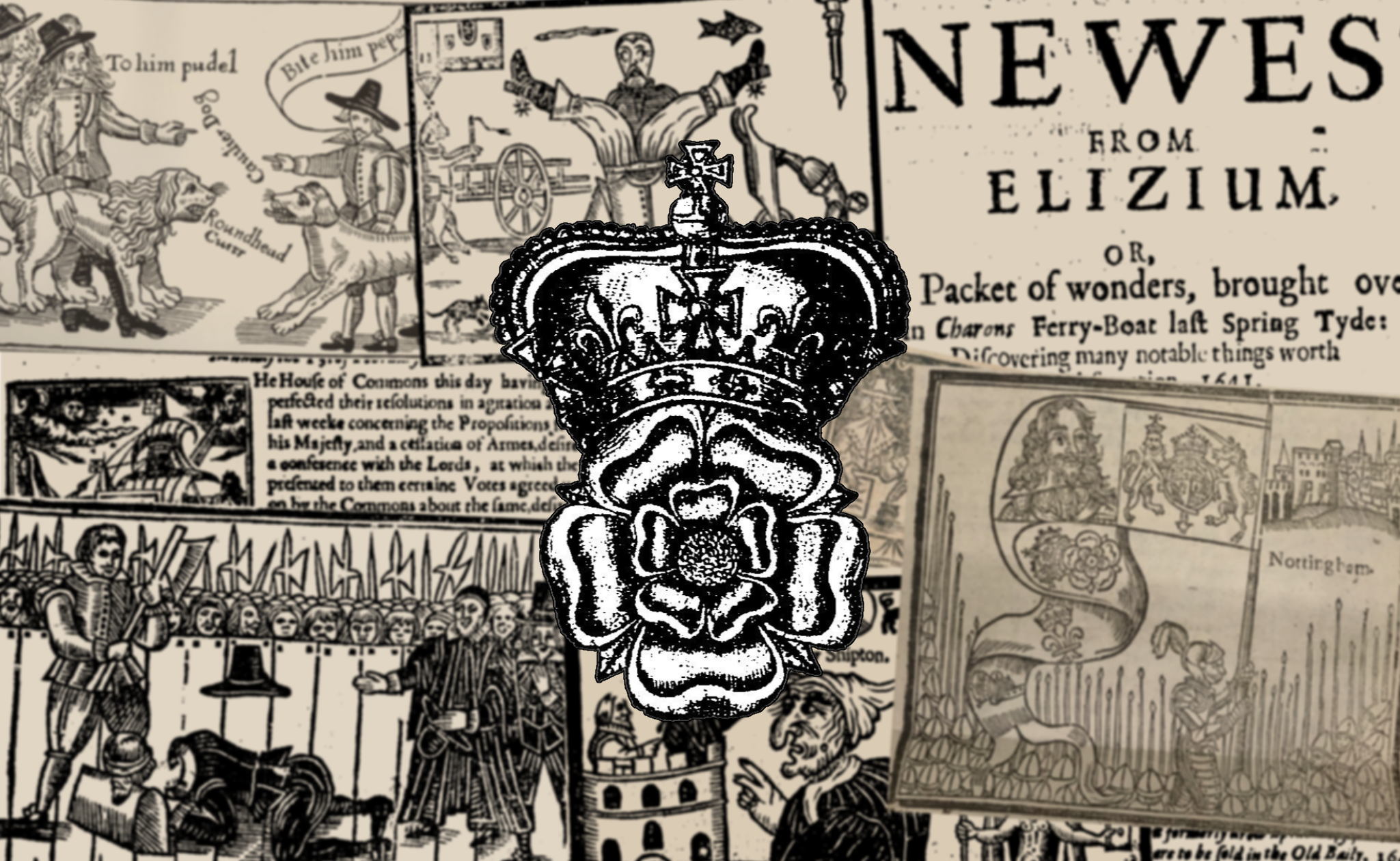
The Twitter spats and crude political memes of today cannot compare to the drama which unfolded in England a little shy of 400 years ago, during its Civil War. Thousands of pro-Christmas rioters gathered in defiance of an actual war on the holiday orchestrated by fellow Christians, defending their right to gorge on plum pudding and targeting shopkeepers who did business instead of celebrating. Meanwhile the printing presses erupted with politically-charged pamphlets both attacking and defending the festivities, accompanied by satires suggesting “Old Father Christmas” (the folkloric precursor to today’s Americanized Santa Claus) had broken out of prison, eager to spread joy once more.

King Charles I had, unwittingly, fired the first shot in January 1642 by granting royal assent to a parliamentary bill which made the fourth Wednesday of each month a day of fasting and prayer. Christmas fell on such a Wednesday two years later — after the fighting between Royalists and Roundheads had broken out — and it was with only six days notice that the Puritan-packed Long Parliament clarified that no exception was to be made. Prohibited, then, were the “carnal and sensual Delights” usually indulged in on that day, namely feasting, dancing, singing, and the playing of sports.
This one-off ban was not yet the comprehensive prohibition of Christmas which the strictest of Puritans had been pursuing for decades. It certainly wasn’t “Cromwell banning mince pies”, as the popular story goes, because it was neither orchestrated by Cromwell, who was not yet at his political apex, nor singled out mince pies, which were eaten throughout the year. The order was probably little observed, not least because the country was still being torn apart by a calamitous war from which Christmas was a welcome distraction.
Come 1647, with Charles I under house arrest, Parliament issued another ordinance banning Christmas alongside Easter and Whitsun. Puritans believed Christmas celebrations were a relic of Catholicism, unsanctioned by the Bible (which they self-professedly followed to the letter), and encouraged drunkenness and lascivious behaviour. Local authorities were instructed to ensure no special religious services or celebrations were held; town criers called out “No Christmas, no Christmas!” and, in London, soldiers patrolling the streets seized any food they discovered being prepared for feasts.

When the Mayor of Canterbury attempted to enforce the ban on Christmas Day in 1647, only about a dozen of the city’s many shopkeepers obeyed and carried out business as usual — the rest, along with the vast majority of inhabitants, celebrating the holiday as if it were any other year. A burgeoning crowd took to the streets and urged traders to close their shops, vandalizing the wares of those who refused. Its size grew in part because a few of the chief rebels supplied two footballs for a merry game of sport, which further aggrieved the authorities.
The city’s sheriff apprehended one of the men but, a pamphlet rushed through the presses early the next year tells us, “was stoutly resisted”. The mayor came to his aid with a cudgel, thus marking the start of a tumultuous brawl in which pro-Christmas rioters attacked soldiers, broke their compatriots out of the local jail, and forced the city’s aldermen to take shelter in their houses, victoriously crying out “Conquest!”.
It is a testament to the fact that both sides of this conflict were Christian that the following day, being a Sunday and thus the Sabbath, passed in “peacable” fashion. Not so on Monday, however, when the mayor assembled soldiers armed with halberds and muskets to ensure there was no revelry (25 December was only the start of 12 days of celebration which ran until Twelfth Night in early January).
Such an authoritarian display of force was provocative, and it did not help that the Captain of the Guard, Richard White, was a local barber whose shop windows had, much to his aggrievement, been “pulled downe to the ground” two days earlier. When a local rabble-rouser tauntingly branded him a “Roundhead”, White cocked his pistol, aimed it at the fellow, and — despite pleas for restraint from the mayor — shot the man, who fell to the ground.
The mob now numbered about 1,000 and (wrongly, as it turned out) believing the man to have been murdered, advanced upon the soldiers with clubs, overpowering them by sheer force of numbers. The rioters seized control of the city’s gates and its munitions store. The mayor fled to a hay-loft, where he was eventually found and dragged through the streets while his house was vandalized and those he had imprisoned in the preceding days were granted their freedom. After a brief period during which Canterbury really does appear to have been governed by mob rule, a detachment of parliamentary horsemen and soldiers regained control of the city on Wednesday.

There were riots in various other cities and towns across the country, including Bury St Edmunds, where apprentices had for the past few Christmases patrolled the streets with nail-studded clubs to enforce its observance. Far from a tired cliché, however, the activities of London’s printing presses prove the pen really was the most powerful weapon in defence of Christmas, and words akin to paper bullets.
Some volleys in this rhetorical war came from the Puritan camp — like the anonymous author of Mercurius Religiosus (1651), who branded Christmas a “Pagan-Popish Strumpet” only observed by the masses because it supplied “the Drunkards good Ale, the Gamesters Delight, the Gluttons Mince-pyes, the Fidlers meat, drink, and money, and the Devils advantage”.
But those curmudgeonly polemicists had a hard task ahead of them. Would readers of The Arraignment, Conviction, and Imprisoning of Christmas (1646) really side with the dialogue’s town crier, clearly the voice of its Parliamentarian author, who criticises the holiday as a reprehensible Catholic ritual, over the lady who speaks of the happiness it brought many people, “made all merry with Bagpipes, Fiddles, and other musicks, Giggs, Dances, and Mummings”?
In response came a number of fiery pro-Christmas pamphlets and ballads, whose authors were undeterred by the (admittedly flimsy) grasp Parliament had over London’s print market — regardless of how many booksellers’ doors they kicked down and printers’ workshops they raided. A popular Royalist ballad, titled The World is Turned Upside Down (1646), reported that “Old Christmas is kickt out of Town”, and offered the following eulogy in its final verse:
To conclude, I’le tell you news that’s right,
Christmas was kil’d at Nasbie fight:
Charity was slain at that same time,
Jack Tell troth too, a friend of mine,
Likewise then did die,
Rost beef and shred pie,
Pig, Goose and Capon no quarter found.
Yet let’s be content, and the times lament,
You see the world is quite turn’d round.
A Royalist author by the probably pseudonymous name of Josiah King put Old Father Christmas on trial again in 1658, only two years before the restoration of the monarchy, and happily declared that he had been cleared by a jury.
In this satirical report of an allegorical court case, Christmas is spared the punishment of death after arguing that he had always preached moderation — “I bid them fill their bellies, not their eyes, and rise from the board, not glutted but only satisfied […] and that they should not loose themselves in their feasts; but bid them be soberly merry, and wisely free”.

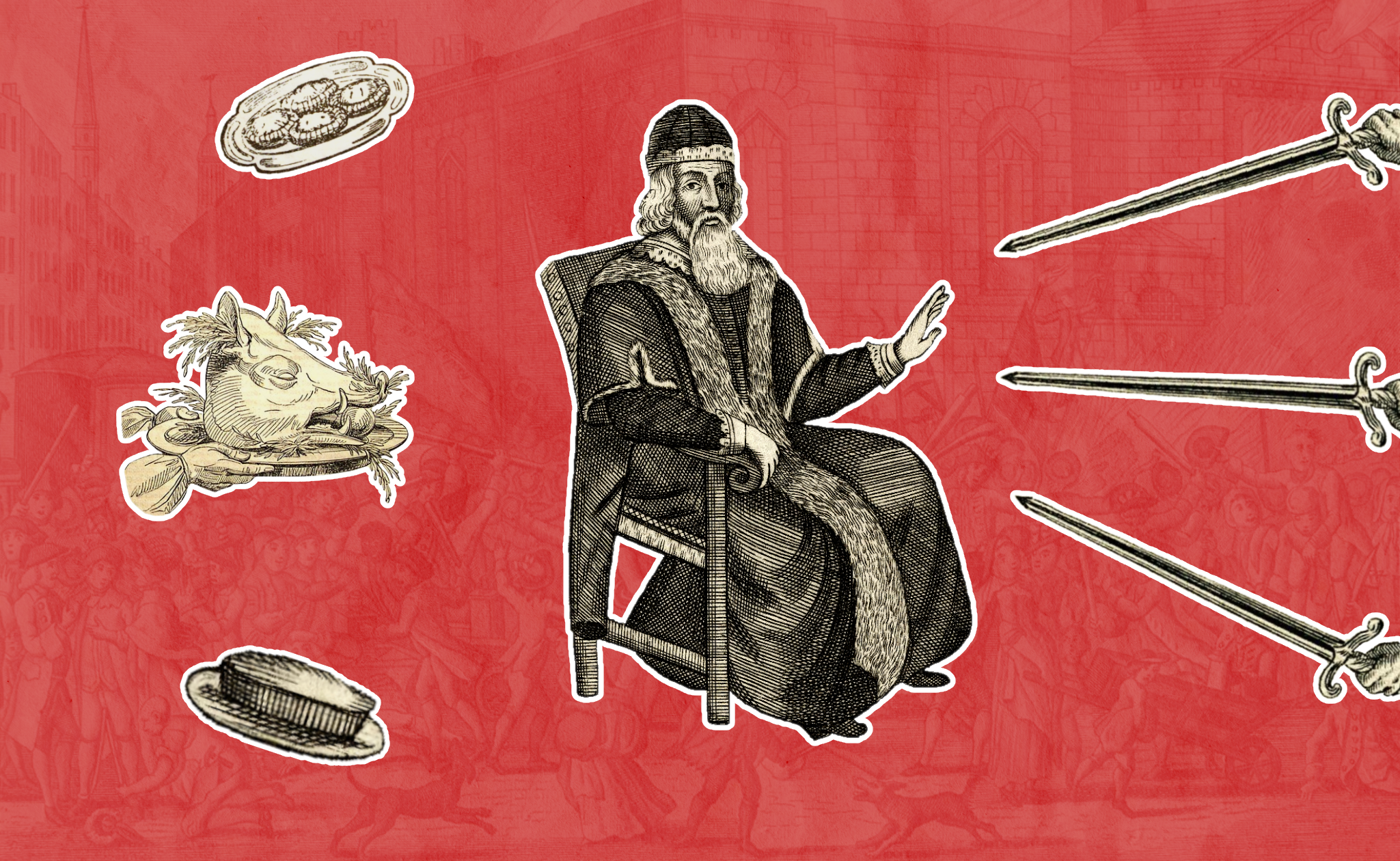
In its eye-catching introductory illustration we see the the hoary-haired and snow-bearded Christmas, clad in a fur-trimmed gown, waving off the Puritan soldiers who have come to arrest him. On the floor beside him are laid out an assortment of those festive victuals which his adversaries so despised — and a small bit of verse below, in alluding to the “many thousands [who] with one breath/Cry out let him be put to death”, reminds us that while the Puritan opinion was in the minority, it was by no means a fringe belief.
The voluminous writer, social commentator, and self-styled “Water Poet” John Taylor, a staunch Royalist who had in happier times found preferment as a loyal waterman to Charles I, could not help but wade into the controversy. Taylor had always been an energetic writer — producing quick-witted pieces of doggerel verse and piercing satires at remarkable pace — and lost none of his literary verve in his old age. By 1646, he was approaching his seventies and, with his wizened frame and silver hair, the wispiness of which he compensated for with a white beard, bore a not-inconspicuous resemblance to Old Father Christmas.
In that year he had contributed to the discourse The Complaint of Christmas, a pamphlet in which Taylor wrote from the perspective of the outcast folkloric figure as he wanders miserable revolutionary London, lamenting the lack of festivity and offering some theological rebuttals to claims that Christmas was in any way Catholic. He noted, in more practical an observation, that banning its celebration had hurt the trade of many London livery companies, such as the Grocers, who usually earned a whopping £100,000 on sales of “Plumb-pottage, Mince pies, and other Cookery kickshawes” during Christmastime.
Taylor probably also penned The Vindication of Christmas (1652), which greatly resembles his style and also puts the reader in Father Christmas’ shoes. The work’s publisher was George Horton, a controversial bookseller specialising in political pamphlets and newsbooks, who would the following year be imprisoned for selling “seditious” works. Here Old Father Christmas is eventually entertained by a merry family and the evening is whiled away with a seasonal feast followed by “Games and Gambols of Hotcockles, shooing the wild Mare, and the like harmless sports”. This kindles some hope in the old man, who departs with a promise to return the following year.
The inhabitants of Puritan-ruled England could not take it for granted that Christmas would return year after year, though Parliament was fighting an unwinnable battle in trying to comprehensively stamp out celebrations. Taylor died two years before the monarchy was restored and Christmas no longer imperilled. He had seen it unsuccessfully suppressed by zealous parliamentarians who held the levers of power and dispatched armed soldiers to enforce its cancellation. What could he do but scoff at the idea that the holiday is under any kind of meaningful attack today?