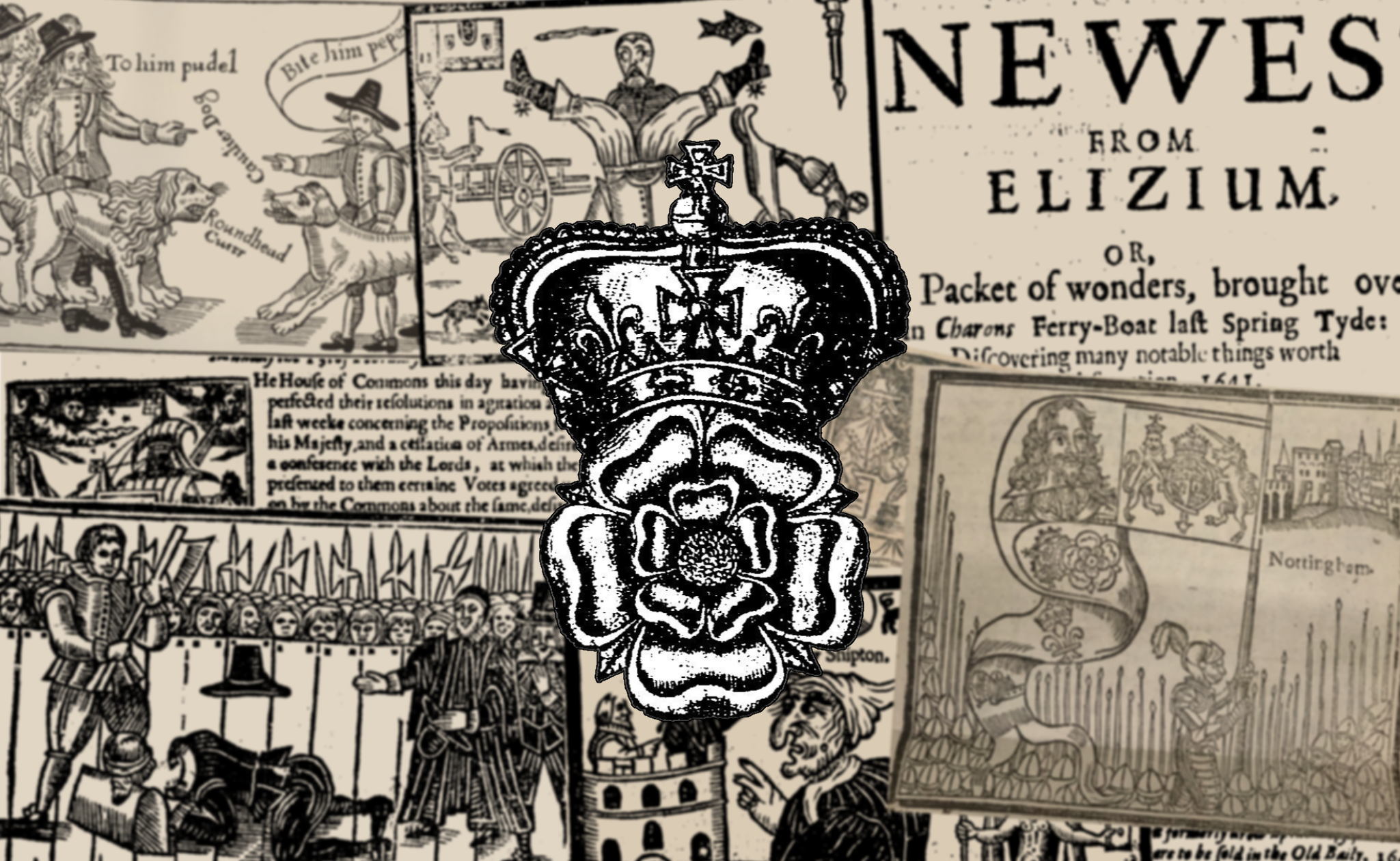
The King of England does not usually keep company with a man wearing his trousers as a shirt, a group of agrarian proto-Communists, and an elderly prophetess. Yet all four are bound together in the weighty volumes of printed works compiled by 17th-century England’s most indefatigable book collector. For nearly 40 years, from his bookshop at the sign of the Rose and Crown in London, George Thomason plied his craft as a publisher. As the country teetered on the brink of civil war, he began a hunt for pamphlets, ballads, and newsbooks which documented the nation’s political collapse and its ensuing republican experiment.
In 1640, Parliament was summoned for the first time following a period of “Eleven Years’ Tyranny” in which King Charles I ruled without it. Thomason had the foresight to detect that the political rumblings so characteristic of those uneasy years were becoming more intense. He was determined, therefore, to acquire as many of the printed items being churned out by London’s printing presses as possible — in the hope, he declared in his will, that they would “prove of great advantage to posterity”.
The fruits of his endeavour — some 22,000 printed items known as the Thomason Tracts and now housed in the British Library — are advantageous indeed to students and historians of the English Civil War and its aftermath. A perusal of the early titles included in the collection neatly links the political crises which in hindsight make violent conflict seem inevitable. To Thomason and his contemporaries at the time, it was unthinkable.
Thomason purchased a copy of the 1640 Canons drawn up by William Laud, the deeply unpopular Archbishop of Canterbury. This included the infamous “etcetera oath” by which ministers seemingly forfeited any right to alter church government. A pivotal overreach, the oath “helped turn moderate godly ministers into rebels”, according to historian David Cressy. A few months later, when Laud was arrested, fellow bookseller Ralph Mabb sold Thomason a copy of John Pym’s condemnatory speech against the archbishop made in the Commons.
So follows a healthy stream of news reports charting the widening fracture between King and Parliament. The accompanying political polemics and religious controversies nearly invariably attacked the perceived threat of Papist agitators such as Laud, who was accused of crypto-Catholicism and corruption in a number of virulent pamphlets. After Charles I, accompanied by armed soldiers, entered the House of Commons and tried to arrest five MPs, including Pym, on 4 January 1642, Thomason purchased his copy of Parliament’s strongly-worded rebuke condemning the “warlike” attempt.
In September that year, Thomason came across the title page of a pamphlet advertised outside Francis Coles’ bookshop in the Old Bailey. It reported news from the previous month: that Charles I had amassed a force of 800 cavalry and 3,000 foot soldiers and raised the Royal Standard outside Nottingham Castle on 22 August, hoping for support from sympathetic Royalists. Coles had commissioned an eye-catching woodcut illustration showing the small army gathered around the tapering flag, on which Charles’ face could be seen. Thomason had already heard about this momentous development, but to see it set down in print and rendered visually before him surely meant there was no doubt — it was war.
It was no easy task to collect the pamphlets, ballads, and newsbooks which powered England’s public sphere through its Civil War years. The collapse of the Star Chamber largely disempowered the Stationers’ Company, which had a monopoly on the print trade in London and was responsible for enforcing much of the censorship over it. As a result, the number of printed books swelled. The 1630s had seen between 500 and 700 titles printed per year. This spiked up to 3,700 in 1642.
Thomason’s profession as a bookseller — though not, by most accounts, a remarkably profitable or influential one — put him in an advantageous position to procure the works he hunted down. From his shop in St. Paul’s Churchyard, the literary hub of London, he sold works of an entirely different pedigree from those he hungrily collected, dealing mainly in foreign books.
He rose steadily up the ranks of the Stationers’ Company, firstly as an assistant warden in 1651, then a junior warden six years later, and was finally made a senior warden in 1661. These responsibilities imbued him, it must be presumed, with a good understanding of London’s book trade. He endeavoured, where he could, to include in his collection works printed in Oxford, which was the hub of royalist activities, and the provinces (where clandestine presses could be found) but without great success.
There are big names in Thomason’s collection — like John Milton, with whom he was apparently friends and whose early anonymous treatise Of Reformation Touching Church-Discipline in England (1641) he collected and identified as the work of the now-famed poet. The bulk of the tracts, though, are ephemeral scraps of print which most regarded with little more than fleeting curiosity, or occasionally open hostility. Even Thomason, considering quitting his great project in 1658, wondered whether the “inconsiderable” pamphlets he was chasing down were “worthy my labour”, as they caused him “great paynes and charges”.
Besides a sensational title, booksellers could employ an eye-catching woodcut illustration on a pamphlet’s front page to grab the attention of passers-by. In January 1648, it was the wrinkled face of an elderly prophetess called Mother Shipton and the presence, to her right, of a frightful ghostly apparition which perhaps convinced Thomason to purchase a pamphlet detailing 14 “strange prophesies” from various soothsayers which had since come true during the Civil War.

A reader thumbing through Thomason’s catalogue of titles is reminded that there was, in fact, a national conflict raging by the presence of news pamphlets reporting on the battles being fought and political actions being taken. The most significant of these was King Charles I’s execution on 30 January 1649. Thomason bought a number of pamphlets lamenting this act of political violence, which even the most fervent of republicans could only queasily stomach.
Though Thomason was a committed Presbyterian and firmly in the parliamentarian camp, he was by no means radical — and proved an impartial collector. He acquired newsbooks produced by both sides, whether the royalist Mercurius Aulicus or its parliamentarian rival Mercurius Britanicus. It is thanks largely to Thomason, who sometimes scribbled the authors’ names onto his anonymous copies, that the editors of these two influential publications (John Birkenhead and Marchamont Nedham, respectively) are known.
In April 1649, a group of individuals calling themselves “Diggers”, or “true Levellers”, took over St. George’s Hill in Weybridge, Surrey, and began to use the land for vegetable farming, inviting anyone and everyone to join them. They were an extremist offshoot of the Levellers — an already-radical political movement led by John Lilburne and Richard Overton, which argued for religious tolerance and social egalitarianism. The Diggers wrote up a manifesto, denouncing the enclosure of common land and social hierarchy more generally, which was sent to a bookseller in London in order to reach readers there.
George Thomason was among them, but he was definitely not persuaded. It was true that he had worked with Parliament as an official collector of funds for the army, and been sympathetic to their revolutionary cause — but he did not wish to see society turned on its head. He had been dismayed at the increasing political influence of the radicals in the New Model Army and supported a reconciliation with Charles I after his capture in 1646 which would have seen him returned to the throne under strict conditions.
Charles I’s execution had put an end to that aspiration and alienated Thomason from the parliamentary cause. His ambition had once been to compile the primary sources from which a tumultuous part of England’s history could be reconstructed by future generations. It was now also — in his own words — to “preserve them for the use of succeeding ages, which will scarce have faith to believe that such horrid and detestable villainies were ever committed”.
Such were his passionate misgivings that he was briefly imprisoned in 1651 for his involvement in the preacher Christopher Love’s plot to restore Charles II to the English throne. This was, at least on the surface, an incredible reversal of political ideology. Then again, Civil War England was often considered a “world turn’d upside down”. One pamphlet from 1647 made the point by including a woodcut illustration full of contradictions summing up the state of the country: a man wears his doublet on his legs and his breeches on his arms; a rat chases a cat, while a rabbit pursues a dog; a fish flies through the air; and a man is pushed by a wheelbarrow.

Needless to say, after struggling through the Interregnum period of the 1650s, during which his fortunes dwindled, Thomason was happy to see the restoration of King Charles II in 1660. He would soon consider his mission complete and stop collecting printed works, dying “a poore man” in 1666. After an abortive effort to sell it to the King, Thomason’s collection — some 14,000 pamphlets and 7,000 newsbooks bound in just over 2,000 separate volumes — passed hands between a number of owners before it was bought by King George III for £300 in 1761 and given to the British Museum. It was transferred to the British Library in 1973.
The collection is on the one hand a testament to the political savvy and determination of its compiler. On the other, it is an invaluable source of information about England during its period of Civil War and republicanism. The dating, authorship attributions, and scribbled notes provided by Thomason have helped shed new light on many of the publications he acquired. Where his is the sole surviving copy, we are indebted to him for its very existence.
With its sophisticated political treatises, cheap polemical tracts, and sensational news reports, the Thomason Tracts seem an eclectic effort at first glance. But George Thomason was a man of contradictions: a publisher who rarely dealt in the kinds of works he spent so much time procuring; an obsessive hoarder of books who expressed little short of open disdain for many of those in his collection; and a hugely important chronicler of Britain’s descent into political chaos and civil war who started off a Parliamentarian and ended his life celebrating the return of a king.


A Grandfather. His descendants immigrated to North America. By 1690, they settled in Louisa County Virginia. My Mother’s Mother was a Thomasson. I lived in Charlottesville Virginia from 1995 – 2000. Before the internet. Louisa County was just to the East. I had no idea of the family connection. George’s wife’s Father or Grandfather was Cuthbert Featherstone. He was General Usher to Queen Elizabeth and Court Cryer for King James the First. England must have been a horrible place to exist then. No wonder so many came to the New World.