Pity the modern alleyway, so frequently imagined as a bleak and miserable space which ought to be avoided entirely or, if necessary to traverse, shuffled through at a heightened pace. Such is the alley of cinema and sensational literature, in which Bruce Wayne was spurred to heroism by the cold-blooded murder of his parents and wherein Victorian penny dreadfuls held lawless characters to lurk, conspire, and set crimes into motion.
It is not often that the lurid caricatures of popular entertainment are genuinely embodied in a real specimen — but Ram Alley, adjoining Fleet Street in central London, really does appear to have been a den of villainy for almost 100 years. This was because English law seemed to protect it as a refuge in which a person could not be arrested for certain offences. Criminals, therefore, needed only haunt the taverns or shops which had side doors opening onto the alley in order to dash outside at the first sign of the authorities and evade capture.
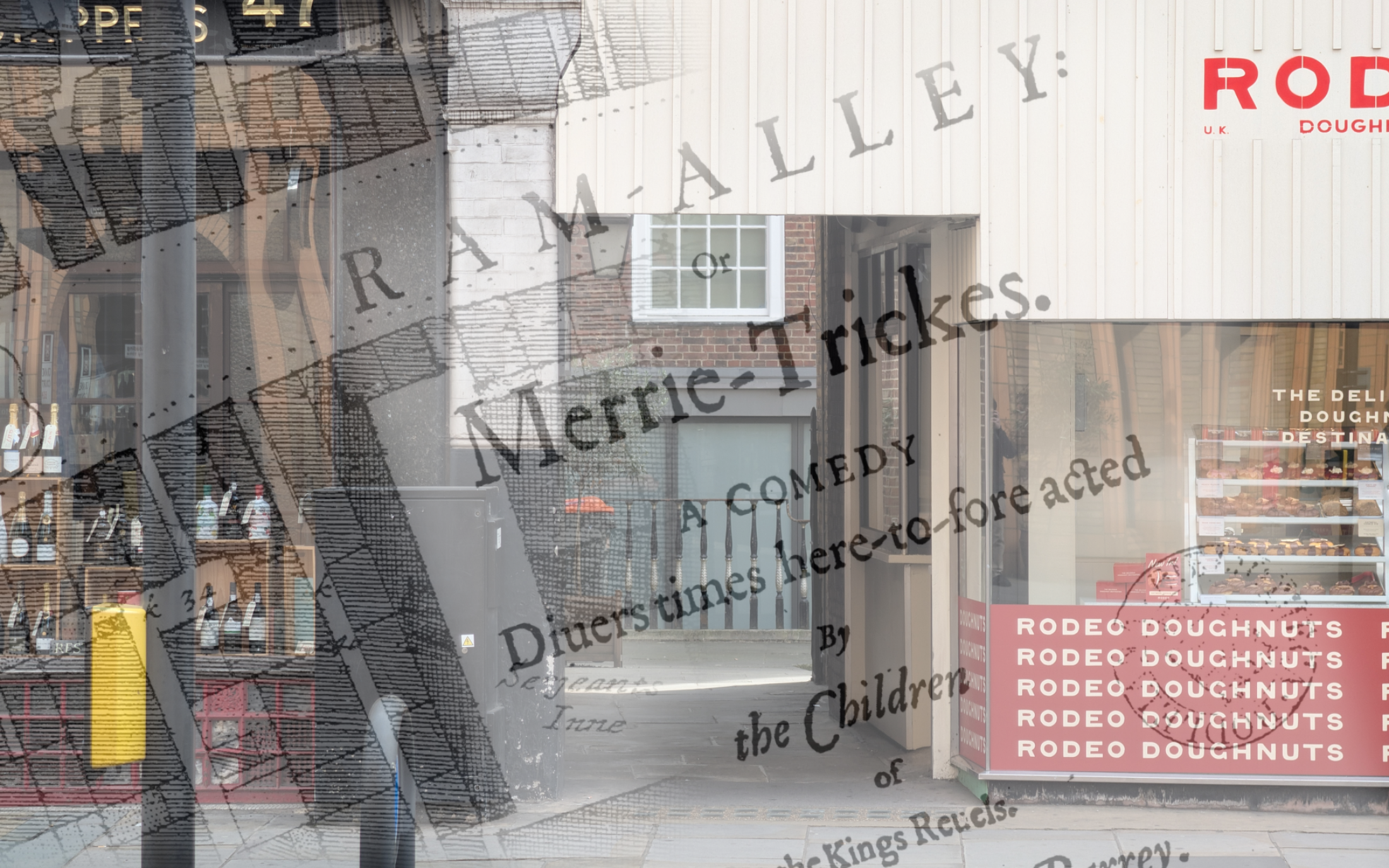
I could see no shady figures lurking about the donut shop or wine bar, which today flank the alley’s entrance, when I visited the place myself. The passage was empty and has been renamed to Hare Place, a change made long ago, ostensibly (and not unbelievably) because of the scandal attached to its previous moniker.

Ram Alley was one of a number of urban crevices whose relative inconspicuousness belied their troublesome natures. It stood just north of the “liberty” of Whitefriars — later known colloquially as Alsatia — which surrounded the Carmelite friary church of the same name and lay outside of the City of London’s jurisdiction.
Churches and monasteries had been granted special immunities from the law during the Middle Ages. After imprisonment for debt was introduced in the 14th century, debtors flocked to these sanctuaries to hide from the bailiffs sent by their creditors. The privileges which drew them persisted even after the religious sites were dissolved in the 1530s.
Around the beginning of the seventeenth century, these havens boomed in popularity — and notoriety. Alongside debtors, it was said, they harboured petty criminals, sex workers, violent drunkards, and even the odd murderer. No surprise, then, that the authorities were eager to take swift remedial action and put an end to whatever legal obscurities were being exploited to protect delinquents.
An act of parliament passed in 1540, during the reign of Henry VIII, had abolished the privilege of sanctuary for the most serious of crimes — murder, rape, burglary, and highway robbery. In the early years of his reign, James I had issued a charter to the City of London extending its jurisdiction to cover Whitefriars and in 1624 a statute nominally abolished all sanctuaries in England. But the communities of lawbreakers who resided in many of them remained in place and appear to have flouted the legislation quite brazenly.
It was one thing for members of parliament to pass restrictions into law, but quite another for constables or bailiffs to successfully apprehend sought-after offenders who might resist arrest, possibly under the mistaken belief that their legal rights were being infringed.

The community spirit apparently present in these disreputable places borders on admirable, as no single debtor or petty crook was left to fend for himself. A fictional dialogue between a trio of constables, published anonymously in 1641, imagined the law enforcers utterly petrified of venturing into those “fortified places” where debtors were known to reside. One of them recalls entering Ram Alley with a sergeant some years earlier to apprehend a lawbreaker, only to be “invironed by the enemies forces that lay in Ambuscado” and violently rebuffed.
The conversation is imaginary and surely exaggerates the lawlessness of those sanctuaries, but reflects the popular notions which surrounded them. It certainly echoes the sentiment of an Edwardian historian who pronounced the inhabitants of Ram Alley “as motley a crowd of evil characters as could be collected anywhere in London” and observed that “every house was a resort of ill-fame, and therein harboured woman and, still worse, men, lost to every instinct of humanity”.
That alehouses, taverns, and inns were natural incubators of sociability and good fellowship was to the advantage of debtors, vagabonds, and other lawbreakers in need of allies. The intrusion of constables into a confined space full of intoxicated patrons who quite possibly had their own troubled histories with the authorities was a recipe for disaster.

Ram Alley, then, is one of those “innumerable little lanes and courts” which the London-loving writer Dr Samuel Johnson said one had to survey in order to have a “just notion of the magnitude of this city”. He would certainly have known of Ram Alley, not just because it was a storied site with which any aficionado of London’s history needed at least a passing familiarity, but also because it was only a few dozen steps from his home in Gough Square.
Dr Johnson regularly patronised the famous Mitre Tavern, which had a door leading into the passageway. Its most famously rowdy establishment, according to one historian, was the Maidenhead — “the worst of all dens of infamy in that notorious court”. The aptly-styled Ram Tavern also adjoined it in the mid-seventeenth century, and the alley’s very name is believed to have derived from the Star and Ram inn.
It was quite the irony, and one which did not evade contemporary commentators, that Ram Alley was situated between, and indeed connected, Serjeant’s Inn and Inner Temple — two inns of court where England’s brightest legal minds trained and worked.

The Jacobean dramatist Lording Barry made Ram Alley the setting of an eponymous play which was first performed in the early years of the 1600s and then published for London’s readers to enjoy.
Ram-Alley: Or Merrie-Trickes was a comedy which played on the juxtaposition between the lawyers, judges, and other respectable citizens who were obliged to traverse the alley and the debtors, sex workers, and criminals they encountered. It was performed at the Whitefriars Theatre, just around the corner from the real-life passage.
Funnily enough, it was Ram Alley’s atrocious reputation which probably caused the theatre to close in the 1620s. Even more ironic was that the production bankrupted Barry, leading to his imprisonment in debtor’s jail. He subsequently abandoned theatre in favour of a career in piracy.
It was only in 1697, during the reign of William III, that an act of parliament finally abolished Alsatia and all other supposed sanctuaries in London, including Ram Alley. This seems to have been the piece of legislation which finally empowered law enforcers to take action; it clearly gave them the support of a monarchy and government which were, quite frankly, beginning to find it embarrassing that a country with aspirations to dominate countries all over the world should not even have complete control of its capital.
How do you fairly assess the character of a place which is only recorded in the prejudicial words of those who sought to condemn it? The answer, probably, is that you don’t — but you try anyway.
Ram Alley and its surroundings were inarguably disreputable and unsavoury, occupied by people at the lower rung of society, and alluring only to those who believed it offered them refuge from the law. But it was also the site of a community, however mocked and shunned, which reflected the strange social and economic dynamics of early modern London.