It is never quite clear what to make of apparently ‘radical’ print. This is in part because it is such a difficult category to define in the first place—if it can even exist as a coherent classification at all. ‘Radical’ is an entirely relative notion, a descriptor which might signify that some idea exists at, or just outside of, the periphery of acceptable social/political/economic/religious norms. But those norms were, and are, in constant flux over time, across places, and between groups of people.
This is not to say that there were no ideas circulating during the early modern period which might uncontroversially be described as ‘radical’, or that these ideas were not printed—one can hardly read The True Levellers Standard Advanced (1649) and maintain that position—but rather that some ideas occupied a liminal space, offering glimpses of radicalism which were ephemeral but present nonetheless. This was a particularly common phenomenon between 1600 and 1640, when the print market and its authorship had expanded rapidly but the Star Chamber still exercised a strict, though hardly omnipotent, authority over it.
A short, but feisty, controversy surrounding female cross-dressing during the 1620s proves fruitful in providing a pamphlet which seems to straddle this awkward line between radicalism and moderatism.
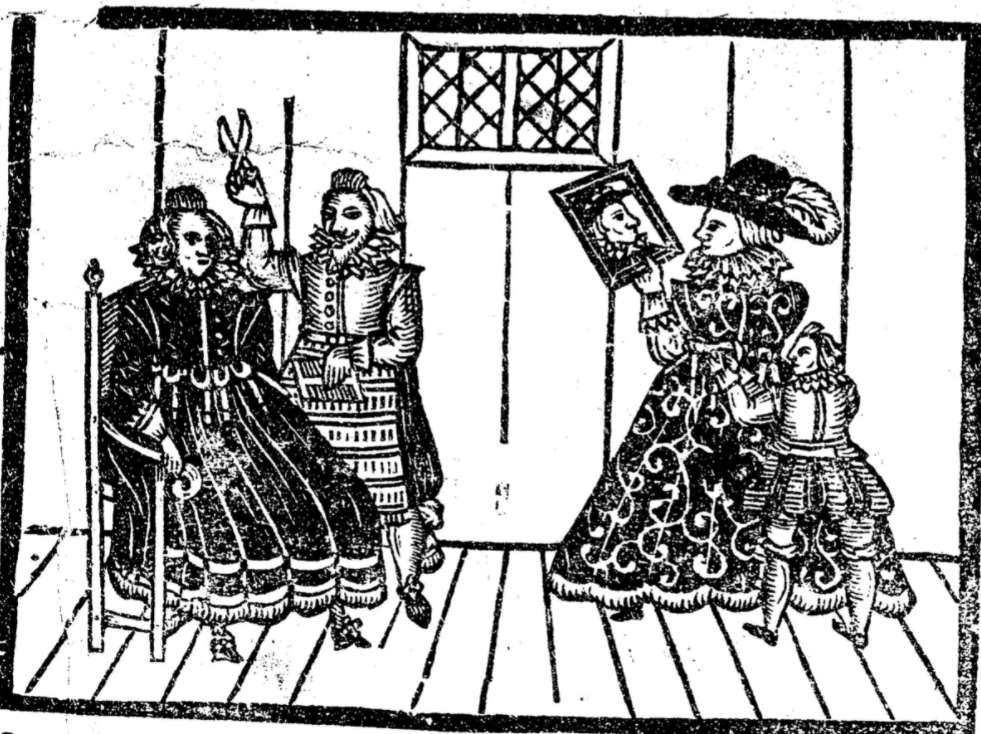
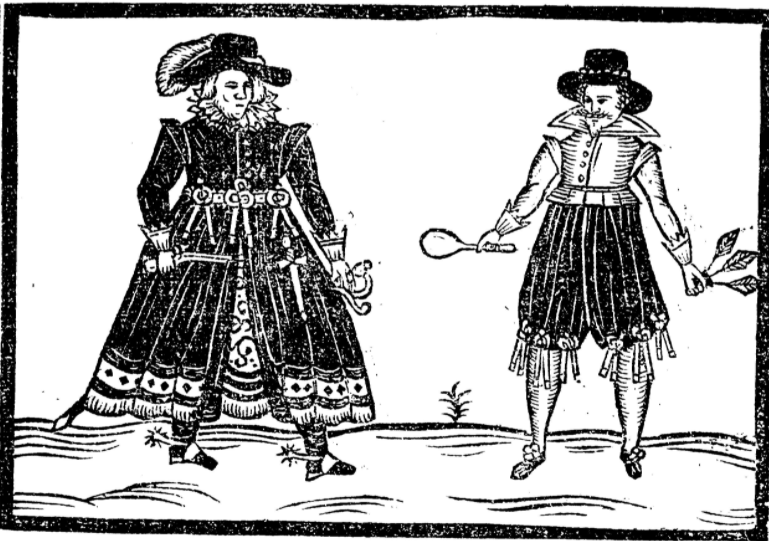
Haec-Vir; Or, The Womanish-Man (1620) is a short pamphlet written in response to a pamphlet published a week prior, entitled Hic Mulier; Or, The Man-Woman (1620). Both pamphlets are adorned with intriguing woodcuts which depict women wearing traditionally masculine clothing (Hic Mulier is on the left and Haec-Vir on the right). The text comes in the form of a dialogue between two characters: Haec-Vir and Hic-Mulier. Hic-Mulier is Latin for ‘this woman’, though ‘hic’ is the masculine form and thus a more accurate translation might be ‘this [masculine] woman’. Likewise, Haec-Vir means ‘this [feminine] man.’ In the dialogue, the man, who adopts a traditional outlook and condemns the woman for transgressing gender boundaries, accuses her (and other women) of ‘Baseness, Unnaturalnesse, Shamelesnesse, [and] Foolishnesse.’ The crux of his complaint is that women who dressed in masculine garments, expressed their opinions independently, and generally rejected the expectation of female subservience were ‘slave[s] to novelty’ who had distorted God’s creation and behaved inappropriately.
If these complaints seem familiar, it’s because they are frequently protested today by conservatives opposing progressive attitudes towards sexual orientation, race, and (most appropriately) gender expression. What is even more intriguing is the response given by Hic-Mulier, one which appears remarkably feminist for its time. Responding to the claim that transgressive women were ‘slaves to novelty’, she remarks:
What slavery can there be in freedome of election? or what basenesse, to crowne my delights with those pleasures
In defending the embrace of change and opposing strict cultural conservatism, she retorts:
For what is the world, but a very shop or ware-house of change? Sometimes Winter, sometimes Summer; day and night: they hold sometimes Riches, sometimes Pouertie, sometimes Health, sometimes Sicknesse: now Pleasure; presētly Anguish; now Honour; then contempt: and to conclude, there is nothing but change, which doth surround and mixe withall our Fortunes. And will you haue poore woman such a fixed Starre, that shee shall not so much as moue or twinkle in her owne Spheare? That were true Slavery indeed, and a Basenesse beyond the chaines of the worst servitude.
She dismisses the importance of obeying customs by pointing out various ancient habits no longer adhered to by the English (Roman women wearing white at funerals, rather than black is one such example). Her conclusion is that ‘Custome is an Idiot; and whosoever dependeth wholely upon him, without the discourse of Reason, will take from his pyde coat, and become a slave indeed to contempt and censure.’
These sentiments are radical enough on their own, and the implications of embracing change and rejecting blind obedience to custom & tradition can be observed in the ensuing ‘English Revolution’ of the 1640s and ’50s, if one concurs with Christopher Hill’s designation. The cultural context, an increasing tendency for some London women to wear brimmed hats, spurs, yellow ruffs and carry poniards and pistols, is also an example of gender nonconformity which, if not radical, was certainly not obedient. Subversive ideas, then, can be just as present in texts which denounce them as in those which defend them. When William Lorte condemned those ‘girle-boyes’ who roamed the streets of London we must recognise that it is defensive literature; a spike in culturally conservative texts does not necessarily mean that English culture was strongly conservative—it may imply precisely the opposite.
The climax of Hic-Mulier’s radical feminism is when she defiantly asserts that women ‘are as free-borne as Men, have as free election, and as free spirits.’ And what an assertion this is—one that could just as easily have emerged from the feminist literature of the 1960s, excepting a few terminological alterations. If one were to stop reading there, or had no further pages of this cheap pamphlet survived, we might account this character and her anonymous author a precursor to Betty Friedan, Gloria Steinem, Angela Davis, and bell hooks (to name a few) in their pursuit of women’s rights and in their advocacy of freedom of speech and expression a female John Milton! L. B. Wright was not afraid to make the latter comparison, holding up Haec-Vir as ‘the Areopagitica of the London Woman.’
But read the pages which follow Hic-Mulier’s impassioned defence of female liberty and it is as if the pen has been passed to an entirely different author. The woman, who had previously defended embracing change and the freedom to express oneself even in defiance of custom, now denounces English men for being too feminine—’the accuser is guilty of as much or more then that hee accuseth.’ Men, we are told, have adopted feminine traits, in their physical appearance, clothing, and behaviour. Female gender transgression is no longer the result of an exercise of liberty but rather a necessary response on the part of women ‘to gather up those garments you have proudly cast away, and therewith to cloath both our bodies and our mindes’. The justification here is that the man’s desire for a ‘distinct and speciall difference betweene Man and Woman’ is correct and the feminization of men has forced female identity to be forged out of previously masculine ideals.
These ideas, and the conclusion that ‘we will heere change our attires’ and adhere to traditional gender norms, does not simply dampen the genuinely radical dissent found but a few pages earlier, it stands in direct contradiction to it. If men become ‘real men’ again, the woman promises that ‘then will we love and serve you; then will wee heare and obey you; then will wee like rich Jewels hang at your eares to take our Instructions.’ Sandra Clark’s explanation for this contradiction is that ‘pamphleteers delighted in controversy, and they were very much at home with the notion of a debate where the only real issue is the eloquence with which a point is made.’ For a modern reader, it is difficult to imagine that any author could have conjured up Hic-Mulier’s lines while not genuinely believing in them, but that can at least in part be explained by the fact that we are likely to agree with her and do not need persuading. Perhaps the author did hold those radical views but knew that reaching any other conclusion would see his (or perhaps her) writing never published. Or perhaps Clark’s reference to the desirability of heated, eloquent debate in the minds of pamphleteers, printers, and booksellers (who knew it would sell well) is a sufficient resolution.
It is certainly worth noting that both Hic Mulier and Haec-Vir were printed by the same press and sold by the same person (John or Edward Wright, in partnership with John Trundle). Their close publications (only seven days apart) introduces the possibility that the responding author had read the other author’s manuscript and the whole ordeal was a ploy to cash in on a trending controversy. But in any case, the radical ideas are still there and it is difficult to believe that none of them would have resonated with at least a few readers.
It might not even be unfair to suggest that, ironically, the pamphlet is not too far removed from the people it seeks to discuss—the womanish-man and the manish-woman. In it we find the attire of radicalism—advocacy of extreme gender transgression and a rejection of tradition—but the person beneath is a moderate, who concludes that both men and women should embrace custom. Or perhaps it is the other way around, a radical person forced into moderate garments—one whose private beliefs might yearn for the abolition of gender hierarchy, but who had to dress sufficiently moderate in order to appease the press censors. The Radical-Moderate or the Moderate-Radical?