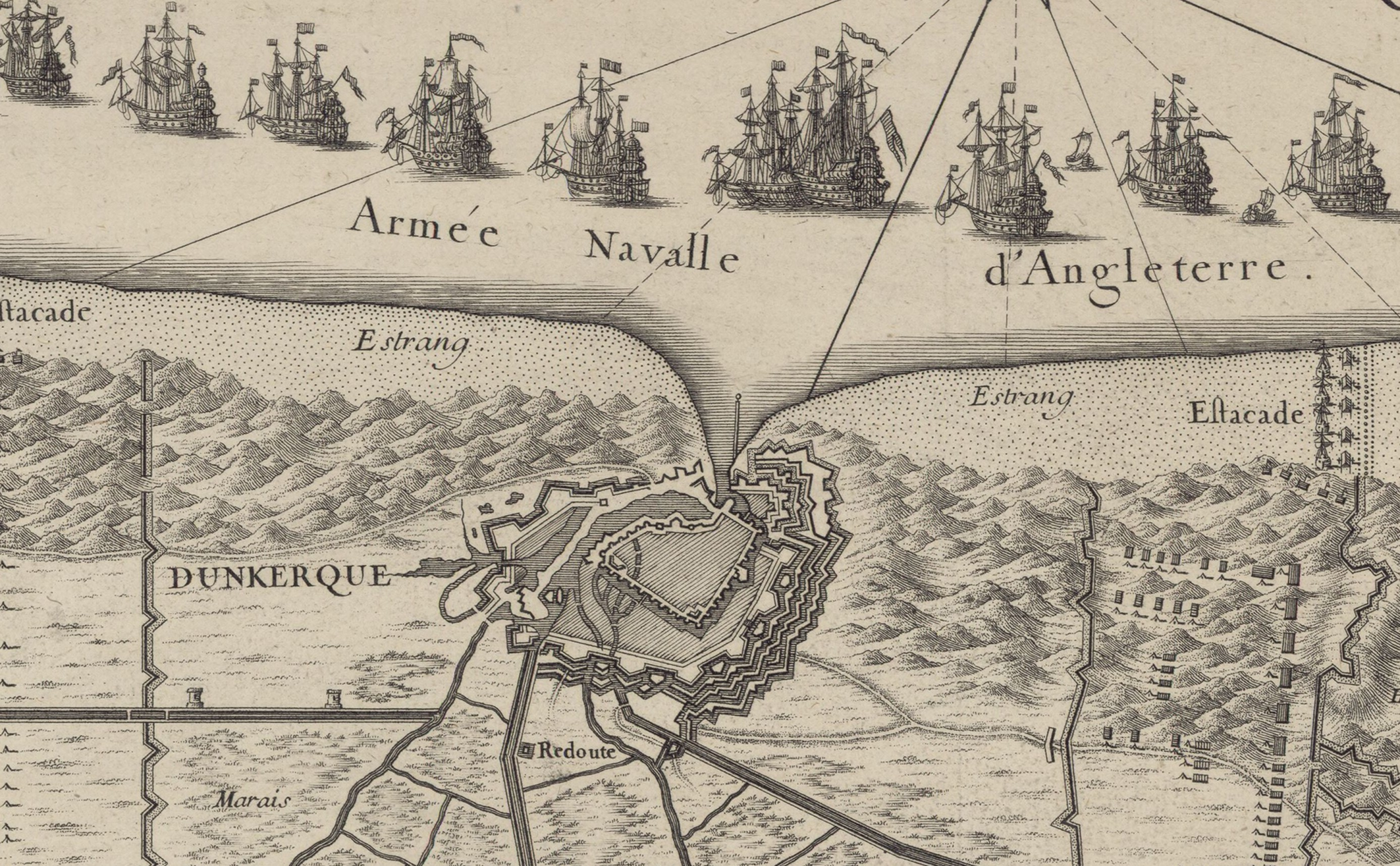
The besieging of any city, even one not surrounded by flooded marshes and rugged sand dunes, is a daunting prospect. Zigzagging trenches have to be dug, defensive fortifications erected, batteries of artillery maintained, and back-breaking materials lugged around — all before a waiting period during which one’s boredom is likely only to be broken by surprise attacks from the defending garrison. It was for good reason, then, that Oliver Cromwell was so adamant to capture Dunkirk.
To the Lord Protector, the port city — then under Spanish control — was little more than a nest of sea robbers. A group, known unimaginatively as “the Dunkirkers”, had for decades been using it as a base of operations from which to target hundreds of merchant ships and fishing boats. In towns on England’s south east coast, residents feared the raiders’ frigates, which roamed the waters with seeming impunity, might at any moment launch an invasion.
And so in 1658 the English joined forces with the French to seize Dunkirk. Under a treaty signed the previous year, success would see the city handed over to the adolescent republic and deal a blow to Charles Stuart, who had turned to Spain for support in his bid to reclaim the throne. Moreover, it gave both the army and navy an opportunity to stretch their legs and justify their (very expensive) existence. On the hundredth anniversary of losing Calais, England could do worse than to gain a territory on continental Europe.
The siege was a triumph. An army of 6,000 English soldiers joined 20,000 men under the command of the illustrious French commander Turenne in encircling Dunkirk — which was denied relief from the sea by a fleet of 18 English warships forming an impenetrable naval blockade.
When a patchwork force of Spanish soldiers, French rebels, and exiled Anglo-Irish Royalists, including the future King James II, attempted to intervene, they were handily defeated by the impressive New Model Army and its French allies at the Battle of the Dunes. A month after the siege had begun, Dunkirk surrendered — and was put under English control.

The taking of that territory was to be the apex of Cromwellian foreign policy. Dutifully reported to the English public in the state-sponsored newsbook Mercurius Politicus, the triumph showed political acuity in the Lord Protector. In France, there was popular anger at the diplomatic sleight of hand by which England had come into possession of so strategically significant a stronghold at so little a cost.
But Cromwell died on 3 September 1658, not even three months after Dunkirk had been relinquished to England. The Commonwealth government soon followed him into the grave and, in 1660, King Charles II returned to the throne. He was not overly attached to a foreign city that England had initially taken, in part, to scupper his own royal ambitions. Two years later, the cash-strapped monarch decided to sell Dunkirk and save the £321,000 spent annually on its upkeep.
The deal struck in October 1662 after months of negotiation saw France purchase the city at a generous price of £500,000 — though King Louis XIV ultimately paid only a little over half of this. Merchants feared Dunkirk would again be used by privateers targeting their ships. The commoners were opposed to the sale too. “In part,” historian Ronald Hutton writes of their hostility, “this was wounded patriotism, but it also drew upon an intense traditional Francophobia.” The thought that Charles II had dealt charitably with the French King because the latter had for a time sheltered him in exile must surely have entered critics’ minds.
The English King had been convinced of the deal by a number of influential statesmen, but principally Edward Hyde, the Earl of Clarendon. It was no closely-guarded secret that members of the Privy Council had been bribed by France into supporting the transfer, and Clarendon did not help himself against similar charges. As recently as May he had told Parliament that Dunkirk and other foreign holdings draining the country’s coffers were “Jewels of an immense Magnitude in the Royal Diadem” — only to radically reverse his position.
One peer overplayed his hand by launching impeachment proceedings against Clarendon in the House of Lords, which failed at the intervention of Charles II himself. The instigator only escaped certain imprisonment for his insolence by fleeing the country. To suggest, as he had in accusing the King’s closest adviser of rank corruption, that the King might be susceptible to foreign influence was a step too far.

In 1787, as the Founding Fathers fashioned a new constitution which would define the civil liberties of the United States, some looked back to the political fiasco of Dunkirk. An important question surrounded the limits that should be placed on the power of a president — and the means by which Congress might forcibly remove him from office. Two of them, Gouverneur Morris and Charles Cotesworth Pinckney, presented Charles II’s dealings with France as evidence that even monarchs could be influenced by foreign actors.
As they debated these political matters, it had only recently been discovered that a treaty agreed between England and France in Dover in 1670 contained secret clauses committing England to supporting a French invasion of the Dutch Republic. Charles II would also make a public conversion to Catholicism; in return, he would be given a liberal annual stipend.
Urging South Carolina to adopt a constitution curtailing the president’s ability to act unchecked in matters of foreign policy, Pinckney argued that kings were harder to corrupt because “the prosperity of the country tended to increase the lustre of the crown, and a king never could receive sufficient compensation for the sale of his kingdoms”. Indeed he struggled to provide a single instance of a king accepting a bribe, “except Charles II, who sold Dunkirk to Louis XIV”.
Morris had similarly told delegates at the Philadelphia Convention, where the constitution was debated and ratified in 1787, that “one would think the King of England well secured against bribery … yet Charles II was bribed by Louis XIV”. The natural conclusion, he said, was that “the Executive ought therefore to be impeachable for treachery”.
These arguments bolstered the case for emoluments and the impeachment clauses of the constitution, and for having treaties require approval of the Senate. After all, if a king could be swayed by foreign interference, a president certainly could.
Dunkirk, then, is quite the influential stretch of sandy beach. It was a contested military stronghold providing a haven for sea bandits, at the besieging of which England’s earliest standing army — clad in their now-iconic red coats — proved its worth. And long before it became famed for the desperate evacuation of Allied soldiers from an encroaching Nazi force in 1940, it was notorious as the piece of land for which a head of state had betrayed his own people in the pursuit of personal interest. The Founding Fathers, therefore, crafted a constitution under which this would never, in principle, be allowed to happen.


