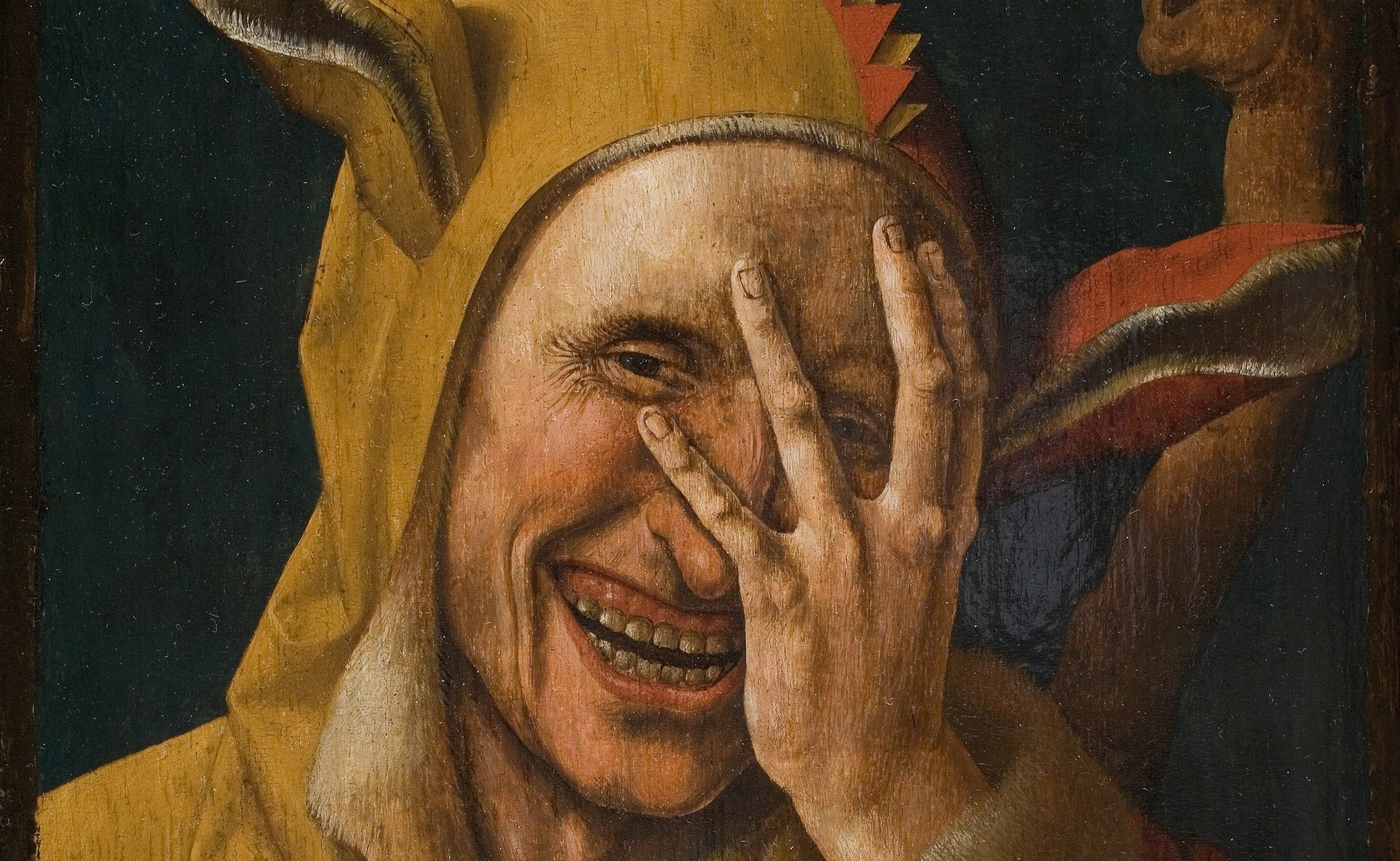
It is, I suppose, some kind of nominative determinism that compels me, on April Fool’s Day, to think about Muckle John. We know three things about this mysterious figure: that he was England’s last-ever court jester, that he preferred payment in fancy clothes over pound sterling, and that he had a mischievous smile.
Beyond that, no shred of biographical information survives. We do not know when he was born or when he died, how he lived his early life or how he came to royal attention. Among the thousands of pamphlets printed in London during the seventeenth century, there are only a few generic throwaway references to the royal clown Muckle John. A writer observed in 1646 that his “talke a man would weary”, which is hardly a glowing endorsement for one whose job was to make others merry.
Muckle John entered the employment of King Charles I at some point after 1637. His predecessor, Archibald Armstrong, had been banished from court in March after drawing the ire of the Archbishop of Canterbury — proof that “jester’s privilege” did not extend much further than the feelings of a monarch or their favourites. Muckle was apparently a more diffident jester and, to the advantage of a king not burdened by an immensity of wealth, cared not a jot about the salary. “There is now a fool in [Armstrong’s] place,” one courtier informed the Earl of Strafford, “but he will never be so rich, for he cannot abide money.”
Clothes were another matter. The best glimpse we have of Muckle’s life is through accounts of payments made for his expensive and fanciful attire. Besides more than £10 (about £2,000 today) being spent on him for a “long coat and suit of scarlet-colour”, the following purchases were made to ensure Muckle looked a jester of impeccable fashion:
One pair of crimson silk hose, and one pair of gaiters and roses for Muckle John, 61s [i.e. shillings]. For a pair of silk and silver garters, and roses and gloves suitable for Muckle John, 110s. For a hat covered with scarlet, and a band suitable; and for two rich feathers, one red, the other white, 50s. Stags-leather gloves, fringed with gold and silver. One pair of perfumed gloves, lined with sables, 5s.
Curiously, given that Muckle is elsewhere a ghost in the archives, historians think he is one of two men depicted in a seventeenth-century double-portrait, alongside Tom Derry, who was employed by Queen Anne of Denmark, wife to James I. He is the figure on the right, colourfully dressed and holding a marotte. He wears a smile which would be worthy of the adjective “unsettling” were it not for the cartoonishly creepy grin which adorns the contorted face of his compatriot.
The picture is titled “Wee Three Loggerheads”, in reference to the two jesters and the wooden face on the marotte. Or, you may wonder as Muckle’s gaze meets your own, is the third fool the one looking at the painting?

That is all we know about Muckle John. From the few aforementioned wardrobe accounts, and the fact that cadavers are rarely in need of amusement, we can suppose that he merrily entertained Charles I, through what was undoubtedly a stressful period, until the King was executed by beheading in 1649.
There were no more royal court jesters when monarchy returned 11 years later, though fools continued to find employment in some aristocratic households. Civil war had deprived England not only of its monarchy but also its royal clowns.
Muckle kept his head. He presumably left his employment if not with a pension, then at least a lavish collection of clothing which he could pawn off. In nearly every way he is shrouded in mystery, except for his colourful depiction in a double-portrait, from which he and his fellow clown smirk — as if mockingly — even at modern-day viewers. Perhaps he had the last laugh after all.
Of other early modern jesters we have fuller pictures, though none complete. Will Sommers, who was employed by Henry VIII from 1535 until the King’s death, is the most famous. The Swedish historian Peter Andersson, in his biography Fool: In Search of Henry VIII’s Closest Man (2023), writes that Sommers cracked jokes and entertained, but was also “an unassuming and uneducated man, with a willingness to rant” who had a habit of falling asleep at inopportune times.
In the paintings of Sommers which survive, he lurks behind Henry VIII and his royal family. In one he has a monkey on his shoulder, marking him as an entertainer. Elsewhere he appears graver, with not the slightest upturning of lip to suggest his employment as a jester. In a portrait from the 1550s he peers over his employer’s shoulder, a staff in one hand and a dog in the other, resembling more a sage adviser than a professional buffoon. Andersson suggests Sommers’ continued presence in Tudor family portraits is because the royals saw him as something of a good luck charm.

Archibald Armstrong, the predecessor of Muckle John, was court jester to James VI of Scotland, and followed the King down south when he acceded to the English throne in 1603. The apocryphal story went that “Archy”, as he was affectionately known, was a reformed sheep thief.
Once, he had very nearly tricked officers of the law by rocking a swaddled stolen sheep in his arms as if it were a baby. Hauled before the monarch, he squirmed his way out of the death penalty by convincing the King to delay punishment until he had a chance to read the Bible. Archy was, of course, illiterate. James apparently so admired this flash of comic ingenuity that he took the man into his service.
There were different types of jesters. The “artificial fool” pretended to be naïve and simple-minded when really, like Armstrong, they were quite capable of quick wit. Sommers was probably an “innocent fool”, who had what we would today identify as an intellectual disability. The brashness and simplistic honesty with which jesters often communicated was seen as important to their role, though excessive temerity could be met with physical punishment.
Armstrong was banished from the royal court after mockingly asking Archbishop Laud “who is the fool now?” after the latter’s unsuccessful attempt to impose the English liturgy on the Scottish. At a tavern in Westminster, the jester had drunkenly branded Laud “a monk, a rogue, and a traitor”.
This anecdote makes more likely the attribution to Armstrong of a fiery little pamphlet titled Archy’s Dreame (1641), published shortly after the clergyman’s imprisonment in the Tower of London on charges of treason. In a dream, Armstrong said, he had seen a vision of Hell, packed with controversial Catholics, including Cardinal Wolsey and the Protestant-persecuting Edmund Bonner. Amid their whipping and violent torture was an empty chair waiting for Laud.