The woodcut above, a crude depiction of a family from the 1630s, looks wholesome enough at first glance. We see a family gathered around the table, probably about to eat. There appears to be food of some sort on offer, perhaps cheese. The two adults are engaging in conversation. The father happily puffs away at his pipe; the mother tends to the couple’s three young children. But customers gazing upon this illustration in Francis Grove’s bookshop on Snow Hill in 1638 would have known something was amiss.
A closer look at the image goes some way to remedying our rose-tinted perception. There is food in the table, and a knife with which to cut it, but only for the husband. The three children huddle around their mother — one raising its hands as another grasps its arm (in fear?) and appears to glance at the father. The wife is clearly gesticulating at her husband but might we now suspect it is an argument or quarrel we are witnessing, not a conversation?
There is also the small fact that it adorned a broadside ballad whose title branded the man ‘a hee-divell’ (i.e. a he-devil) who was regularly drunk and ‘doth beat and bruise’ his wife for such minor infractions as leaving a spot of dirt on his shoes after cleaning them.
The ballad’s title also remarks that ‘If this Womans Husband use her well,/Ile say some kindnesse may be found in Hell’ to stress the evil at play here. Hell, of course, is not a kind place by any conventional barometer of nicety, as even less astute readers or listeners were likely to appreciate.
I mention ‘listeners’ because we’re dealing with a printed ballad, designed to be communally sung aloud. That the alehouse was the most popular venue in which these songs were, often quite raucously, recited by early modern Londoners is ironic. It is from precisely this venue that the ballad’s abusive husband returns — sufficiently stupefied by intoxication — before shouting at and beating his wife. One verse tells us:
When he comes home drunke at night,/if supper be not drest,
Most divellishly heele raile and fight,/though humbly I request
Him to be patient,/but there is no such matter,
And if the meat doe not him content,/heele breake my head with the platter.
The emotional impact this has on his wife is expressed with a surprising eloquence and intimacy for this kind of ephemeral literature, by far the most demeaned and derided type of writing, which not infrequently veered into sensationalist nonsense or soppy hyperbole. We’re told the wife labours every day to ‘earne my food with sweating’ but she and her daughter ‘dare nothing eate,/but dine (like servants) after’ — recall the woodcut only showing food in front of the father, not his family. The narrator also describes herself as ‘like a servile bond-slave’ and isolates herself socially for fear any chatting or dining with neighbours will be seen by her husband as an attempt to cheat on him. Though perhaps the mask slips a little at the end, as our protagonist concludes:
All you Maidens faire,/that have a mind to wed,
Take heed and be aware,/lest you like me be sped.
And you good wives,/that heare my wofull Ditty,
If you ere bought Ballad in your lives,/buy this, for very pitty.
Such an explicit appeal to potential customers is a stark reminder there are strong commercial incentives at play — the writer, publisher, and printer had bills to pay and mouths to feed.

We’re dealing with no ordinary writer, however, as a familiar pair of initials below the final stanza informs us this is the work of Martin Parker, the master balladeer and prolific writer of verse. He had evidently garnered a sufficient reputation to justify stamping ‘M. P.’ at the bottom of the page. In 1641, the author Henry Peacham identified Parker by name as a balladeer from whom journalistic ditties could be expected and he was given as one of only a few ‘sufficient writers’ active in London in another text from the same year. A gifted writer no doubt — whose career would blossom further during the Civil War — but a jobbing one nevertheless, who had to appeal to popular taste.
This financial pressure, and the fact that Parker was a man writing in the 1600s, is presumably why a portion of the blame is said to lie with the wife — as this kind of victim-blaming sold well. Like other ballads concerning marital strife, we’re told her ‘over hastily’ marriage was a mistake on her part which she now ‘repent[s]’.
It’s also unclear how sympathetic this woman’s struggles would be to the ballad’s audience, likely to be roaring its lyrics in a crowded alehouse, where ballads were both sung and frequently pasted to the wall as a kind of decoration. Perhaps Parker or the publisher Francis Grove were trying to target precisely that crowd. The husband’s abuse stems, after all, from his visits to the alehouse and many of the allegations levelled at him are inversions of misogynistic tropes of the time. That he ‘doth consume & waste [his wife’s] means’ was an accusation frequently made against women; the notorious ‘woman-hater’ Joseph Swetnam wrote in 1615 that women were quick to spend their husband’s money and lead them ‘into great poverty’.
Likewise, the notion that a person might prevent their spouse from talking to other people, or socially interacting with others at all, because of a possessive jealousy was usually associated with overbearing wives, not the other way around. Even the ballad’s tune, which is apparently ‘The Shee-Divell’, suggests Parker is using a melody usually associated with troublesome women to highlight the harm caused by alcoholic, abusive men.
There can be little doubt in any case that the construction of this ditty was tailored with great care in order to maximise sales, likely also targeting pedlars who spread ballads far and wide across the country. Its publisher, Francis Grove, was a big name in cheap print and by the late 1630s was something of a powerhouse in the ballad market, competing valiantly with a group of booksellers who had banded together to form a ballad partnership, among them Henry Gosson and John Wright.
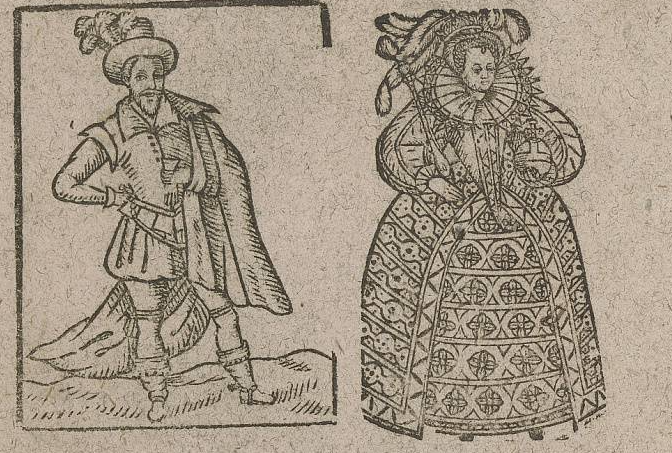
The woodcut was clearly a selling point of the work. It takes up more than a third of the ballad’s first leaf and, somewhat untypically for broadsides of its time, is the sole illustration. It certainly trumps the generic woodcuts usually employed by printers to make their wares visually enticing. Romance ballads often deployed two non-specific illustrations of people to represent lovers.
Though the woodcut which adorns the ballad we are concerned with has clearly been custom-made, it is not clear that it was intended for this narrative. The text only makes mention of one daughter, but the illustration clearly depicts three children (probably one son and two daughters). This may mean it had been commissioned for another similar tale — perhaps based on a true story — or could be a mistake on the part of the printer.
The woodcut appears on two other ballads from around the same time, which may even predate it. One is titled A Penny-worth of good Counsell (c.1638) and also concerns marital strife, as a wife laments marrying a man who is ‘not the man I tooke him for’, being frugal and, in her view, quite pathetic. We’re told at the end of each stanza that ‘My Husband hath no fore-cast in him’ — a lamentation which becomes an increasingly obvious sexual innuendo throughout the work. This text has a familiar author: Martin Parker.
The other ballad featuring the woodcut is not by Parker but his arch-rival, Laurence Price. In this work, from about 1640, there is a different problem at play: a pregnant woman has no idea who her child’s father is.
But the woodcut does not offer quite the same meaning here in as both of Parker’s ballads. The only family to which a reader, singer, or hearer’s mind could be drawn in Price’s work is the type of family wished for by its pregnant narrator — one where the children know their father and live together happily. But how could a woodcut depicting an abusive situation represent this ideal? The trick lies in our tendency to project emotions and ideas.
As noted at the beginning of this article, the contents of the woodcut occupy a fairly vague space. All that’s objectively true is that we see a family of two adults and three children next to a table indoors. Reading Parker’s domestic abuse ballad offers a set of tempting interpretations: the children huddle around their mother in fear, the husband eats alone while they go hungry, the wife gestures towards him in fear or defence — the knife on the table certainly takes on a much more sinister meaning.

In Parker’s other work, about a husband who has not lived up to expectations and cannot satisfy his wife, the illustration can be interpreted as a less severe representation of marital strife. Perhaps the wife is confronting her partner, who does little more than sit at home all day puffing away at his pipe. In Price’s ballad, where the illustration reflects an ordinary family scene, we simply stick with the most basic facts and overlook any implication that something is amiss.
This was often how woodcuts worked, adopting different meanings depending on their context. Historian Christopher Marsh has demonstrated how one generic woodcut illustration of a person, whom he labels ‘how-de-do man’, appeared on many broadside ballads and assumed various different identities. This was a common practice among printers which saw woodcuts’ meanings re-negotiated with the public. The most absurd example may be this dramatic picture from a 1635 ballad entitled A wonderful wonder.
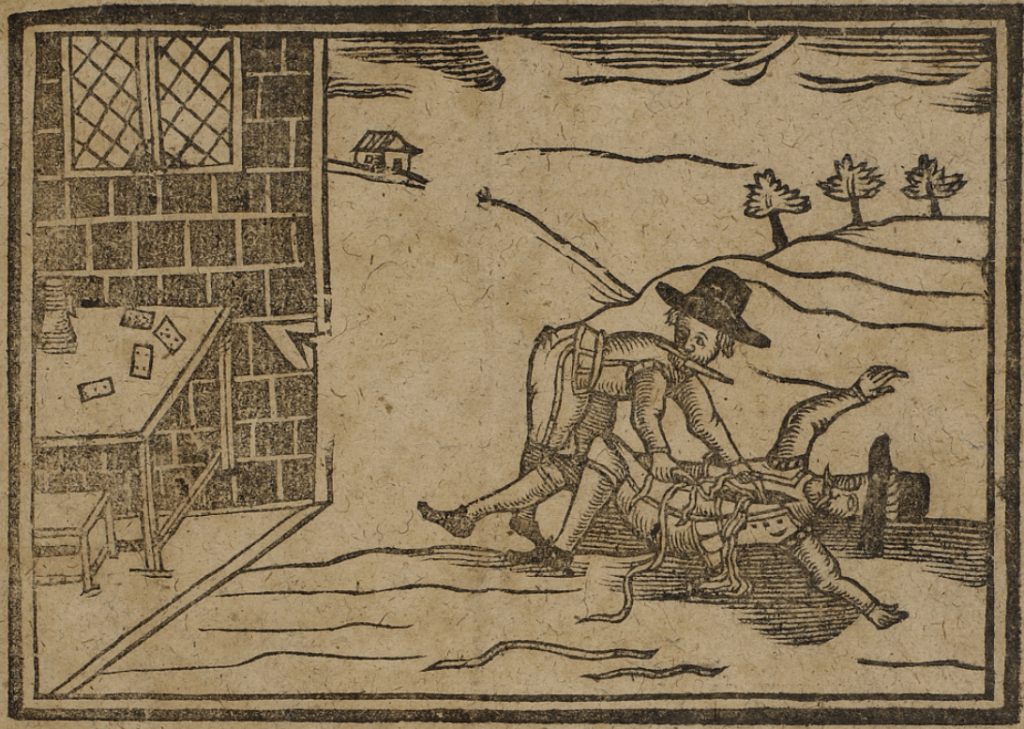
We are dutifully informed that this man — rummaging through the guts of an unfortunate fellow, a knife held in his mouth, glancing nervously back at a room where a heated card game has evidently taken place — is a professional surgeon performing an autopsy on a man who had choked to death on a piece of meat. That he had done so after taunting God to make an example of him was ostensibly the reason this ballad had been published, though no small number of early modern Londoners must have mistaken it for a murder report at first glance. Clearly that was the source of the image.
The balladeer responsible for penning this work was none other than Laurence Price.
We don’t know who created any of the woodcuts referred to in this article. They were presumably people working in the workshops of the printers who produced them, though woodcuts were loaned and passed around so pinning down their provenance can be tricky.
We do know that Laurence Price’s ballad Tis a wise Child that knows his own Father (c.1640), which contains the family scene woodcut, was printed by Richard Oulton. He was the son or son-in-law of Elizabeth Allde, wife of the famed printer Edward Allde, who took over her husband’s business for a short time after his death in 1628. The Hee-Diuell ballad was likely printed by him. Its woodcut was probably custom-produced by Oulton for one of the three ballads it adorns from between about 1638 and 1640 but apparently never re-appeared in print.
It’s almost boring at first glance. A typical crude depiction of family life in the 17th century, cut into cheap wood at short notice to accompany an inexpensive ballad and maximise profit by enticing customers. Hardly the ideal environment for artistic innovation, to be sure, but what we’re left with is a chameleon — an image which changed its meaning in different, even conflicting, ways depending on the words around it. And when Martin Parker sat down with quill in hand to write his ditty for Francis Grove in 1638, this was a harrowing — if fictional — tale of early modern domestic abuse.