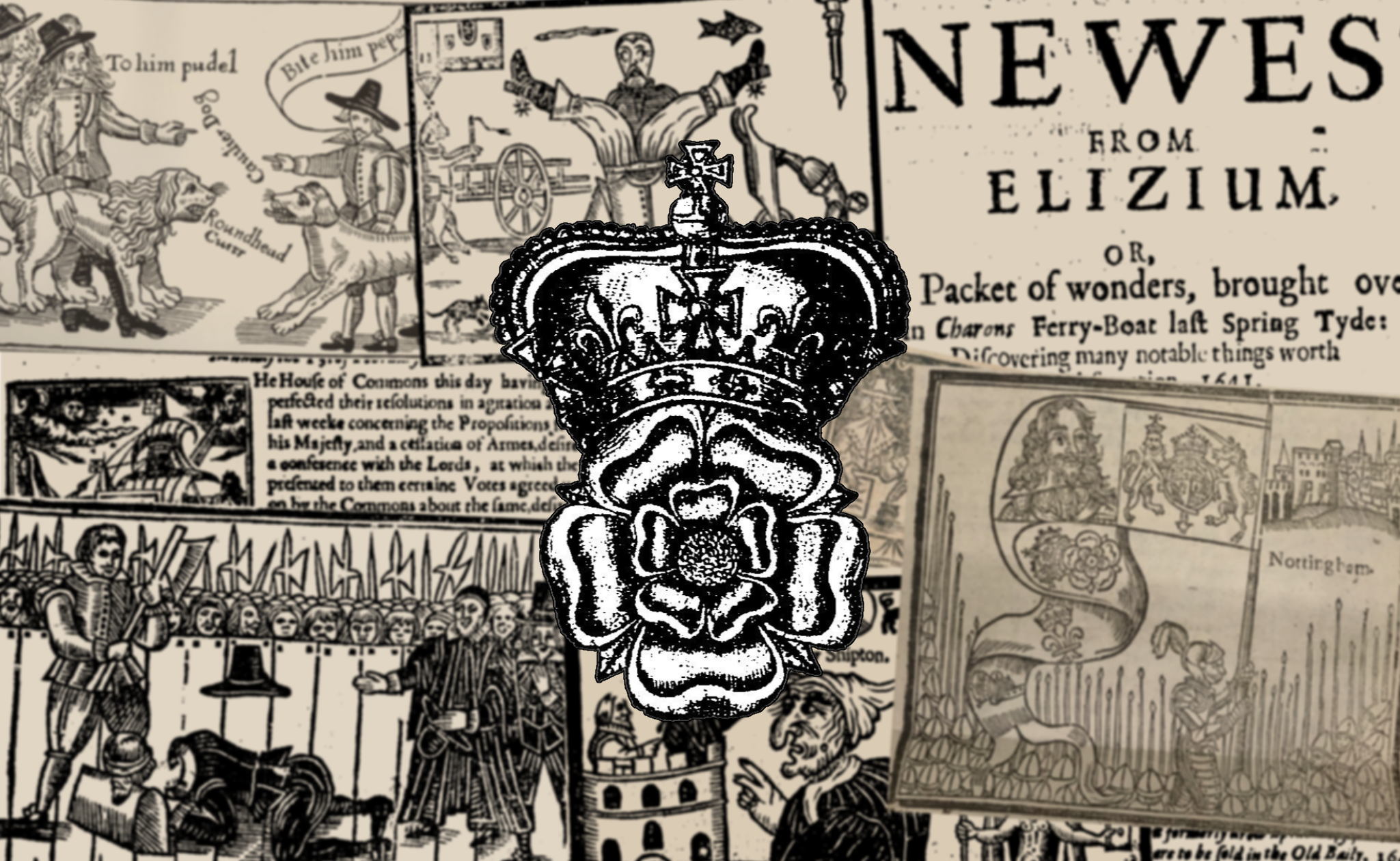
The career of the Elizabethan pamphleteer was financially perilous, socially paradoxical, reputationally unglamorous, and intellectually awkward. It was nothing short of extraordinary, and unthinkable to previous generations, that even a few of the literate men who haunted London’s bookshops could, by the end of the sixteenth century, earn a living (however meagre and precarious) simply by writing.
For the most part, these early professional writers had no long-term financial stability or job security, depending on the success of their most recent publication to afford food and rent. They sought aristocratic patrons, sometimes successfully, and when trying their hands at drama or secretarial work could brush shoulders with the politically powerful in mansions and palaces — but this must have felt like a fleeting dream upon returning to their squalid lodgings.
Pamphleteers enjoyed no general respect from the urban readership whose fickle tastes they fed, and though their brains may have been brimming with grand religious ideas or social commentary, they more often had to content themselves with writing up sensational news reports and low-brow poetry.
Harsh critics branded them “scribblers”, whose ephemeral works were not worth the paper they were printed on. The dramatist Thomas Dekker, who was himself a prolific pamphleteer, criticised those of his contemporaries who obsessively churned out new books, which he branded “a very poore and foolish ambition”.
What is a pamphlet, and who produced them?
A pamphlet was a small, cheap printed booklet mass-produced at little cost. Book prices were primarily dependent on the number of sheets required to produce them, and pamphlets were typically printed in quarto — meaning a single sheet of paper could hold eight pages of text. A pamphlet would only set a reader back a penny or two and rarely exceeded a few dozen pages in length.
They were the product of a joint business endeavour between publishers, who funded a book’s creation and usually sold them from their shop, and printers, who oversaw a work’s physical construction, including its title page and any accompanying woodcut illustrations. It was not uncommon in the earlier years of the sixteenth century for printers to act alone, taking on the responsibilities of a publisher, though this was increasingly uncommon by the end of the Tudor period, as the book market became progressively specialised.

When the writers of these works — among them Thomas Nashe, Robert Greene, and Philip Stubbs — began entering the regular employment of booksellers in the final two decades of Elizabeth I’s reign, they were stepping into an entirely unprecedented line of work. Authorship had hitherto been the domain of university scholars, intellectuals, and a few others whose writing supplemented income from other sources; these full-time professionals were something new.
Pamphlets might contain polemical religious or political ideas, and we often associate the term with such material today, but the majority were less visionary, including news reports, spiritual conduct books, and devotional texts. The financial precarity of the profession meant it naturally inclined towards popular topics which would sell well. And since trouble with the authorities could have your book banned, and its profits lost, it was best not to stick one’s head above the parapet in pursuit of some noble cause.
This new career was possible only because of an explosion in popularity of cheap, topical literature written in the vernacular, itself permitted by increasing literacy rates and the invention of the movable-type printing press more than a hundred years earlier.
Pamphleteering was not a reputable profession, nor a profitable one
Pamphleteers were not without their detractors — frequently other writers who lamented the degradation of popular literature in pursuit of constant novelty. After John Webster’s new play The White Devil flopped at the Red Bull Theatre in 1612, he blamed the playhouse’s audience — too ignorant and uneducated, in his view, to appreciate its merits and subtleties. Writing defensively in the preface of its publication that same year, Webster compared the spectators to another type of consumer: “…those ignorant asses (who visiting Stationers shoppes their use is not to inquire for good books, but new bookes).”
In a jest-book published five years earlier, Thomas Dekker and George Wilkins joked that if a writer, desiring “to be a foole in print”, presented a genius and “everlasting” work to a bookseller, he could expect to be told that, “everlasting bookes are ill commodities in our trade, bring me a booke that will go away”.

The two authors had begun their book with the following bleak picture of the obsession with novelty and base entertainment possessed by readers shopping in St. Paul’s Churchyard, which was England’s literary hub:
Men that write to feede fantastike humors, are no better then Apes, that shew their trickes to others, the doing of which is painefull to themselues, and at going away are but laught at, and so nice are our Paules Churchyard-walkers in beholding these pictures, that today they cry excellent at the drawing of that, vpon which tomorrow they will cast a mewing countenance
Thomas Dekker and George Wilkins, Jests to make you Merie (1607), sig. A2r
So it is clear that by the beginning of the Jacobean period, writers of popular prose and verse had a poor reputation (as paradoxical as that may seem). Being a pamphleteer derailed at least one political career, when the writer George Gascoigne was unable to take up his parliamentary seat in 1572 after the Privy Council received an anonymous letter informing them that he was “a common Rymer”, “a notorious Ruffianne”, and had been accused of manslaughter. (The latter was probably the more damning accusation but his activity as a writer of cheap verse had been included for a reason.)
But even though writing earned a pitiful and unreliable salary, and did not bring with it a good public reputation or fulfilling work, it seems that an alarming number of people — fancying themselves skilled wordsmiths — pursued it, or at least wished to.
One writer, probably a religious scholar, groaned in 1591 that “every red-nosed rimester is an author, every drunken mans dreame is a booke, and he whose talent of little wit is hardly worth a farthing […] scarce a cat can looke out of a gutter, but out starts a halfpeny Chronicler, and presently a propper new ballad of a strange sight is entitled”.
An ‘anonymous and uninspired’ life for England’s earliest professional writers?
It is sometimes easy to forget that such an overwhelming proportion of pamphlets published in the sixteenth century were news reports, cheap pieces of poetry, and other topical publications. This is in part because these ephemeral works are both less likely to have survived (meaning they are under-represented in archive collections) and were often not entered into the Stationers’ Register — an effort to systematically record publishing rights — so can disappear from the historical record altogether.
Even those which do survive frequently omit the name of their author. For pieces of news this was often a deliberate tactic, which allowed the author of a printed report to assume an air of credibility which may perhaps have been questioned were their name pinned to its cover.

Accounts of gruesome murders, terrible accidents, extreme weather, and deadly plagues were put through London’s printing presses in their hundreds during the 1580s and 1590s. These belong to a genre of topical print which Alexandra Walsham has labelled “providential journalism” and combined sensational reporting with religious edification. Pamphleteers, she argues, found regular employment as “ghost-writers” in the “small factories” maintained within the bookshops of publishers such as John Danter.
The “skill” of these writers lay most in their ability to produce, at a moment’s notice, fairly sensational reports, rather than their literary merits — but it was a skill nonetheless, and one which could require great flexibility; the rookie bookseller Andrew White hired a writer in May 1591 to assemble a report of the triumphant victory of four English ships over a fleet of Spanish galleys which had ambushed them off the Straits of Gibraltar a few weeks prior. It was very possibly the same pen behind a ballad of propagandistic verses on the same topic which were licensed with the publishing authorities on the same day.
Balladeers and pamphleteers were derided and ridiculed alike, though the former bore a greater brunt of the insults, and it was not uncommon for one man to find work in both careers. The scholar and writer Gabriel Harvey singled out “[William] Elderton, and [Robert] Greene: two notorious mates, & the very ringleaders of the riming, and scribbling crew” in a 1592 pamphlet targeting the recently-deceased playwright and pamphleteer.

Robert Greene had enjoyed immense success as an author of “cony-catching pamphlets” designed to excite London readers with accounts of the cunning tricks employed by thieves and fraudsters. He was so popular, in fact, that it appeared not even death could put a stop to his writing, for some of his most renowned works were published posthumously — with his writing edited and, to extents which are the subject of intense academic debate, augmented by others.
Greene was stereotyped as such an obsessive pamphleteer that John Dickenson’s Greene in Conceipt (1598) rhetorically “raised [him] from his grave to write” a new book and featured a woodcut illustration of Greene writing while wearing the winding sheet in which he had been buried.
William Elderton, on the other hand, was a pioneering ballad-writer who produced verses on events including a monstrous birth in Buckinghamshire, the failed Rising of the North against Elizabeth I, and the subsequent execution of a Catholic priest in Durham.
Gabriel Harvey’s written attack on Greene and his ilk was but one example of a “pamphlet war” — where writers dramatically insulted one another in print, to the great excitement and amusement of readers. Harvey famously feuded with the pamphleteer Thomas Nashe between 1592 and 1596.

Nashe was the very prototype of an Elizabethan pamphleteer, a Cambridge graduate who had arrived in London utterly destitute and in desperate need of literary work to fend off starvation. He found regular employment in the shop of printer-publisher John Danter, with whom he likely lodged for some years and, in the spirit of thankful reciprocity, may have helped the stationer with domestic tasks.
It is only because of the diligent, forensic academic work of historians and literary scholars within the last 150 years that the very best of Nashe’s pamphlets — now recognised as early masterpieces of satire and fiction — have been rescued from the oblivion of obscurity, so little were pamphleteers’ works regarded in their own time.
In a letter from 1595, Nashe complained that serious works he pitched to booksellers were being overlooked in favour of ephemeral news reports about warfare abroad. His involvement in the Marprelate controversy of 1588-89, where he penned at least one opinionated pamphlet defending the Church of England from its Puritan detractors, had given him a taste of the lively literature the print market was capable of producing. His subsequent Pierce Penniless (1592) and The Unfortunate Traveller (1594) were further forays into the kind of adventurous work his brilliant mind was capable of contriving.
But Nashe knew the safest bets for publishers were topical news items. An earthquake which had shaken London in 1580 (alongside the Netherlands and parts of northern France and Germany) prompted a flurry of no fewer than four pamphlets in quick succession. The pamphleteer Anthony Munday, who was already busy at work on a collection of murder reports, hastily appended an account of the tremor, which caused part of St. Paul’s Cathedral to collapse.

Churning out sensational reportage and other trivial literature, with little hope of lasting fame, for a bookseller in whose house you may well have been a quasi-servant was hardly living the dream. It’s little wonder the academic Joad Raymond summed up the career of England’s earliest proto-journalists as “anonymous and uninspired”.
Not everything was terrible for the Elizabethan pamphleteer
Still, there was a reason that so many chose to struggle through the myriad of hardships pamphleteering brought. These were intelligent men for whom a transition into more lucrative professions — such as law, politics, or clerical office — was well within the remit of their skills. To be sure, some writers fled the field at the first opportunity, but many stayed the course. And it could be a very rewarding course at that.
Anthony Munday is a neat example of a pamphleteer whose life and career must have been the envy of many a contemporary. He was — in turn, and often simultaneously — a printer’s apprentice, journalist, actor, translator, pamphleteer, priest-hunter, Puritan-catcher, playwright, poet, government spy, pageant writer, and historian. His career spanned from 1576, when he was briefly bound apprentice to the printer John Allde, to 1623, when he organised a water show for the inauguration of a new Lord Mayor of London. He died in 1633, aged probably about 73.
Munday grew tired working in Allde’s printing shop in central London as a teenager and very shortly after exiting his apprenticeship turns up at the English College in Rome, a Catholic seminary which trained priests before sending them off on clandestine religious operations in England.
This trip of Munday’s, which spanned 1578 to 1579, was initially viewed by many historians as a clear example of state-sanctioned spy work, carried out at the orders of William Cecil or the famed “spymaster” Francis Walsingham, with whom Munday would become well-acquainted in the future as a government agent. But, in fact, there is no evidence that Munday was doing the Privy Council’s bidding in Italy.
He probably really was just in search of exciting and scandalous experiences which could make good journalistic copy for Allde, as he claimed in a subsequent pamphlet titled The English Roman Life (1582), which was essentially an exposé on what life was like for the Catholics there.
Munday also wrote less interesting prose and verse — news reports and broadside ballads about which not much interesting can be said, and many of which were probably anonymous — but maintained a healthy relationship with his long-time patron Edward de Vere, 17th Earl of Oxford, and was never impoverished, though his will suggests he died with only a modest fortune.
His writing of mayoral pageants was rewarded generously by the City of London, who also paid him £60 for updating the late John Stow’s chronicle The Survey of London, and in 1623 granted him a £4 yearly pension.

Munday may have been the exception to the general rule that pamphleteering was not a profitable pursuit, but his less successful colleagues still had things to be thankful for.
On 8 October 1600, the publisher Thomas Fisher entered Shakespeare’s A Midsummer Night’s Dream into the Stationers’ Register for publication. Look three entries down and you’ll see the record of a work which is virtually unknown today: Samuel Rowlands’ The Letting of Humours Blood in the Head-Vaine (1600).
Rowlands was a remarkably productive pamphleteer in prose and verse (particularly the latter) for about 30 years, from 1598 until 1628, but not a single record of his existence has survived apart from his printed works. He was likely impoverished, probably lived and worked for some time in the house of one of his publishers, and never nurtured any significant literary connections.
But, reading his works, it is clear that he could never have been anything but a pamphleteer. Rowlands was a keen observer of the characters and customs of his time, and in what other profession could he earn even a meagre sum making these observations public?
The Letting of Humours Blood (1600) was a collection of epigrams — short, witty pieces of verse — which satirised the kinds of people you might run into in Tudor London, from a foolish astronomer to a vain gentlewoman. Like most of his poetry, it is written in a lucid and plain style which would have appealed to an ordinary audience of apprentices, shopkeepers’ wives, and literate workers. Rowlands’ voluminous output owed surely to his need to constantly write for a living, but it must also have been an enjoyable exercise of his talents.
Likewise, a weighty religious treatise was off the table for hack news writer Anthony Nixon when he first ventured into the world of publishing just before Elizabeth I’s death, but he peppered his news reports with scriptural musings and moralising digressions which must have been a palatable alternative. About a decade later he was finally able to convince a publisher to pay him to write a theological tract.

The life of an Elizabethan pamphleteer, and that of their immediate Jacobean successors, was rarely easy. Most would never achieve a comfortable living, let alone become affluent, and the whims of self-serving publishers could at once derail a years-long career. Those seeking to influence public opinion for the better quickly found that, with few exceptions, it was their writing which needed to fashion itself to the tastes of the moment, not the other way around.
Pamphleteering was important to an extent not remotely understood by those who commissioned and consumed it in the early modern period — and only fleetingly gleaned by most scholars until about a century ago. Thomas Nashe and Robert Greene are now recognised as skilled writers and dramatists who, alongside their contemporaries, helped develop English theatre and literature. The army of anonymous writers who mass-produced sensational news reports and popular ballads were part of a nascent journalistic industry which shaped the news media we take for granted today; to a smaller, but non-negligible, extent they laid the literary and intellectual groundwork for the Enlightenment.
It is incredible that even a single man braved the financial instability, social disrepute, and intellectual constraints which came with becoming a pamphleteer. We should be so thankful that they did.