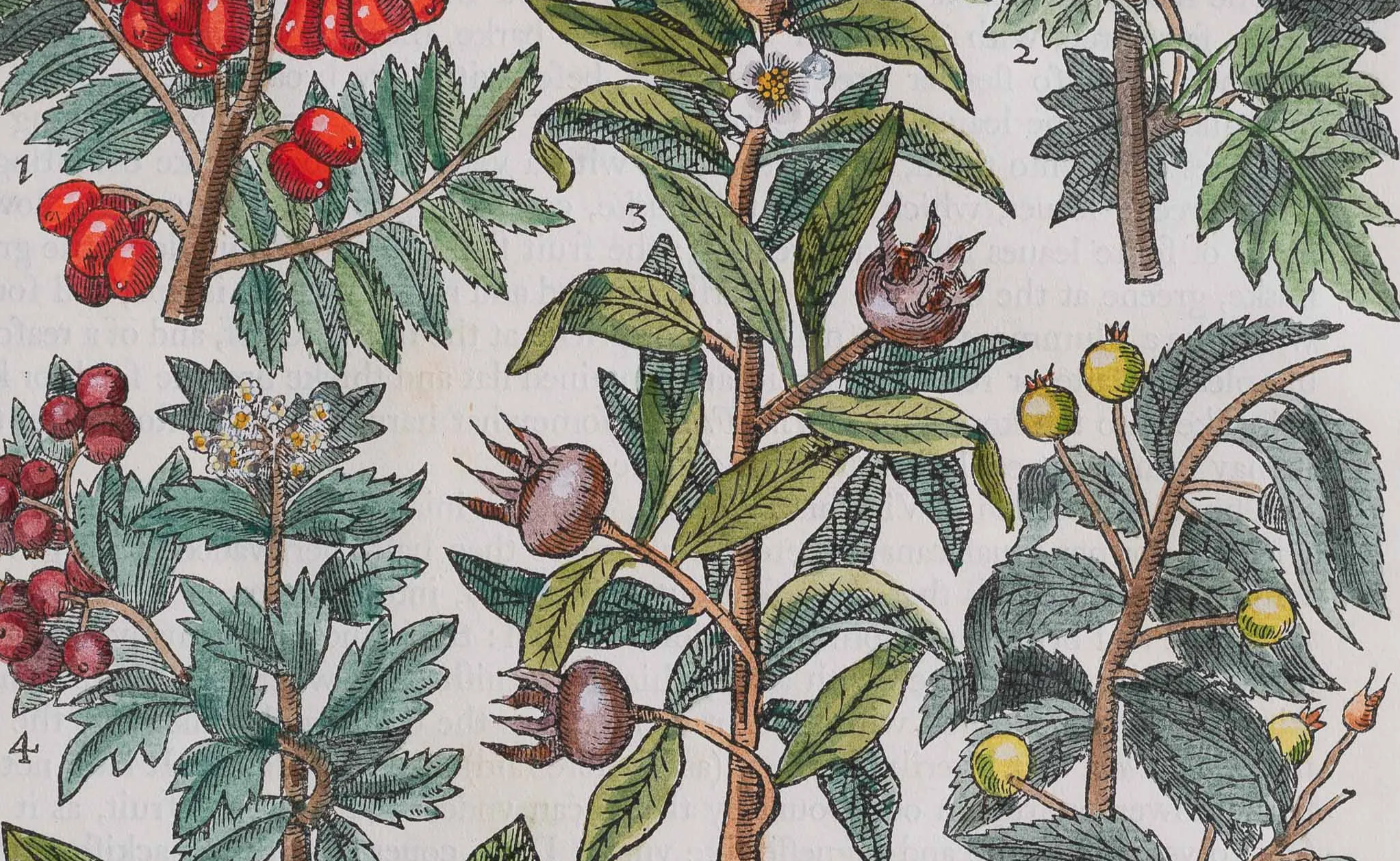
For medical practitioners in early modern Europe, every plant was a potential wonder drug. The challenge was teasing out which flowers, leaves, or roots were useful for particular ailments. The pungent herb sage, for example, was renowned during the Middle Ages for healing wounds and curing fevers. Not long after the invention of the printing press in about 1440, the bookshops of Europe became increasingly full of cheap medical tracts. Pamphlets known as “herbals” helped readers identify and apply healing plants — some newly discovered by explorers in faraway lands.
Two prominent 16th-century physicians thought the puzzle of using medicinal plants from the Americas was not purely scientific. Instead, it hinged on the will of God. English doctor Timothy Bright and Spanish botanist Nicolás Monardes penned rival medical texts on the benefits of New World plants and herbs. The crux of their disagreement was whether divine providence allowed foreign remedies to work on patients thousands of miles away, according to new research in Renaissance Quarterly.
Nicolás Monardes published an expanded collection of his writing on the medicinal plants, herbs, resins, and minerals of the Americas in 1574 under the title of Historia medicinal. He had been writing on the subject of exotic medicines since 1565. Though he never travelled across the Atlantic Ocean, Monardes came into contact with merchants arriving in Seville from the West Indies who brought with them guaiacum shrubs and bristly sarsaparilla plants, among other foreign items of vegetation.
Tobacco was the jewel of these materia medica, and a particular object of the Spanish physician’s fascination. Monardes’ treatise was one of the earliest studies of its potential medical benefits. He ascribed to this thick, unbranched, green plant an almost innumerable variety of medical capabilities — including that its leaves could be used to cure cancer and heal venomous wounds. Indigenous people also smoked it “to make themselves drunke withall, and to see visions”. Their chiefs apparently used these hallucinations to get advice on matters of tribal governance.

In Seville, Monardes had taken some tobacco into his possession and used it to cure patients of sores and scabbing. By the 1570s, the plant was in England, France, and Portugal too. Monardes’ book was also spreading. It was soon translated into Latin, Dutch, French, Italian, German, and English. In 1577, it appeared under the title Joyfull newes out of the newfound world on the shelves of William Norton’s bookshop outside St. Paul’s Cathedral in London. It was joyful news indeed, for Monardes would have readers know that the American medicinal plants were working just as well among Europeans as they had the natives.
The English physician Timothy Bright was sceptical. Three years after the English translation of Monardes’ work — and just as a second edition of Historia medicinal was published in Spain — Bright responded with a book of his own. In A Treatise, wherein is declared the sufficiencie of English Medicines (1580), Bright patriotically asked “what can be more pleasant unto thee, than the injoying of medicines for cure of thine infirmities out of thy native soyle, and countrie, thy Field, thy Orchard, thy Garden?”
By 1580, Monardes was 87 and a respected physician in Spain. Bright was a young man, probably still in his twenties, and had only received his medical doctorate from Cambridge University a year prior. He no doubt knew it was provocative to suggest, as he did, that “our English bodies, through the nature of the region, our kind of diet & nourishment, our custom of life, are greatly divers from those strange nations” and that therefore “the Medicines which helpe them must needs hurt us”.
To support his view, Bright cited the Roman naturalist Pliny the Elder, whose seminal work Naturalis historia, completed in 77 AD, argued against the use of medicine from remote lands. More recently, German physicians Martin Ruland and Leonhart Fuchs had made similar observations. Bright’s book surely made uncomfortable reading for the merchants who stood to profit from the transport of exotic medicines. Mechoacán root was of no use to Europeans, just as rosemary could not heal the Americans.

How could it be that two educated physicians had reached such contradictory conclusions? In her recent article “Of Plants and Providence: Assessing Drugs, Difference, and Divine Will in Timothy Bright’s The sufficiencie of English medicine”, historian Melissa Reynolds suggests that Bright and Monardes disagreed because they held polar opposite views on the nature of God’s divine will.
Reynolds writes: “Perhaps fittingly, both of these sixteenth-century physicians grounded their arguments in the doctrine of divine providence, or the belief that God’s good intentions for his people were apprehensible in the natural world he had created.”
Where the two men differed was in whether the divine provision of resources was universal or local. “Bright believed that the differing apportionment of medicinal resources across the known world reflected God’s differing provision for differing peoples,” Reynolds continues. “American medicines were thus not universally efficacious, nor should they be extracted or trafficked, as this represented a threat to the inviolable will of God.”
But to Monardes, it made perfect sense that the New World was part of a universal natural order — and so “the Spanish were duty-bound to extract and export these medicinal resources”. In proposing this action, the physician was offering yet another justification for not only the existence of a Spanish empire, but one which aggressively seized all it could.
Bright’s intense nationalism and conviction that God’s providence was particular in scope had blinded him to the imperial possibilities offered by foreign medicines. But he had hit upon a point which would be used to justify racial discrimination during the growth of the British Empire. As Reynolds observes: “Bright argued that the observation of medicines’ effects on different bodies would reveal essential differences among peoples — differences that were marked on the landscape, manifest in the body, and registered in the soul.”
Monardes’ view that American plants could be used to treat Europeans was right, of course, even if it was not necessarily built on an argument we would think of as scientifically compelling today. An appeal to the supernatural was quite understandable in his own time, though. In matters of medical disagreement, it was not always to the dissection table or practical experiment that early modern physicians looked — but sometimes up to the heavens.