From the late-sixteenth century, ballads became increasingly popular. One particularly common type of ballad was the ‘news’ ballad, which claimed to relay recent happenings in England or abroad. Included in that category were reports of natural disasters, executions, supernatural acts, and crime. Crime was a particularly prominent genre of ballad and by the mid-17th century many ballads claimed to give ‘a true account’ of various felonious misdeeds ranging from theft to adultery and from witchcraft to murder.
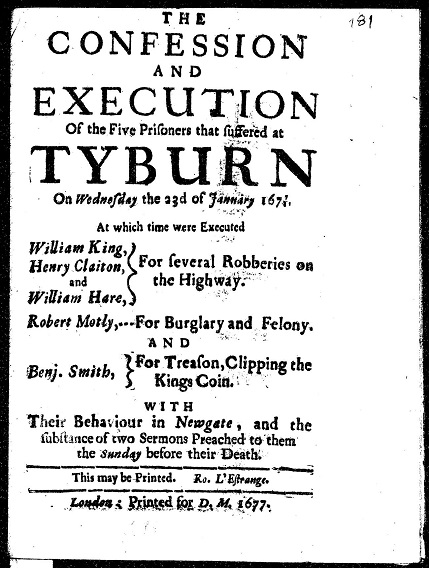
Most crime literature at the time focussed on communicating a moral imperative to its readers (essentially attempting to edify them on matters of virtue and religious righteousness). The Ordinary of Newgate’s Account, for example, was a pamphlet published regularly from 1676 to 1772 which included details of prisoners’ crimes but focussed on their dying words. The purpose of this was to allow for them to recant their ways and warn others from allowing themselves to follow a similar path. Whether they realised it or not, the real subject matter of the writing was the audience itself; every person reading could potentially resort to a life of crime. Although some crimes were so evil that it was never presumed a normal person could inadvertently come to commit them through living immorally (Garthine Walker emphasises the depiction of child rapists as monsters and ‘more a Devil than a man’), even crimes like murder and violent robbery were presented as only a few bad choices away.
Crime ballads similarly tended to stress which moral lessons were to be learned from those who had fallen to a life of villainy but were also often very detailed, occasionally graphically so. In large part, this will be to afford the tale an air of verisimilitude or make its point more poignant but – as a form of cheap print which was written to be sold – it also catered to the demand for exciting, affordable literature. Although it was often ‘murder pamphlets’ which historians such as Peter Lake argue were produced quickly and for profit, I wish to focus on crime ballads.
Take The York-shire Tragedy (1685), an anonymous ballad which claims to give a true account of the murder of a young man and woman by a group of men, ending with the execution of the ring-leader. The ballad goes into explicit detail to recall how the ‘cruel Ruffins in close ambush lay’ and upon entering the house and encountering the ‘poor frighted Damsel’ one of the men ‘discharged [his pistol] through the midst of her head,/Blood and brains both did follow, she fell down for dead’, later to be found by her mother ‘wreaking in gore.’ The description in this ballad is surprisingly graphic, even for ballads which focussed on murder. Although there is a clear moral takeaway at the end, when the ring-leader is on the scaffold and repents, regretting the ‘bad Company which I have kept’, the majority of the ballad’s verses are concerned with the actual murder itself. How much of this story is real is naturally unclear. It’s very possible that the named ‘Henry Grigson’ did indeed kill a young man and woman in 1685 (although I cannot find any records of him online) but the precise order of events and gory details are, if not completely fabricated, at the very least embellished to make for an exciting – if unsettling – read.
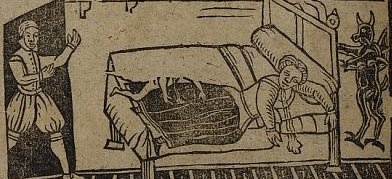
Another anonymous ballad from the first half of the 17th century, entitled A Warning for all Murderers takes a rather interesting view of how justice might be served. The title makes its moral intentions clear and the ethical proposition that ‘murder is bad’ was a rather uncontroversial one at the time, to say the least. This story is most definitely a fabrication as will become evident, ascribing a supernatural atmosphere to the crime of murder which results in those who commit it being found out and punished. One of the intended murder victims have some sort of strange premonition of the act as ‘His sleepe was full of dreadfull dreames,/in bed where he did lie’ and ‘oft as he did sit at meate,/his nose most suddenly,/would spring and gush out crimson blood.’ To a modern reader this is a little bizarre, although a reader at the time would have been familiar with the idea of nose bleeds being a sign of misfortune and would not have doubted the possibility of nightmares preceding a terrible event. What one would hope might stretch the suspension of disbelief of even the most credulous 17th century reader is what comes next: a baby ex machina who delivers justice.

This part of the ballad, although on the same broadside, is from the ‘second part’ with a separate tune. The baby in this case is no random child but the offspring of the woman who, along with her husband, was murdered in part one. The baby was born while she was dying and is sent to a nurse yet, through pure coincidence, stumbles upon one of his mother’s murderers five years later as a young child. The child gets under a table at which the man is sitting and bites his ankle which cannot be healed and eventually ‘sweld and rotted in such sort,/that thereof dyed he.’ Similarly, the second murderer is killed when the child sticks a pin into his thigh which causes unstoppable bleeding which kills him three days later. Assuming that neither man was a haemophiliac, this seems like a pretty tall tale but presented in the context of ‘Gods judgement just’ it can be put down to divine justice. The final murderer is dispatched of in an equally ridiculous manner. Sleeping in a field, he is found by the child who proceeds to stick a ‘bramble sticke’ down his throat which the man tries to pull out but in doing so destroys his wind pipe and dies shortly afterwards, although not before confessing to the aforementioned crime. Although graphic, this crime ballad places an emphasis on the idea that justice always prevails. In this sense, it’s not too dissimilar to modern police dramas which focus just as much on the process of catching the criminal as they do on the crimes themselves. Except in this case DCI John Luther is a baby and instead of rigorously following the evidence he bites his suspects and sees if they bleed to death.
It’s important not to underestimate just how popular ballads could be. Literacy rates in England were rising (from 11% in 1500 to 60% in 1750) and even those who could not read, or even afford the relatively cheap ballads, could enjoy the drama. Ballads were written to be sung, the tune given at the top of the sheet, and were often recited in public settings such as alehouses. Ballads increasingly featured at least one woodcut which tended to share some connection with the subject being discussed, although the cost of producing new woodcuts meant that most ballads simply reused previous ones. On the most fundamental level, people want to be entertained. We do today so why wouldn’t we in the 16th, 17th, and 18th centuries? Crime ballads might not have the character development of a well-written book, the suspense of a well-written crime show, or the ambience of a well-scored piece of television but if you’re a fan of exciting scenes of robbery, fighting, and murder, you’d fit right in with much of the early modern English population.