
A trusted enforcer of Henry VIII’s sweeping religious reforms risked his life by stashing away a Catholic manuscript that he had been tasked to destroy, researchers have discovered.
There are several signatures on the final page of Yale University’s copy of Nicholas Love’s Mirror of the Blessed Life of Jesus Christ, a 15th-century bestseller which became controversial during the Reformation for its promotion of orthodox Catholic doctrine.
The names listed are of those people who read or owned Love’s book, a translation of an earlier Latin work. Two of them are thought to be religious women — but the final signature belongs to Sir John Gage, a shrewd Tudor courtier who was responsible for the destruction of precisely this kind of literature.
Sir John Gage (1479–1556) was a devout Catholic who stuck to his conservative faith even as Henry VIII pursued religious reform which made these beliefs dangerous, sometimes punishable by death. He was also an intelligent political navigator, occupying a string of important posts in the King’s court and household, becoming vice-chamberlain by 1528.
Gage wisely aligned himself with the increasingly influential Thomas Cromwell. When the dissolution of the monasteries began in 1536, he was tasked with overseeing the handling of monastic houses in Surrey, Kent, and Sussex. This included seizing controversial books, which would often be burnt.

Nicholas Love’s Mirror of the Blessed Life was precisely the kind of work Cromwell and other reformers thought should be reduced to ashes. Among other “suspicious and dangerous ideas” ideas, the researchers point out that it included a treatise arguing for the real presence of Christ’s blood and body during Holy Communion, something Protestants understand to be merely symbolic or spiritual.
In turning to the Yale manuscript of Love’s text, researchers from the universities of Cambridge and Sussex solved a century-old puzzle. Six detached pages of the book were given to the Sussex Archaeological Society by the Gage family as part of a large deposit in 1929 — but their origin had until now been unknown.
The researchers proved the fragile pages, now part of The Keep archive in Brighton, were from the same manuscript held in Yale by matching the scribe’s handwriting and finding that the missing content perfectly filled the gap in the digitized manuscript.
Medievalists James Wade, of the University of Cambridge, and Katie Walter, of the University of Sussex, argue that Gage’s split loyalties — between obedience to his King and commitment to his faith — shed light on just how precarious religion and politics were in England at the time.
“Gage had a very long career in a highly turbulent court,” Wade said. “He survived when many other very shrewd people did not. And he made a fortune in the process.
“But he’s also this incredibly conflicted man, because he remained a Catholic throughout the Reformation. He’s got all this power and bureaucratic savvy combined with a risky conviction in his faith. Somehow he manages to reconcile these two things, and survive.”
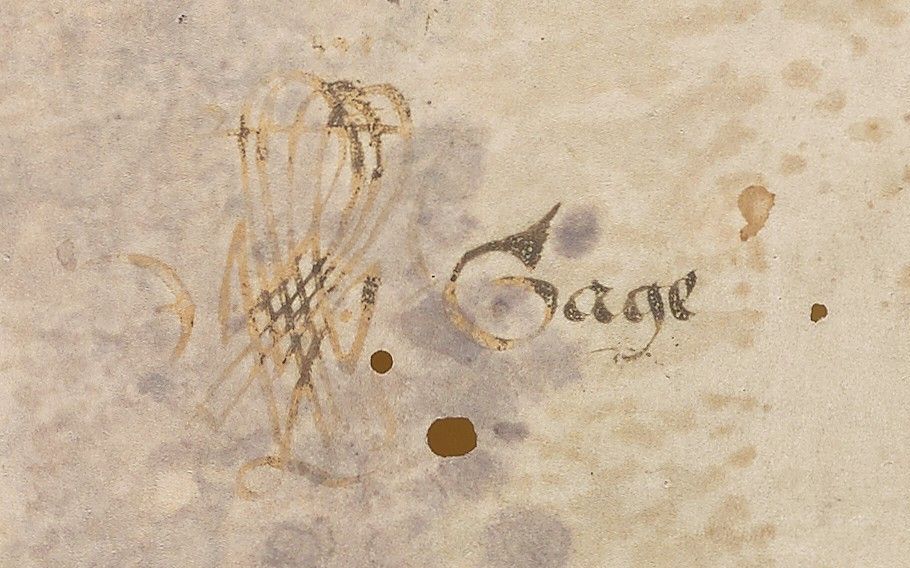
Some historians have suggested that Gage may have slyly concealed his Catholic convictions as he did Cromwell’s bidding, including interrogating priests. He also profited from speculating on monastic lands made available by the Reformation.
The historian David Potter has argued that Gage then “chose to nail his colours to the mast as a conservative” after Cromwell’s execution in 1540, when it was politically safe to do so.
But Gage’s ownership of Love’s medieval bestseller, which the researchers think he may have smuggled out of a monastic library, suggests he was willing to risk his life to preserve Catholic teachings.
“By keeping this book on his shelf, John Gage and his family were part of a much bigger secret effort to preserve Catholic literature and knowledge,” said Walter. 65 copies of The Mirror of the Blessed Life are known to survive today, a large number for a 600-year-old text.
The work, probably written by a former Benedictine monk in about 1400, allowed English Christians to read a devotional text in English at a time when Bible translations were strictly prohibited. It was approved at the time by the Archbishop of Canterbury, Thomas Arundel, and was first brought out as a print edition by William Caxton in 1486.
Though the Reformation saw its printing abruptly halted, the new study, published in the journal Notes And Queries, shows that not even the draconian regime of suppression and censorship enforced by Cromwell on behalf of Henry VIII could stamp it out.


