The Will-o’-the-wisp is many things. It is an eerie blue flame hovering over a marsh at night; it is a dancing fairy tempting travellers to stray from their homeward path; it is the spontaneous combustion of dead organic matter; it is a devil intent on mischief or a wandering penitent soul; it is the ghostly ignis fatuus — “foolish flame”.
These faint, flickering lights have been observed since at least as early as the Middle Ages. The Welsh poet Dafydd ap Gwilym wrote in 1340 that “there was in every hollow a hundred wrymouthed wisps”. Will-o’-the-wisps, or spectacles matching their description, have been sighted from England to Brazil (where they are known as Boitatá) and India to Ireland. They are still, rarely, spotted today.
Though Will-o’-the-wisps can sometimes be chalked up to bioluminescent bugs or the sighting of distant lanterns, most have a distinguishing and remarkable trait: as you approach, they will recede with an apparently spring-heeled agility. You will capture the most evasive of insects before coming close to making a Will-o’-the-wisp your prisoner.
By the onset of the early modern period in England, it was in rural areas that superstitious ideas — of fairies, spectres, goblins, and sprites of all sorts — stubbornly persisted in the face of scientific advancements and the harsh repression of the religious authorities, for whom such fanciful beliefs were relics of Catholicism.
This was a time, nonetheless, when both theologians and scientists held certain magical events to be perfectly possible, and many supernatural happenings condemned by the elite were not rationalised in purely natural terms, but thought of as tricks played by Satan. In the case of Will-o’-the-wisps, however, quite ordinary explanations were proposed.

As early as 1569, a Swiss theologian addressed the spectacle of floating flames in a popular book assessing, and sometimes debunking, superstitious beliefs. “Sometimes these fiers go alone in the night season, and put such as see them, as they travel by night, in great fear,” Ludwig Lavater wrote. “But these things, and many such like, have their natural causes.” Others had observed that “thicke exhalations aryse out of the earthe, and are kindled”.
Even the great polymath Isaac Newton was drawn to consider these lambent lights, writing in Opticks (1704), his major treatise on the behaviour of light, that “vapours arising from putrefy’d Waters, usually call’d Ignes Fatui” were among those natural substances capable of shining brightly if “sufficiently agitated”.
We seem, then, to have our answer as to why bogs, marshes, and swamps are the chosen haunting grounds of the Will-o’-the-wisp. Wetlands are gaseous places, after all. Littered with rotting vegetation, their surfaces sporadically release bursts of combustible methane gas. The specifics of the chemical process which thus allowed atmospheric ghost lights to twirl about in the air were not yet clear, however — and would not be developed for quite some time.
And so, even with this scientific explanation, how could the imaginations of writers and artists not be captured by Will-o’-the-wisps? Many painters have tried their hands at depicting these curious lights, sometimes portrayed as a devil holding a lantern or a luminescent temptress.
Other times they are little sprite-like forms of light whose rippling beams resemble arms and legs, as in Hermann Hendrich’s chromolithograph Will-o’-the-wisp and Snake, based on a 1795 short story by Johann Wolfgang von Goethe which opens with two of the ghostly beings dancing and talking to a ferryman.

Bram Stoker alludes to Will-o’-the-wisps in Dracula (1897) when Jonathan Harker’s journey to the vampire’s castle in Transylvania is interrupted by the appearance of a “faint flickering blue flame”, which astonishes Harker and causes the carriage’s driver (the Count himself in disguise) to briefly disembark.
“He then explained to me that it was commonly believed that on a certain night of the year, last night, in fact, when all evil spirits are supposed to have unchecked sway, a blue flame is seen over any place where treasure has been concealed,” the English solicitor writes in his journal.
Sure enough, Emily Gerard’s 1885 essay “Transylvanian Superstitions” — which, alongside her subsequent book on the region’s folklore, is known to have heavily influenced Stoker — makes reference to such a belief concerning St. George’s Eve (5 May in that part of the world).
Beyond the aesthetic, these inexplicably alluring lights, always just so slightly out of reach, lent themselves nicely to metaphor. What could better embody the concept of illusory hope or deceptive ambitions likely to lead one astray?
An English Civil War pamphlet titled The Round-head Uncovered (1642) sought to explain the conflict by suggesting that Satan had “throw[n] his false flashes into the soul” of each Parliamentarian, and so “the minde is led awrie with an ignis fatuus, or a Will with the wispe towards some dangerous precipice”.
The Spectator, weighing in on Irish politics in 1895, spoke of “the Will-o’-the-wisp of Home-rule”. Nearly 60 years later, in the midst of the Cold War, the magazine’s contributor Compton Mackenzie wrote that “the belief that Turkey will ever do any more to resist Russian aggression than she did to resist German aggression is the old Will-o’-the-wisp which has danced before British policy for fifty years”.
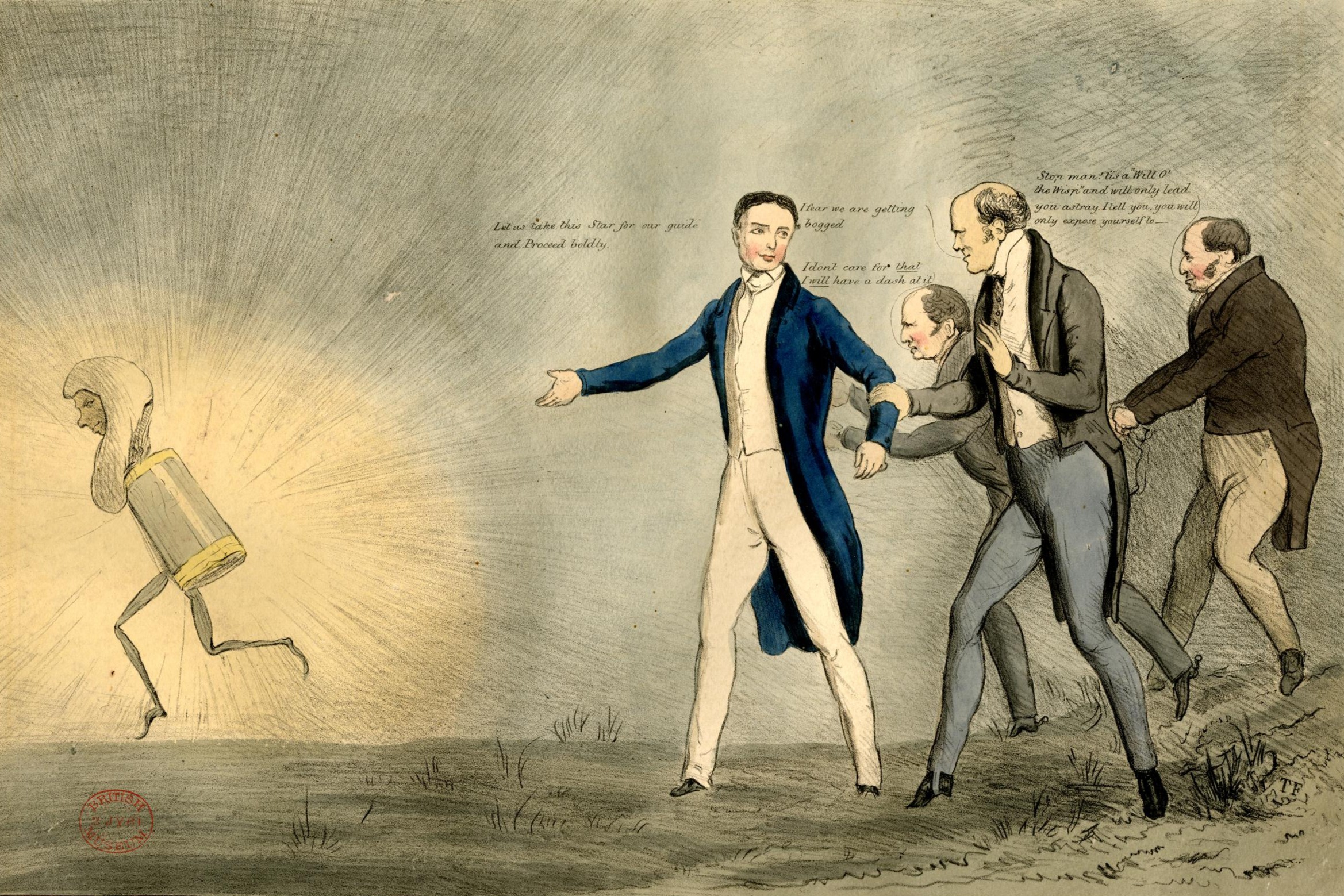
The eye-catching visual and rhetorical convenience of the captivating, misleading Will-o’-the-wisp made it a useful reference point for nineteenth-century political cartoonists and politicians alike. When, in 1831, a speech by the Marquess of Londonderry was branded “a regular Will-o’-the-Wisp”, it took only a few weeks for a satirist to produce a visual accompaniment.
But the Will-o’-the-wisp was slowly losing its charm. Scientists were exploring and explaining, with increasing clarity, the natural mechanisms behind their ghostly ways.
Not even the short-lived youth magazine Bits for Boys could bring itself to make the phenomenon intriguing to its juvenile readership. “Nobody nowadays entertains any superstitious ideas about the will-o’-the-wisp,” the publication reported in 1893, “except a few people in isolated localities where ignorance of common natural laws still prevails.”
And it really was quite simple physics which underpinned the flames’ unusual behaviour. The ability of Will-o’-the-wisps “to elude close pursuit” was “a peculiarity easily accounted for”, the magazine declared. “The pursuer, in his chase after the phosphoric curiosity, displaces the air more or less, driving it before him, thus constantly pushing the luminous gas away.”
It was now common knowledge that there were no spooky goings-on at all. “As regards our English Will-o’-the-wisp, which flickers over boggy land,” the scientist Thomas Phipson had written in a letter to The Times in 1862, “it is evidently nothing more than ignited marsh gas (carburetted hydrogen).” These ignitions, of what we today call methane, were faintly visible at night and entirely invisible during the day.
Phipson had that same year published a book on the emission of light by organic matter which suggested the phenomenon may sometimes “be connected with those curious cases of luminous mists … in which electricity doubtless plays an important part”.
How prescient, or serendipitous, a theory. It was only last year that a study came out appearing to have the last word on the matter, and electricity was at its core.
The paper, published in the Proceedings of the National Academy of Sciences USA, resolved a centuries-long question over Will-o’-the-wisps by suggesting they are occasioned by “microlightning”: the sudden and spontaneous igniting of methane caused by sparks of electricity given off by tiny differences in charge on water droplets’ surfaces. This emits a flamelike glow.
Well, that rather stamps out the mysterious charm of these ghostly flames, which, it turns out, are both not ghosts and aren’t even technically flames.
Still, what a testament to the ingenuity, rabid imagination, and rational capabilities of the human mind that such a trivial thing as flickering, floating lights have spawned a myriad of superstitious beliefs and lore, spurred writers and artists to creative action, and encouraged centuries of scientific inquiry. Such is the allure of the humble Will-o’-the-wisp.