Bills of mortality in early modern England might seem fairly boring at first sight and for most people it’s probably little more than a morbid curiosity which earns them a second glance. Lists of numbers don’t make for particularly entertaining reading, after all. Of course, from a medical perspective these statistics are very useful because—inevitable human error aside—these numbers can reflect the spread of disease over time and space, albeit within a single city.
But even for historians these bills are significant because they reflect the harsh realities of early modern life. And, while it might not seem like it, the bills of mortality were regularly printed, easily accessible, and widely consumed which makes them as deserving of the title of “cheap print” as any pamphlet or ballad. In fact, because they were publicly distributed (as a regular occurrence during the 17th century) and could indicate whether your parish had an outbreak of plague you should watch out for, they were possibly one of the most significant type of cheap print consumed.
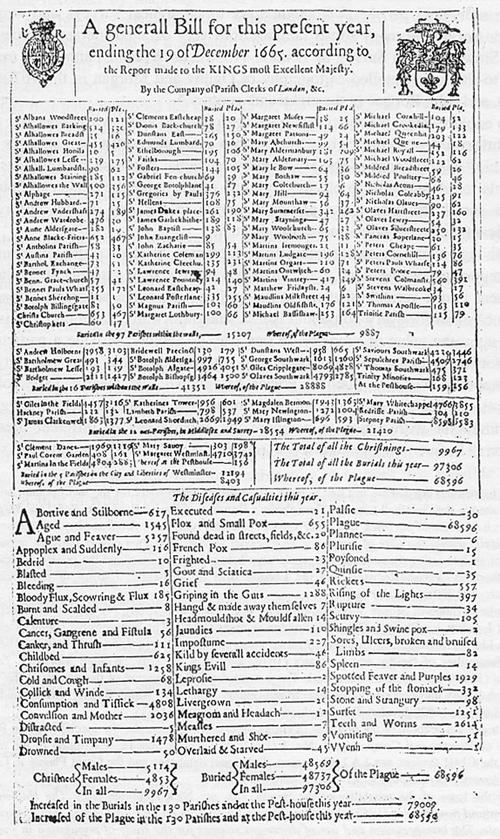
The supposed causes of death can reveal contemporary medical ignorance or superstition. “Teething” (or “Teeth”) was regularly listed as a cause of death because many children died young, when their teeth were first developing, and so it was assumed that there must be some link. Similarly, the attribution of deaths to “Kings Evill” is referring to what is now known as scrofula (tuberculosis of the neck) because it was commonly believed throughout Europe that it could be cured by the King’s touch. Statistics are also provided for those who died due to execution, drownings, and suicide. The report on the left records the deaths during 1665, the year of the Great Plague of London, so the total number of deaths is, unsurprisingly, greatly increased.
The total increase in deaths from the previous year, 1664, is given as 79,009. This might be a little surprising since even if we deduct plague deaths, that leaves an excess of 10,413. Perhaps more importantly (because London’s population could change a lot over the course of a year), these discrepancies can be observed on a weekly basis when plague struck suddenly, followed by a spike in non-plague deaths. John Graunt, one of the founders of demography, observed this and included it in his famous Natural and Political Observations on the Bills of Mortality (first published 1662). Graunt observed that 1603 had been the greatest plague year, it accounting for 4 out of 5 deaths, but was tied for the title of most deadly year with 1625 (both having an 8:1 ratio of deaths to births). Graunt reasoned that unless there was some reason to suspect that non-plague deaths should be much greater in 1625 (as relative to births) then the plague deaths of that year must have been underestimated. He noted that in 1625, there were 35,417 plague deaths and 18,848 deaths from other causes. Yet in the years before and after, the number of deaths was between 7 and 8 thousand, a difference of around eleven thousand. Assuming this excess to be down to misattribution and adding it to the plague total, the number rises from 35,000 to 46,000. This new figure would put plague deaths at ~4/5 of total deaths, the same rate as the year 1603. Graunt concludes that plague deaths tended to be underestimated by about 1/4, so taking the plague deaths and multiplying by 1.25 gives the real figure. By this logic, the 1665 bill of mortality which records 68,596 plague deaths should actually read over 85 thousand—a much higher figure, although still lower than the 100,000 statistic that most modern historians agree on.

There is compelling evidence that plague deaths were under-reported. The cause of death was established by “searchers” (often older women) who were often uneducated and inexperienced, meaning they made mistakes. There was also a good reason for people to lie about causes of deaths. Those whose family members had the plague could be “shutt up” (quarantined) in their houses until they recovered or, more likely, died—so if a family member or servant of yours died from the plague and you were afraid of potentially being quarantined, you might bribe searchers or otherwise try and mislead them. In a 2012 article, Kira L. S. Newman emphasises the fear of quarantine by highlighting a case where two searchers were bribed to lie about the cause of death of a servant who had died from the plague. This was not something which was unrecognised by other contemporaries. In London’s remembrancer (1665), John Bell writes that some people accused the bills of mortality of being of ‘little worth, by reason the Searchers are generally old and simple women’ who could not ‘distinguish between Diseases.’ Bell himself objected to these criticisms but this is likely because he was himself a ‘Clerk to the said Company [of Parish Clerks of London]’, who were responsible for producing the bills. In any case, Graunt’s qualms regarding the plague figures are justified both by his own reasoning and contemporary evidence of incompetence and malpractice.
Graunt’s estimation can only ever be a very rough approximation, and one which hinges on the accuracy of the 1603 data, but it is one which makes a lot of sense. It’s certainly possible that an increase in non-plague deaths would occur during plague years, as other diseases could be brought with it or the disruption caused by the high number of deaths (particularly if food became harder to get) could lead to casualties itself. At the same time, some people who would have otherwise died that year from old age, colds, or “griping in the guts” will have instead perished due to the plague, so the numbers probably balance out. The only obvious limitation to Graunt’s method is that its reliance on death statistics’ relation to the number of births assumes a consistent relationship between the number of births and the total population of London, which might not be true during periods of increased immigration.
These figures can also be used to try and approximate London’s population, which had long been a matter of contention and wild speculation. Graunt does this by estimating the number of ‘Child-bearing women’ to be double the number of yearly births, since ‘such women […] have scarce more than one Childe in two years’ and emerges with 24,000 (double the number of christenings, which stood at 12,000). Since Graunt reckons that the number of families must be twice that and there are around 8 people per family, he arrives at a figure of 384,000. He arrives at the same figure by noting that since on average 3 people die per 11 families per year, the average of 13,000 deaths per year must mean that 48,000 families live in London (13000*(11/3) is 48000) and multiplying this by 8 (the number of people in a family) gives 384,000.
If these figures seem excessively rounded and the maths used to reach an answer a tad reliant on extrapolation, that’s because it is. Graunt himself concedes that he has reached his number ‘perhaps too much at Random’ but it is a reasonable estimate nonetheless.

An associate and close friend of Graunt’s, Sir William Petty, also used the bills of mortality to calculate population figures for London. Petty agreed with Graunt that the number of deaths per year accounted about 1/30th of the total population (this figure being deduced through the use of parish figures at a local level). In Another essay in political arithmetick (1683), Petty reasoned that since 22,331 people died in 1682, this would suggest a population of 669,930 (a reasonable number, considering that Petty had been informed that there were 84,000 occupied houses in London which—if each housed a family of 8—would give a similar population of 672,000).
The maths behind both Petty’s and Graunt’s calculations is surprisingly simple. The key is simply in recognising correlations between figures which are known (numbers of burials, deaths, etc…) and those which aren’t (total population figures) and then using simple multiplication to extrapolate.
Although these calculations made great use of the bills of mortality, this was not their intended—or primary—purpose. They were designed to record the spread and severity of disease, particularly during outbreaks of the bubonic plague. John Bell wrote that the bills of mortality were ‘of very great use and necessity […] in that it giveth a general notice of the Plague and a particular Account of the places which are therewith infected, to the end such places may be shunned and avoided.’ Stephen Greenberg’s estimation that the bills’ weekly circulation in London was around 5,000 to 6,000 copies a week at the start of the 17th century certainly suggests that there was an audience for them and he remarks that their popularity is almost paradoxical, ‘a rapid dissemination of data at a time generally thought to be starved of information’. Today, many of us have probably recently googled UK coronavirus statistics (or even statistics at a level more local than that), so it should be more obvious than ever that these statistics would have been both useful and incredibly important to the inhabitants of plague-ridden London.