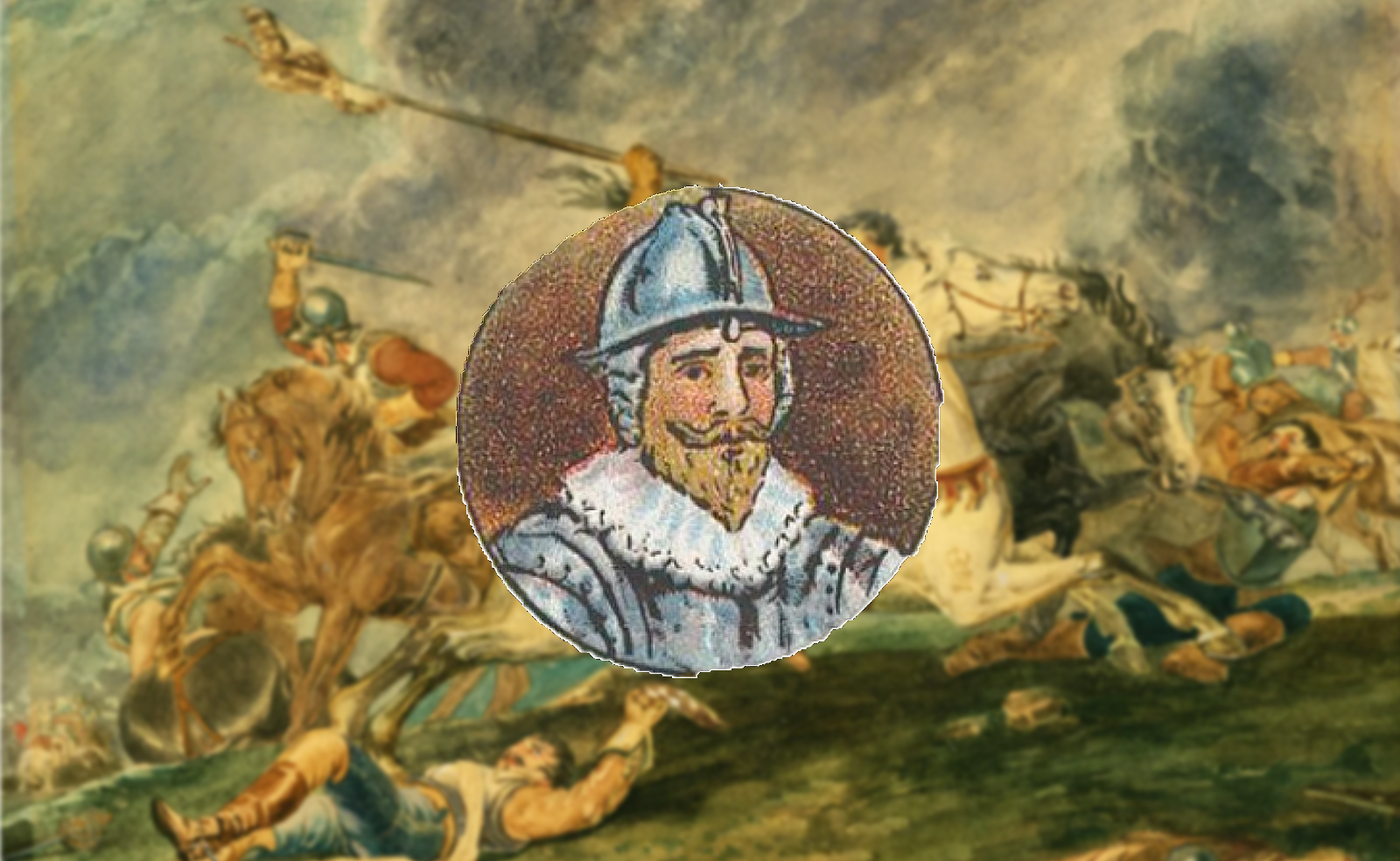
This post concerns three news pamphlets published by Ralph Harford in November 1638. Each concerns the same event: a ‘most Lamentable Accident’ which occurred at the Church of Saint Pancras in Widecombe-in-the-Moor, Devon, the month prior. The pamphlets, two of which are nearly identical and one of which constitutes an updated version of the two antecedent reports, tell of a terrible thunderstorm afflicting a congregation gathered for afternoon Sunday Mass. They are not only intriguing narratives in their own rights, but shed considerable light on the nature of procuring, presenting, and propagating information through the medium of cheap print.
The Thunderstorm of 1638
The sequence of events transpired as follows:
On the 21 October 1638, during afternoon Mass, ‘there fell […] a strange darknesse’ which shrouded the church and its congregation to such an extent that each parishioner could not even see the person sat closest to them. Simultaneously, there could be heard ‘a mighty thundering’ followed by ‘terrible strange lightning’ which entered the church, filling it with fire & smoke and carrying with it a ‘very loathsome’ sulphuric smell. Some witnesses claimed that ‘they saw a great fiery ball come in at the window’ which passed through the church, terrifying them. Members of the congregation were so affrighted that many resorted to prayer and others gave up all hope, ‘supposing the last Judgement day was come, and that they had beene in the very flames of Hell.’
In the ensuing chaos, a great many people were scalded and injured, including the minister’s (George Lyde) wife. A gentleman named ‘Master Hill’, sat by the chancel, ‘had his head suddenly smitten against the wall’ (killing him), though his son who was sitting beside him was unharmed altogether. A gamekeeper employed by Sir Richard Reynolds was likewise killed, ‘his head was cloven, his skull rent into three peeces, and his braines throwne upon the grounde’. A man attempting to flee the building with his dog was, it seems, warned against such an action as the animal ‘was whirled about towards the doore and fell downe starke dead’, causing its owner to step back inside and avoid harm.

Most peculiarly, some people’s skin was terribly burnt but their clothes ‘not one thred singed’ and others — more fortunately — survived the ordeal entirely intact but for their tattered garments. A beam fell between the minister and clerk, injuring neither, and only one death could be ascribed to the falling stones and timber. One man in the chancel stood and watched as a collection of ‘dust or lime […] (as with a puffe of winde) was whirled up and cast into his eyes’, blinding him for twelve hours. After the dust had settled, the local vintner Raph Rouse urged everyone to leave the church which — against the minister’s advice — they did.
The damage around the church was considerable. The nearby bowling green had been ruined and pieces of stone from the building had been flung ‘as thick as if a hundred men had been there throwing’ and significantly further than any man could have achieved. Around the same time, the nearby village of Brixton had experienced hailstones ‘as big as ordinary Turkies eggs’, weighing up to seven ounces, and ‘there fell out the like accident unto the Church at Norton in Somersetshire’. What had started out as nothing more than an ordinary Sunday had ended in disaster.
The First News Report Emerges
One need only possess a passing familiarity with the nature of the 17th century news market (or perhaps, I venture more cynically, with today’s) to appreciate the appeal of such a morbid and seemingly supernatural event. Even today, the claim of a ‘fiery ball’ entering the church earns the incident a space on Wikipedia’s list of historical examples of ‘ball lightning’, a rare spectacle in which lightning appears to travel as a sphere (and at slow speeds) but which lacks supporting evidence as a scientifically coherent phenomenon.
The first entry into the Stationers’ Register of an attempt to license a pamphlet about the event is by Ralph Harford on the 17 November, 27 days after the incident, although we can presume that its creation was devised as soon as news reached London — which cannot have taken long.
This first impression does not appear to have survived. We can deduce this from the fact that a second entry only two days later (a testament to the success of this first issue) specifies that it comes ‘with some Addicions of a Preface and Application’ , yet the three surviving pamphlets all contain such elements and thus cannot have required such alterations.
Nonetheless, the content is likely to be very nearly identical. The second and third impressions of this news report, however, are suggestive of Harford’s commercial priorities. These later reports, evidently trying to quench a popular thirst which had quickly drained the stock of the first print run, include a preface which is little more than a sermon, warning of the dangers of ignoring God’s warnings. Its absence in the initial publication, presumably produced in a hurry, suggests that Harford prioritised getting the titillating story out as soon as possible — its didactic function was of secondary importance. The precise cause of the storm is never specified (though it is implicitly religious disobedience, whether on the part of that particular congregation or more generally within England). This is despite an apparent local legend that it had been actioned by parishioner’s playing at cards during service time.

The author of the pamphlets (and it is possible that the various amendments permit there to be multiple) is unknown. A manuscript piece of poetry apparently discovered in a trunk belonging to George Lyde leads the local historian Robert Dymond, writing in 1876, to suggest that the minister was himself the author:
The poetry coincides so closely with the prose narrative, both in fact and sentiment, as to lead to the conclusion that they both flowed from the same pen.
*Note: I assume Dymond is referring to the pamphlet (which he has just provided in whole) when he talks of ‘the prose narrative’. Perhaps he is referring to some other prose found apparently in George Lyde’s trunk (or elsewhere), but this is never obviously suggested.
I am sceptical of this claim. The religious allusions of the pamphlets, and of the preface in particular, does suggest the writer may have had some clerical training (though this is insufficient evidence on its own). The similarity of the sentiment is entirely unsurprising, its dissimilarity would guarantee distinct authorship but its absence does not by that logic preclude it. It is true that there are some striking similarities of content — ‘the church was darkened so/As did presage a sudden overthrow’ mimics closely the pamphlet’s description, for example. The poetic nature of Lyde’s verse (if we accept — and we might not — that this is his writing) necessitates some linguistic differentiation, however, and from my perspective, having read over both pieces, there is no self-evident shared authorship, even if its possibility is established and made plausible.
There are, however, some significant reasons to doubt that Lyde is the author. It would be strange, for example, for the minister’s authorship not to be paraded as a testament to the source’s veracity; Lyde would also have to be making an active choice to write about himself in the third person (he does not do this in his poem). Certain claims pertaining to the sources of information made in the pamphlet would also have to be brazen lies (given that the author is a first-hand witness, not a compiler of testimony). Moreover, the pamphlet’s author explicitly situates himself in London by including testimony from ‘a Gentleman who travelled in those parts [… and has] since come to London.’
What is much more plausible is that parts of the narrative are informed directly by letters from the minister provided either directly to Harford or, perhaps, to someone else who had then forwarded them in some manner to the publisher. The author reveals as much on page 13 (of the second impression) by describing his account as ‘extracted out of the letters of Ministers and other men of quality […] and by those that had the full relation from Master Lyde his own mouth.’
The Second Edition
So popular was this item of news that on 27 November — only a few days after the third impression had been issued — a second edition was licensed with the Stationers’ Company.
This edition contains additional information, clarification, and correction which is annexed to a copy of the original text. We find within this augmentation some amendments which give specificity to what had previously been approximated: the congregation totalled ‘300 persons’ and the amount of people injured was ‘to the number of fiftie or sixtie.’ Interesting details about the lightning ball are included — it apparently split into two at one point, one ball leaving through a window and another entering the chancel where it ‘tooke [eight boys] up from their seates’ at the Communion table and ‘threw them all on heaps within the rayles, and not one of them hurt’. Apparently the vintner’s house was also damaged, a detail previously omitted, and a gruesome anecdote is added about an old women who was ‘so terribly burnt […] the flesh was so rotten and perished [that] her hand is cut off that it might not endanger her arme’. Another explains that one man was horrifically burnt from head to toe but languished for a week before he died. The scene is incredible — a ball of lightning essentially bouncing around the church to the detriment of both its congregation and architectural integrity, bouncing off of walls as it goes like some kind of hellish pinball.

Most fascinating is the light this second edition sheds on the aftermath of the event. In the evening of that same day, as people returned to move the corpses from the church into the churchyard, they found inside the building two twins ‘going hand in hand with another little childe’ who seemed entirely unafraid — and even more odd is the fact that the single child’s mother had apparently been so affrighted that she had forgotten she ‘was gone home, never remembring shee had a childe till it was brought to her.’ In one instance, the vintner (Raph Rouse) was looking for his friend, the aforementioned gamekeeper (who we’re told is called Robert Meade) and spots him ‘sitting in his Seate, leaning upon his elbow’ as though asleep or in shock. Yet when Rouse got closer he discovered his friend was in fact dead and although he looked normal from the front, the back of his head had been entirely split apart.
The ‘Lord of the Manor of Widecombe’ sent a man named David Barry to gather information. Barry was present at the burial of Master Hill and Robert Meade the following day which went awry when a clump of dirt being scattered on the coffins made such a loud thud that it ‘made them all in a greate feare runne out of the Church, tumbling over one another, supposing that the Church was falling on their heads.’ Barry persuaded the sexton to accompany him to the upper levels of the church to assess the damage but the officer retreated when he encountered ‘a most loathsome smell beyond expression’, ‘complaining hee was poysoned.’ Barry eventually was able to inspect the destruction alongside finding a ‘strange compound […] like slimy powder tempered with water’ which made him so sick that night that it was not until he had vomited multiple times that he recovered.
Sources of Information
Both editions of Harford’s publication reveal much about how early modern news writers and publishers obtained information. The first edition presents the information ‘as it hath been carefully extracted out of the letters of Ministers and other men of quality and good account’ alongside eyewitnesses. The product, then, is an amalgamation of sources which produces an unstable narrative voice, and one in which authorial identity is hard to identify at all. These letters were presumably sent to Harford, who then commissioned a writer to put together the report at short notice. The lack of specific numbers is one clue as to the hastiness of procuring this information. Another is that many injured people are described as ‘not like to recover’ and thus the information provided must be too immediate for their deaths to have yet occurred.
The second edition makes a stronger claim to its own veracity. The reader is promised that ‘it is not grounded on information taken up at second hand’ but rather the testimony of ‘those persons being now come to London, who were eye witnesses herein.’ In reality, it is more likely that first-hand testimony has been combined with newer information from letters (the kind that gave some extra nuance to the third impression). This kind of hybrid model — of direct testimony and hearsay evidence — is typical of early modern journalistic practice.
But how accurate is the news reporting in this instance? Dymond believes there to be little reason to doubt the pamphlets’ veracity, as they were ‘so well attested, and licensed to be printed by the Bishop of London’s domestick chaplain [Thomas Wykes]’. This fact certainly reduces the likelihood that known lies were allowed to be circulated but we might just as easily ascribe Wykes’ approval to the implicit and explicit function of the event as a vehicle for religious propaganda.
More convincing for me is the fact that the author treats his sources in a manner which is explicitly critical. At one point, the writer relays the fact that many witnesses claim the lightning ball moved from the chancel back into the nave, however he points out that ‘some reasons there are to thinke it did not’, explaining that there was not substantial displacement of the chancel doorway in that direction. In the preface, there is also a reference to the unreliability of witness testimony:
wee know fame and report varie exceedingly, not knowing wherein to pitch our beleefe, for it much increaseth or diminisheth by flying, according to the apprehension and memory both of the givers out, and takers up
Moreover, some information has clearly come from somebody directly familiar with the coroner and his examination of the bodies (or perhaps the coroner himself) — his opinion is cited as evidence that a ‘maid of Manaton’ was killed by a falling stone.
This is not to suggest that we are looking at an objective, unemotional relation of facts. The religious preface is enough to dispel that notion, as is an explicit appeal to the reader’s emotions on page 14:
Which relation you can difficultly reade without sighs, nor understand without tears
Religious edification and the communication of factual information were not viewed as contradictory, however, and it is precisely the fact that the author’s narrative rings true (or so we’re told) that strengthens the religious moralising found within.
The Story Spreads
The spread of this devastating thunderstorm predates the pamphlets themselves. The second edition makes reference to a ‘multitude of people being there […] come from divers places thereabouts, to see and heare of this spreading ill newes.’
Once it had been entered into print, and it seems that Harford was the first to do so, it clearly spread rapidly throughout the reading population. This can be ascertained from the multiple impressions and editions printed. The lack of any title page woodcuts surprises me, though perhaps one was not readily available or could be commissioned quickly enough. It is also possible that the incredible nature of the topic rendered a woodcut unnecessary to excite people. It is also tempting to imagine that rumours of the thunderstorm were already circulating London orally to such an extent that a simple reference to ‘those sad and lamentable accidents, which happened in and about the parish church of Withycombe’ was enough to conjure up the mental images of fire and destruction which potential customers had already formed.
The story — and Harford’s version of it in particular — appears at least five times in other items printed within the following five years. The first is a news report of a ‘tempestuous spirit’ (a hurricane) in the West Indies, penned by the self-styled ‘Water Poet’ John Taylor and sold by Francis Coules. Appended to the titular hurricane is a relation in verse of the Widecombe thunderstorm. It was entered into the Stationers’ Register on 4 December 1638, only a week after the second edition of Harford’s pamphlet had been licensed. Before this pamphlet’s text had been found, it was erroneously thought by some that the appended verse was Lyde’s poem. In fact, it seems to be written by Taylor. Its proximity to the second edition is so great that the information contained within it is actually from the first. Consequently, a few details are noticeably absent. What is included, however, is almost a direct copy of the first edition’s prose but transformed into a poem. For example:
…and such Haile-stones, that for quantity they were judged to be as big as ordinary Turkies eggs; some of them were of five, some of six, and others of seven ounces weight.
From the third impression (first edition) of A true relation of those sad and lamentable accidents (1638)
The Haile-stones, bigge as Turkies Eggs to sight,
From Newes and strange newes from St. Christophers of a tempestuous spirit (1638)
Some, five, or sixe, and some seven Ounces weight.
The second is a 1640 religious tract written by Lewes Hughes and sold by Nicholas Bourne. Hughes argues that many people demonstrate ‘their want of reverence’ towards God by ‘leaning lazily on their elbowes, and by their sitting unreverently in time of prayer’, proceeding to observe that such behaviour leads God to punish men through such acts as destroying churches — ‘rent and spoiled with lightning and thundring’. His prime example is Widecombe in 1638.
A tract from the same year, also authored by Hughes, includes a dialogue where one character relates the 1638 thunderstorm as an example of divine judgement and in doing so paraphrases, and sometimes quotes, large sections of Harford’s news report.
Additionally, both the puritan John Shawe and the polemicist John Vicars reference the storm as an example of God administering divine punishment. It is from the former’s work that the woodcut I have used in this post comes.
It seems that Hughes had a copy of A true relation (1638) to hand, and both Shawe and Vicars had likewise either read the pamphlet (the former makes a very detailed report of the event) or it had come to their attention, refracted through the report and/or publications of others. In the case of Newes and strange Newes from St. Christophers (1638) it is possible that Taylor possessed a copy (assuming he wrote the verse) or Francis Coules had provided him with one to adapt — given the bookseller’s motive to make reference to recent events (a commercial tactic) and his probable control over the pamphlet’s contents, I suspect this is more likely to be the case.
A Microcosm of Early Modern Journalism
What the 1638 thunderstorm, Harford’s pamphlets, and subsequent references in print demonstrate is varied, but there is one important detail that emerges: if it was financially fruitful, 17th-century journalism could be incredibly dynamic.
Here was a journalistic endeavour which evolved over time. Each of Harford’s issues added some value, whether factual or religious, and the second edition demonstrates that interest was sufficiently great for the publisher to continue seeking information and following the story. Eyewitness accounts and letters containing information were combined to produce a narrative which was neither excessively titillating, nor obsessively moralising (the traditional dichotomy supposed by historians). The writer, whoever they were, presents a compelling and convincing account in which religious and exciting language is combined with what might tentatively be labelled ‘proto-journalism.’ The story may seem absurd to a modern reader, but it fell well within providential frameworks popular at that time, and the attempts by the writer to reconcile apparently contradictory sources of information demonstrate a genuinely critical approach to news reporting which may well have been equally present in other publications, even if less explicit.