
Griffin Flood worked as an informer in early Stuart London and was by all accounts a thoroughly nasty person. By the time of his death in 1624, he was infamous in the city as one who harassed, extorted, deceived, betrayed, and destroyed the lives of those unwilling to submit to him. It was only after he had killed someone and was subsequently executed that his reign of terror came to an end.
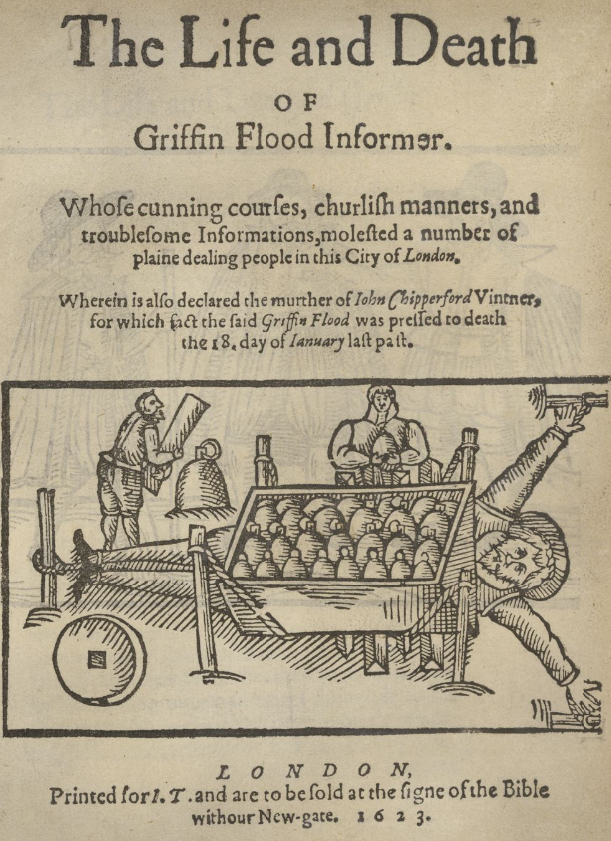
A pamphlet from the year of Flood’s execution saw the unpopular man denounced as ‘churlish’, ‘stubborn’, and ‘unruly’. Its title page offered a woodcut illustration of Flood’s death in the pressing yard of Newgate Prison and accused him of having ‘molested’ ordinary Londoners for many years before going on to fatally stab a wine-seller and injure a constable.
Despite being a convicted killer, most of Flood’s notoriety arose from his occupation as an informer. This was, in technical terms, one who was permitted by the aldermen of London to bring prosecutions against illegal traders and other miscreants in the Mayor’s court for a monetary reward. Put simply, Flood was a professional snitch.
Commerce in London had since the 12th century been strictly regulated and overseen by livery companies. By the 17th century, these professional associations were so deeply embedded in the city’s municipal structure that it was unlawful to trade goods or offer services if you were not a ‘freeman’ of the relevant company. This status was typically attained after completing a seven-year apprenticeship under one of its members.
In the winter of 1612, Flood took aim at a tapster who had served beer despite not being a freeman of the Worshipful Company of Brewers and, to make matters worse, was overcharging for it. He had prosecuted two ‘foreign’ textile workers at the beginning of the year and, in July, encouraged the prosecution of ‘hucksters, higlers and forestallers’ who operated in London’s markets. These are a few of the archival records historians Mark Jenner and Lena Liapi have uncovered which show Flood regularly working for local authorities.
When informing work dried up or was denied by the aldermen, who feared the court was being overburdened by too many lengthy cases which often proved unfruitful, Flood quickly found other work. This included a seven-year stint expelling newcomers from his home parish of St. Stephen Coleman Street (where overpopulation was rife) and a brief gig as a keeper of Moorfields, which saw him stop people trampling on the grass or engaging in other disorderly conduct, at a salary of £15 a year.
The dark side of Griffin Flood
Flood also had a nastier side to his character which landed him in court on multiple occasions, Jenner and Liapi have found. He was hauled before the city’s aldermen in 1609 for a drunken assault on his wife, Dorothy, which was apparently so severe that it frightened his neighbours; when a constable tried to arrest him in 1616, Flood resisted and hurled abuse at him; a few months later he upset residents by blocking a water gutter; and in the following year his wife again complained of his behaviour towards her.
But it is the 1624 pamphlet purporting to recount his ‘life and death’ which contains his most vile and despicable deeds. The anonymous author claims Flood used his profession as an informer as a guise under which to bully and extort those who had breached trading laws, even if inadvertently or on the most minor technicalities. Flood, we are told, was ‘a fellow of meane birth, rude bringing up, ill instructed in eyther learning or good manners, harsh in speach, and churlish in condition, full of quarrels, stubborne and unruly, and in briefe, of a most debauched condition’.
As a young apprentice currier — someone who dressed leather after it had been tanned — he quarrelled with his fellow apprentices and relentlessly threatened to report them to their masters with false slanders until they offered money to buy his silence.
When Flood eventually became a freeman of the city and an informer, he took to patrolling taverns, alehouses, bowling alleys, and theatres, hoping to catch sight of youths skipping out on mandatory church service. Under threat of reporting them to their parents or masters, they would pay up ‘before their names and credits should come in question’.
Flood honed and developed his methods of deception over the years, initially exploiting his relative obscurity to pose as a well-wisher willing to defend an unfree trader against informers who threatened their livelihood. His later strategy was to lodge a case against offenders in the Mayor’s court, which meant no other informer could initiate legal proceedings, but promise not to advance it if his victim coughed up a monthly fee. This was a cunning bit of trickery which was probably necessitated by Flood’s growing reputation as a villain.
Nor was he shy about his exploits but boastfully bragged about them, and in one triumphant moment — probably after a particularly profitable prosecution — is said by the pamphlet’s author to have stood ‘in the middle of Guildhall, with his armes akimbo on both sides’, exclaiming that he was ‘the veriest knave in all England’.
Flood certainly appears to have had a keen grasp of the law, for there was no technicality too small or trivial that he would not seize upon to harass those who broke the rules. We are told that when he witnessed a poor shear-grinder’s own father lovingly offer to turn the grinding stone for him (saving him the expense of hiring a worker), Flood was not only shocked that the trader was, technically, violating trading laws but also that his mere presence had not stopped them: ‘My friend, quoth hee, how darest thou bee so bold as to set a Forreiner on worke, knowing that Flood stands here as a witnesse; I tell thee I will make thee repent it.’ The pair were fined.
This anecdote is one of many instances where Flood is rebuked as acting with ‘shame and disgrace’ despite technically upholding the law. It is clear that his methods were legally sound but brought him a reputation for cruelty.
The informer’s first taste of humility came when he was imprisoned after an alewife he had been extorting attacked him and falsely accused him of attempted murder and sexual assault in order to rid herself of him.
But Flood does not appear to have engaged in much introspection while in prison. The author of the 1624 pamphlet says he went on to harass and extort a ‘poore Flaxe-maid’ who had set up shop despite being unfree. After she did obtain her freedom, he spied on the woman, hungry to spot any transgression, and was eventually satiated when a travelling chapman illegally purchased some goods from her to sell in the countryside. The ensuing prosecution, which saw the maid fined and her reputation tarnished, reportedly caused her to hang herself.
The author also alleges that Flood was sacked as a keeper of Moorfields because he set up traps to ensnare those who tried to walk across the grass, which tore their clothing. Anyone who was rude towards him in response soon found themselves in the stocks.
Griffin Flood goes a step too far
It was a double knife attack, resulting in the death of a wine-seller and the severe injury of a constable, which ultimately put an end to Flood’s escapades. The pamphlet does not detail the circumstances surrounding this murder, the causes of which are unclear, but offers a crude woodcut illustration of the attack on its facsimile. The writer alleges that, ‘in an agony of wrath (furthered on by Satan)’, Flood stabbed the vintner John Chipperfield and also attacked a constable. The latter survived but Chipperfield died ‘after he had long lyen languishing’.
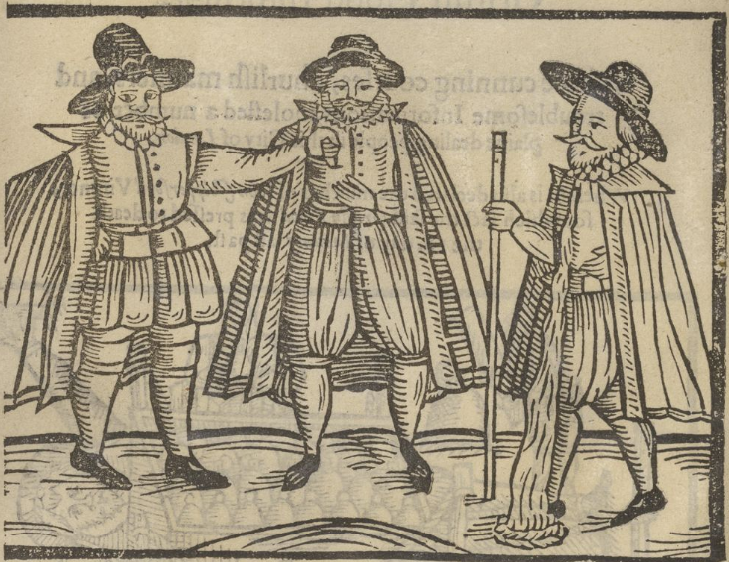
What drove Flood to kill isn’t known, but it’s tempting to think his brazen abuse of power had finally met firm resistance from the pair, one of whom was also employed to keep the law.
He certainly seems to have been hated by this point and after his imprisonment was regularly mocked and tormented by the public. This included a group of tapsters who took revenge against him for his previous informing by guzzling down beer in front of the parched prisoner, tossing to him only their empty cans. He was also apparently tormented by nightmares and visions.
For upon a night in New-gate as hee lay in his bed, in his dreame a fearfull vision appeared unto him, which was (as hee thought) the ghastly shape of the man hee had murthered, with a bleeding wound in his brest gaping wide open, threatning as it were a speedy revengement, at which Flood in his sleepe cryed out most fearefully, the Diuell, the Diuell pursues me, helpe, helpe, hee will teare me in pieces…
Anonymous, ‘The Life and Death of Griffin Flood Informer’ (London, 1624), sig. C3r
On the 18th of January 1624, Flood’s ‘wicked courses’ were finally halted after he was executed by pressing — one of the most excruciating forms of punishment and torture which was still used in England — at Newgate prison.
A criminal twice pressed
But as with many criminals in the early modern period, Flood soon found himself subjected to the press for a second time with the printing of a topical pamphlet, thanks to which his most scandalous deeds are known. Its publisher was John Trundle, a prolific bookseller who specialised in sensational news reporting. He was not the most reliable of sources, having informed the London public 10 years earlier that a dragon was roaming around in Sussex, burning people and livestock to death, but this report was probably more factually accurate.
Its birthplace was the printing press of George Eld, a successful printer and one of two who had been granted a monopoly over the printing of all bills and petitions on the behalf of prisoners in 1617. It was not uncommon for booksellers, printers, and writers to develop networks within prisons, but Eld’s particularly privileged position may have helped him obtain detailed information about Flood’s incarceration.

We also know a vintner name John Chipperfield was active in London at around this time and as bold as publishers were when peddling lies for profit, it seems unlikely that Trundle would have spread such an easily debunkable falsehood. He delegated the actual selling of the pamphlet to John Wright, who had a much better reputation for accuracy.
A ballad was also produced about Flood’s crimes and execution. It has not survived but is mentioned in a contemporary play, A Cure for a Cuckold, by John Webster, William Rowley, and Thomas Heywood, when one character references ‘the Ballad of Flood that was prest’.
If Flood desired notability, he had achieved it — but at the expense of being liked. His incessant ranting and railing, which did not cease even when he was imprisoned, meant other people ‘accounted him rather a monster than a man’, while his blasphemy and swearing sparked allegations of atheism.
Griffin Flood was an arrogant and spiteful man who had little care for others and even fewer friends. But he was above all an instigator of ‘arch knaveries’ who would probably have blushed at his portrayal in the pamphlet as a cunning rogue who manipulated and deceived his way into infamy.


