
Dragons, lions, and bears were a familiar sight on the streets of Tudor and Stuart England. That these beasts were formed of paint (not flesh) and were imprisoned within the confines of wooden signboards probably extinguishes much of the interest this fact may have piqued in a reader — but the signs which adorned taverns, alehouses, and tradesmen’s shops were very important indeed.
Not all signs were so intriguingly illustrated, many bearing a simple star, bell, or deer. Their purpose was to identify the establishment to which they were attached, so that anyone in search of such services as lodgings or a new pair of shoes could find them with ease. These illustrations did not usually identify the nature of the business itself, as this could be accomplished by prominently displaying an article of the trade in public view.
Most of England’s population being illiterate, pictorial identifiers meant prospective customers of all social status, including travellers unfamiliar with local urban geography, needed only enquire about a business’ sign in order to orient themselves.
Though the precise choice of animal or object could be ostensibly arbitrary — largely defined by a need to distinguish oneself from others nearby — signboard illustrations nonetheless came to occupy a prominent (and at times rather peculiar) position in the country’s collective imagination.
Undoubtedly the place with which signs were most readily associated was the alehouse. The Romans had identified their taverns by hanging vines outside, though publicans in the cold and miserably wet England they invaded had to settle for bushes. This practice persisted even into the 17th century, as some signboards were accompanied by hanging shrubs.
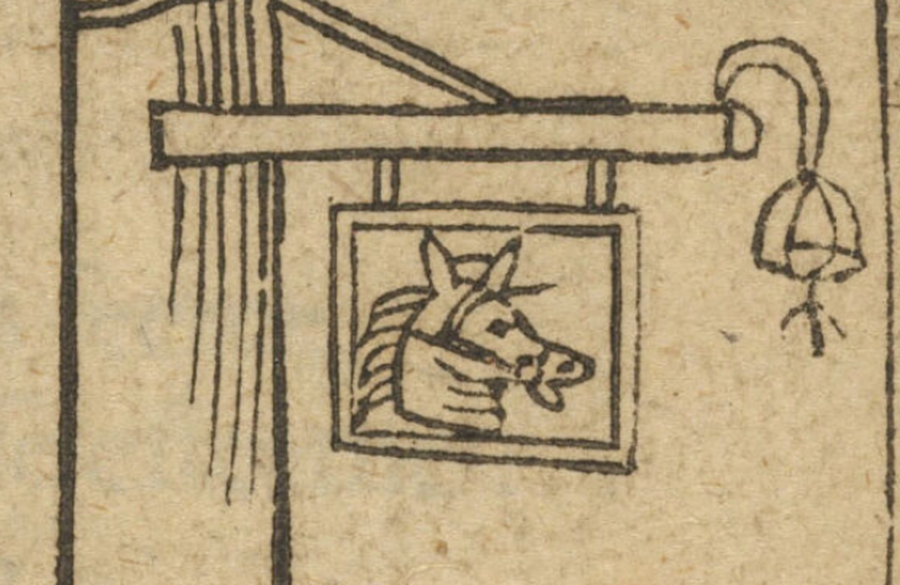
Certain drinking establishments gained reputations for serving particular trades and types of people. One balladeer, writing in about 1640, played on this phenomenon by linking these groups to the signs which best related to them:
The Ladyes will dine at the Feathers,
Londons Ordinarie, Or Every Man in his humour (c. 1640)
the Globe no Captaine will scorne:
The Huntsman will goe to the Greyhound below,
and some Townesmen to the Horne
For travellers, the sight of a painted sign suspended from a bar which jutted out over a doorway was a welcome one — and publicans had profit aplenty to make. A printed ditty from 1632 which heartily praises the “vertues” of barley (from which beer is brewed) told readers that “Twill make a poore man rich to hang/a signe before his doore”.
The alehouse included in the title page illustration of a pamphlet of similar sentiment published 10 years later features a signboard (probably depicting a fox) with an ale flask positioned on top of it — a way to quickly let passers-by know that alcoholic refreshment could be found within.


When, nearly 20 years earlier, the bookseller John Trundle had desired a woodcut to accompany his ballad warning “swearers and drunkards” of strict legislation newly passed by parliament as part of a crack-down, he included a signboard bearing a rose. That this hung above a vomiting man with a smoking pipe in hand and all manner of drinking vessels laid out before him meant readers could not mistake the scene for anywhere else but an alehouse. (There even appears to be a chamber pot beneath the table.)
The indefatigable Stuart writer John Taylor — an early journalist who styled himself the “Water Poet” — undertook what he described as a “circular perambulation” of all the taverns in and around London’s 10 shires in 1636. This pub crawl saw him document just shy of 700 drinking establishments, grouped by the type of sign they bore. For each one he provided a witty epigram.
Of those bearing a picture of a fountain on their sign, he writes:
These Fountaines are not Proud, like many a knave
Taylors Travels and Circular Perambulation (1636)
That brags of goodness, yet no Goodness have:
The Fountaines promise Water, yet affoord
Good Wine, and so are better than their Word
The following year, Taylor published The Carriers Cosmographie (1637), a compendium of information which told the reader which alehouses pedlars from specific places used as lodgings. If, for example, you wanted to have your wares taken to Sheffield, you’d find the right people at the Sign of the Castle in Wood Street. This innovative and extraordinarily useful piece of work demonstrates just how important identifying the right taverns could be.

The above depiction of a busy street in 1636 comes from a ballad celebrating the “overthrow” of hackney coaches, and may well have been penned by Taylor, who regularly railed against them. By trade he was a waterman, one who ferried passengers across the River Thames for a fee, and had been long before he put quill to parchment. It was this profession which was under threat from these speedy new vehicles. Many Londoners also complained that horse-drawn carriages exacerbated the city’s existing problems with over-crowding and noise. The ballad hailed the increasing popularity of sedan chairs, which were significantly quieter and took up less space.
It is thankful the only sense impacted by this illustration is sight, for the scene is evidently a fetid one; A man shovels manure, a woman defecates on the street, a pig roams freely about, and one householder throws waste from a chamber pot out of her window, almost directly onto a passer-by below. In the doorway we can see a man with two horns atop his head — the familiar image of a cuckold. Just to the right, above a travelling sedan chair, is a signboard which seems to show a pig, or some other animal, eating from a pot.
This is clearly a deliberate image and probably communicates something similar to the Dutch proverb “to find the dog in the pot”, i.e. that the dog has eaten your dinner before you could get to it. Here, it likely means the husband has lost his wife to another man — demonstrating that the sign of a building could be used to represent (or ridicule) the person who dwelt inside.
John Taylor was himself a publican towards the end of his life — under the sign of the Crown. A staunch Royalist, he began referring to it as the Mourning Crown after King Charles I’s execution in 1649. This drew the attention of the authorities, however, and so he commissioned an illustration of himself and his alehouse went by the Poet’s Head. The signpost had become an unlikely site of political tension.

The sign besides which the above pair of blacksmiths in a 1635 ballad illustration ply their craft does not in fact belong to them. The latticed window and table laden with jugs, flasks, and flagons identifies the establishment as an alehouse. When tradesmen found themselves in business next to, opposite, or in the immediate vicinity of a signposted building, it was not uncommon for them to locate themselves relative to it.
The bookseller John Grove simply listed his address in 1658 as “betwixt S[aint] Katherines Stairs and the Mill, next door to the sign of the Ship”. This perhaps risked sending customers in the wrong direction, but saved the time, money, and effort he would otherwise have to spend on constructing a sign himself.
The benefit of having your own sign was that it could develop an identity of its own, bringing a fair bit of publicity. The proprietor of the “Three Dancing Bears” in St. Katherine’s found his sign included in Ben Jonson’s The Masques of Augurs (1622) as part of a ballad featuring a bear-keeper and three dancing bears, which would go on to be printed.
There is even a subtle reference to a popular shop sign in Shakespeare’s The Tempest (1611) — first spotted, to my knowledge, by historian Tiffany Stern. In one scene, Ariel, an invisible spirit, begins playing a tune on a pipe after the jester Trinculo complains that his friend, Stephano, is singing a song out of tune. When Stephano asks where the music is coming from, Trinculo replies: “This is the tune of our Catch, plaid by the picture of No-body.”

This is an allusion to Ariel’s invisibility, but also a subtle reference to the bookseller John Trundle, who frequently traded in ballads meant to be sung aloud. From the early 17th century, he ran his London publishing business out of a shop in the Barbican at “the sign of No-body”. This was a satirical nonsense character — a man lacking a torso with whom one could down a flask of ale yet still truthfully declare, “I drank with nobody”. The persona was featured prominently in a play Trundle had sold in 1606 and the woodcut which accompanied it (pictured above) was likely near-identical to the image on his sign.
Alongside publicans, it was booksellers who most commonly used signboards to distinguish their shops. Indeed, historians find a huge database of shop signs and locations in the form of books’ title page imprints, which typically gave the sign of a bookshop alongside the street or area in which it could be found.

It was also common during the Tudor period for those who ran publishing operations — which included both printers and booksellers — to include an illustration of their signpost’s image at the end of books. In places where there were dozens of bookshops crammed in close proximity, like St. Paul’s Churchyard, which was England’s literary hub, this clear identification was crucial to a business’ survival.
Though signs were supposed to be helpful geographical markers, one popular 17th century story turned one into a tool of deceit. Thomas Brewer’s The Life and Death of the Merry Devill of Edmonton (first published c. 1608) barely features its titular character, the magician Peter Fabell — included only as an attempt to exploit the popularity of a contemporary play about him. Instead, it follows “the merry jests” of a blacksmith named Smug.
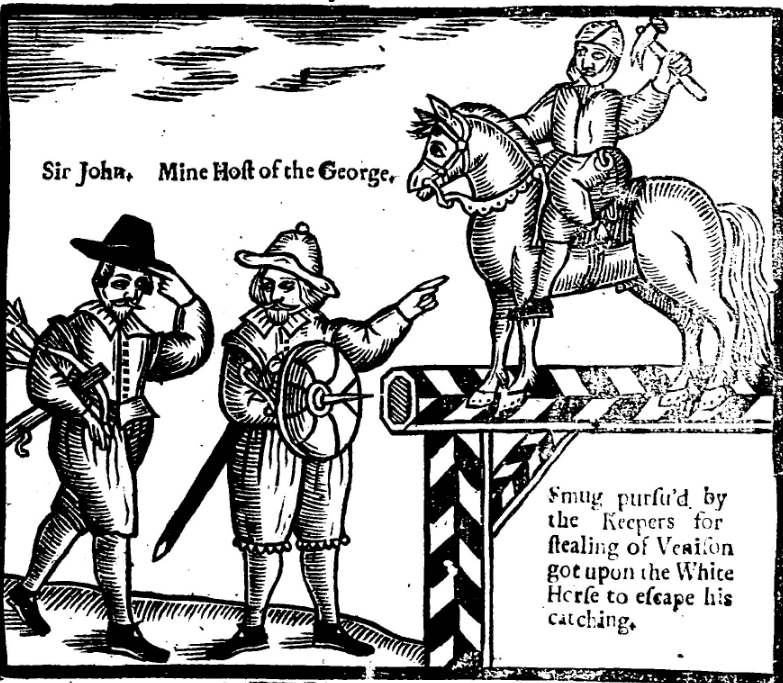
Smug is a sympathetic troublemaker, rascal, and part-time poacher who tries to steal venison from a park. Spotted by two gamekeepers who begin to pursue him, the blacksmith devises a cunning strategy: spying the sign of the White Horse inn before him — not painted on a board but carved like a sculpture — he quickly climbs on its back and raises his hammer into the air.
Smug’s hope is that the keepers will come across the sign and believe it to represent St. George, a common illustration which depicted England’s patron saint atop a white horse with sword in hand, passing him by unnoticed. This trick was clearly thought to be the tale’s most notable, since it features on the title pages of most editions of the story, which was re-issued for decades.
And it worked: Smug escaped the keepers using only his wit. If his pursuers had noticed he wielded a hammer instead of a sword, they would probably have put it down to shoddy craftmanship on the part of its sculptor.
After all, shop signs back then were not grand works of art, deserving of preservation, and so rarely survive to the present day. But even today you’ll spot an illustration hanging outside nearly every pub in Britain, though most make sure to have accompanying text. They may not be the most fascinating parts of England’s history — packed with rebellions, scandals, and captivating personalities — but the next time you come across a humble sign, maybe you’ll think of the people to whom they once offered a sense of direction and even a little entertainment.


I enjoy reading the works of the water poets, from pubs to fish types, Taylor offered something unique… also, his constant fear of offending Ben Johnson adds some charm… Wonderfully written post.