On 19 January 1726, two English ships anchored in a small bay on the coast of a remote island in the South Atlantic Ocean. More than 900 miles from the African coast, and even further from any other land, the sailors had no intention of lingering — and only docked because one of the vessels was in need of urgent repairs.
Ascension Island is the tip of an undersea volcano that breached the waves about a million years ago. It is desolate and rocky, studded with volcanic cones, craters, and lava fields. At 34 square miles, the island is a tiny speck of land between Brazil and Africa that is practically invisible from space. With scarce rainfall and scorching temperatures, the soil is naturally difficult to farm. The Atlantic’s violent waves have deposited enough sand for a only few scattered beaches to form on Ascension’s shoreline. It is almost like another planet.
The two East India Company ships — the Compton, which had sprung a leak, and the James and Mary — landed near one of these beaches, at Clarence Bay, where passing vessels sometimes docked when travelling between Europe and the East Indies. A few English sailors went ashore to look for green turtles, of which the island boasted a famously large colony. Kept alive on the ships to remain fresh, some could be eaten during the homeward voyage; the rest would be sold, at an attractive price, to the wealthier citizens of London.
But while hunting for these tasty turtles, the sailors stumbled across something surprising on the beach: there was a tent, with bedding inside. They also found a kettle, tea, pipes, and — most remarkably of all — a journal. It was written by a Dutch mariner who had been exiled on Ascension Island in May 1725 after being convicted of sodomy aboard a Dutch East India Company ship. The English sailors searched for hours, but there was no trace of the castaway.

His name was Leendert Hasenbosch, and his body was almost certainly still on the island. Hasenbosch was probably 30 years old when the VOC Prattenburg unceremoniously dumped him on Ascension after he was caught having sex with another man on board. The sailor’s salary log recorded that “he was sentenced to be set ashore, being a villain”.
Hasenbosch had joined the Dutch trading company as a soldier in 1713 and risen, in the subsequent 12 years, to become a low-ranking bookkeeper, overseeing the ship’s journal, its muster rolls, and other registers. This slight status perhaps saved him from being thrown overboard, as his sexual companion may have been, but he was convicted of sodomy nonetheless. On 5 May 1725, Hasenbosch was marooned on Ascension, with only a survival kit containing the bare necessities for his sustenance — water, onions, peas, chickpeas, rice, a frying pan, a hatchet, and a tinderbox.
Everything else we know comes from the journal Hasenbosch kept for a little over five months on the island. It had been taken back to England by the sailors who discovered his belongings and, translated into English, was printed in three editions between 1726 and 1740. Historians believe the first to be the most accurate. Though it was titled Sodomy Punish’d (1726) and included a hostile preface which condemned the sailor, the contents of the journal — which oscillate between his miserable struggles to survive and long stretches of comfortless boredom — must have induced a little pity in even the sternest of readers.
With not enough food or water to last him more than a few weeks, Hasenbosch was forced almost immediately to become an unwitting geographer of Ascension. “I went on the Hills, to see what there might be on the other side of the Island proper for me, or any Greens or other Things to subsist on,” he wrote on the second day of his abandonment, “but to my sorrow found nothing worthy of notice. I sincerely wish’d some Accident would befall me to finish these my miserable days”.
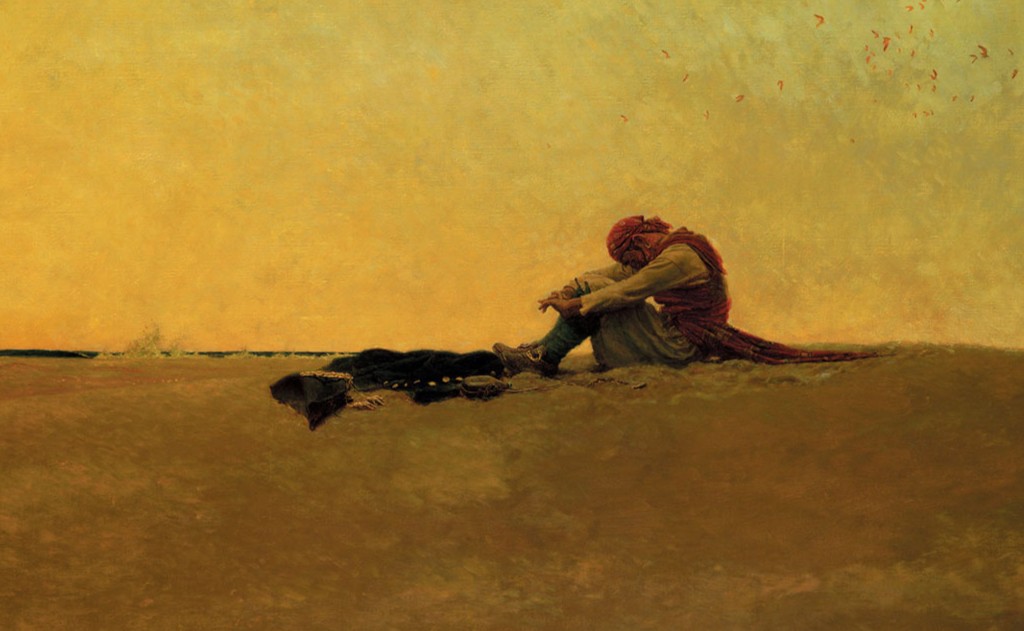
Hasenbosch set up his tent — which he secured with stones — on the beach where he had been left, and erected a white flag on a hill near the sea in the hopes that a passing ship might come to his rescue. Courtesy of the seabirds and turtles he found and killed on the island, Hasenbosch ate surprisingly well. But hydration was another matter. Much of the sailor’s journal recounts his unsuccessful search for a reliable fresh water spring.

By early June his water casket was empty and he made many fruitless searches for water sources. There were two on the island. One was a strong spring which had saved the English explorer William Dampier and his crew in 1701, after the HMS Roebuck sank off the island’s coast. The other was a weaker source, erroneously known as “Dampier’s Drip”, which Hasenbosch found later in the month but could not rely upon for more than a couple of weeks.
Hasenbosch began to dig a hole in desperation, hoping he might reach water. His shoes were disintegrating by this point and his firewood fast running out, without which he could only eat raw meat. Dampier and his men had been rescued after five weeks. Though Hasenbosch looked out at the sea stretching infinitely beyond him in all directions, and sometimes tricked himself into thinking he spied sails in the distance, there was to be no such deliverance for him.
Between his want of water and the island’s sweltering heat, Hasenbosch began to experience vivid hallucinations. He linked these visions to his guilty conscience. On June 16, he wrote that in the evening:
I was surprised with a Noise of the most horrid and dreadful Swearing and Cursing, mixt with such Blasphemous Discourse, that no humane Creature can express, nor dare I write it with my Pen; it seem’d to be as tho’ all the Devils had broke out of Hell. I was certain there was no Man on the Island but my self, and yet I felt my self pull’d by the Nose, Cheeks, &c. and beat all over my Body and Face. […] They tormented me without ceasing in this manner for several Hours.
Leendert Hasenbosch’s journal, as recorded in Sodomy Punish’d (1726)
Two days later, Hasenbosch had a vision in which “appeared to me the Resemblance of a Man I had been well acquainted with, whose Name I am afraid to mention”. This apparition — presumably a past lover — soon vanished, but reappeared regularly. “He haunts me so often, that I now scarce mind him”, Hasenbosch wrote in his journal. By the end of June, Dampier’s Drip had dried up and Hasenbosch fell once again into despair.
Over the next few months he explored much of Ascension in search of water and firewood, making new tents for shelter and praying constantly for rain, which he very rarely received. By this point, Hasenbosch had resorted to drinking the blood of turtles he had killed, along with the water he found in their stomachs, and his own urine. On 24 August he recorded: “This Morn I fetcht my bowl full of Eggs, then boild some Tea in my own Urine, which in the miserable Times tasted tolerably well.”
At his most desperate, the sailor even drank urine from the bladder of a dead turtle — which, “to my great Astonishment, proved as cool as Ice, and tasted like Rain Water, but somewhat bitter, so that I drank the whole Bladder out with a good relish”.
The final diary entry, dated between 9 and 14 October, tells us only that Hasenbosch “lived as before”. The editor of Sodomy Punish’d (1726) postulates that the castaway may have died by suicide, thirst, sickness, or perished in a fatal accident — if he was not rescued by a passing ship. Given that Leendert Hasenbosch has not been found in any archival record since his marooning, it seems almost certain he died on Ascension Island in October 1725.

In 1726, as those English sailors returned with the journal they had found on Ascension, a high-profile sodomy trial took place in London; it resulted in the execution of three men. This made Hasenbosch’s story especially relevant. A publisher called James Roberts, who operated a popular bookshop in London, soon had the Dutch sailor’s papers translated and available for purchase as a small pamphlet. The original journal has since been lost or destroyed.
It also helped that the first edition of Daniel Defoe’s novel Robinson Crusoe (1719), about a castaway’s struggle to survive on a desert island, had been released only seven years earlier. When Sodomy Punish’d (1726) was republished in two further editions — An Authentick Relation Of the many Hardships and Sufferings of a Dutch Sailor (1728) and The Just Vengeance of Heaven Exemplify’d (1740) — the influence of the novel was even clearer.
In the 1740 edition, the editor fabricated details to make the narrative more gripping: Hasenbosch’s skeleton was said to have been found with his journal, which ends mid-sentence, as if the sailor had perished in the act of writing. The illustrator of its frontispiece engraving also took inspiration from the one which adorned Robinson Crusoe (1719). In both, the castaway can be seen (somewhat beyond rescue in Hasenbosch’s case) beside their makeshift habitation, with a ship approaching in the background.
Indeed, Hasenbosch’s tale is so like an adventure story that it was for many years thought to be almost entirely fictionalised. In 1728, the publisher put the original manuscript on display in his shop so incredulous readers could satisfy themselves. The story had international appeal, too: it was printed in Dublin in 1726, before crossing the Atlantic to New York and Philadelphia in 1748.
Only in 2002, after a thorough examination of the relevant archives, did the Dutch historian Michiel Koolbergen discover Hasenbosch’s identity and confirm the core details of his story. This was a necessary endeavour because in 1978 the American writer Cy Adler, under the pseudonym Peter Agnos, released The Queer Dutchman, which claimed to be based on a copy of the original journal found tucked away in the New York Public Library. Here, Hasenbosch is renamed Jan Svilt, is tortured into confessing that he kissed a cabin boy, and has a much more headstrong personality. Every single one of these new details was, unfortunately, a fabrication.
Hasenbosch’s story crops up occasionally these days as an example of how gay people were treated in the past. A fictionalised version of Hasenbosch’s marooning, Ascension, was performed at the Edinburgh Fringe festival in 2024 and 2025, starring Dan Hazelwood, also the play’s writer, as the abandoned Dutch sailor. There is no happy ending here, as indeed there was not in real life, but it is still tinged with hope. If only because in seeing the terrifying ordeal to which a gay man was once subjected on account of whom he loved, we can appreciate how far we’ve come.