This week’s newsletter largely builds on my most recent article, which is about a compendium of (mostly quite trivial) information published in 1651. It was “collected”, not authored, by John White and published first by William Gilbertson before a string of other booksellers sold it in at least seven further editions, which were often revised and expanded. It contained guidance on catching fish, telling the time at night, sending secret love messages, and building pyrotechnic devices.
White was studious in his compilatory efforts and there were far too many experiments, tricks, and other conceits for me to include them all in the post. A 1689 reprint of the pamphlet, which claims to be the “Sixth Edition, with many Additions”, can be read for free on the Internet Archive, though it is not in the best condition.
A lot of the entries can be easily tried at home and someone with the prerequisite time, money, and effort could test the more elaborate pieces of advice — like building a mechanical fire-breathing dragon — in what would probably make for an entertaining television show or YouTube series.
Please enter your email address above if you’d like to be notified whenever a new post/newsletter is out.
Featured Woodcut
The below woodcut comes from a pamphlet sold by William Gilbertson in 1650, the year before White’s pamphlet hit the shelves, under the title of Englands Summons: Or Londons Alarum From Heaven.
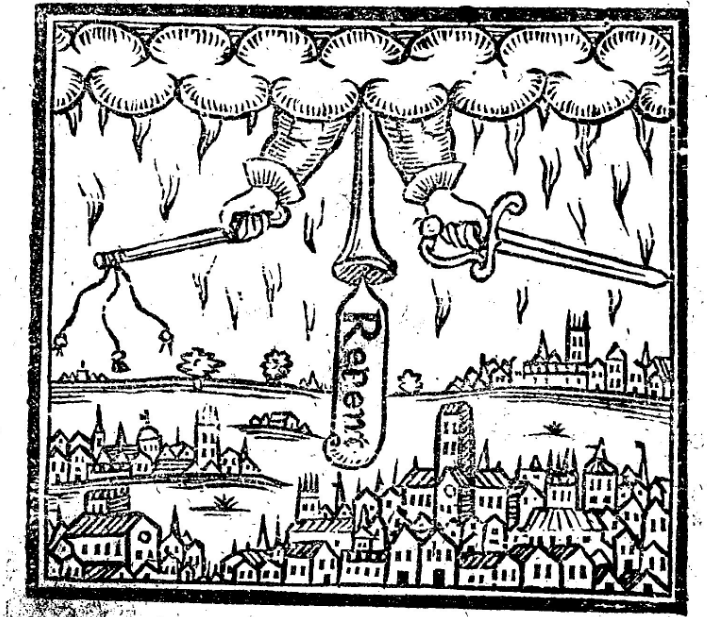
Curiously enough, the title page of this text tells us it was “Collected by J. W”, which is identical to the byline given on A Rich Cabinet (1651), and so it is possible this is also a work by John White, though there is no further evidence for this.
There is an “explanation of the Emblem” (i.e. woodcut) at the beginning of the tract which somewhat insults the intelligence of its readership by explaining what would assuredly have been obvious to them, if only through sheer exposure to this type of providential image. Dozens of images of this type, and many more written examples of the allegory, survive from the early modern period; the hands of God descend from the heavens with a three-tailed whip (representing the three scourges of war, famine, and plague) and a sword for vengeance. This appears to be accompanied by a violent lightning storm, and in-between the two arms is a trumpet warning London to “Repent”.
There had been a small outbreak of plague in 1650 (a regular occurrence at this time) and London’s food supply had been significantly disrupted by the Civil War, but it was of course the deadly conflict itself — which had seen some 200,000 people die across the British Isles — which would have been most of the minds of the author and his audience. That same year Charles II had been crowned King of Scotland, prompting an English army under Oliver Cromwell to invade their former allies.
The body of the text is a religious admonition structured by various intertwined Bible verses — far more than the average printed sermon, which probably suggests a weakness on the part of the writer’s own rhetorical skills then any particular affinity with the source material.
It was printed primarily in the black letter font, suggesting its contents had been tailored to a less elite (but still literate) audience. The author thought it fit invoke the description of a “sinful nation in” Isaiah 1:4-6 as an apt description of the Commonwealth of England:
We are a sinfull people laden with Iniquity: The whole head is sick, the whole heart is heavie, from the sole of the foot to the crown of the head, there is nothing whole therein, but wounds and swellings, and sores full of corruption
Other magic tricks and strange pursuits in early modern England
On a lighter note, here are some of the most interesting “inventions” found in John White’s A Rich Cabinet (1651) which I could not find room to include in my article:
You could tell the phase of the moon by looking at your cat’s eyebrows, apparently. White says “Our common house Cats also have this propertie by the subjection that the Moone hath over them; that their Eie-browes doe increase, or decrease each day, according to the course of the Moone and her aspects”.
How to burn a piece of paper with writing on it and make the text transfer to your arm: to achieve this feat (which was maybe a risky magic trick at a time when witches were still being hanged!) you need to dip your pen in water and scratch the words onto your arm. Then, putting your sleeve back down, write the same words in an identical fashion onto a piece of writing paper in front of your friends. Next, burn it in a fire and retrieve the ashes; then roll up your sleeve and rub the ashes onto your arm. The ash will stick to the wet areas, meaning the text “will plainly be read on your arm in black letters”.
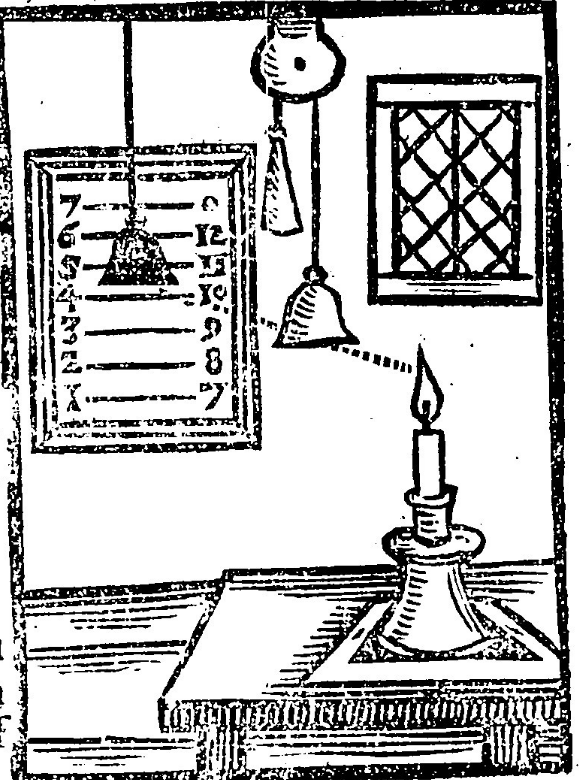
The image above accompanied instructions on how to build a “Candle-Dyall” in order to tell the time at night. I imagine this could actually have been quite a useful little contraption at a time when houses did not have clocks or other time-keeping devices. White says he came up with this idea himself. It required putting a square wooden frame on your wall with the numbers 1-12 (and 0) laid out as can be seen above. Then a pulley had to be installed on the ceiling, with two lead plumb lines attached by string, one with a broader base.
You then pull the broader-based bit of lead down until its shadow is cast on the bottom of the wooden board, and mark that point with a line of ink. Wait an hour (using an hourglass as a timer) and mark the shadow’s location again. Take a compass and, measuring the rise, you can plot the remaining lines yourself without having to wait. This apparatus can now be used to work out how many hours of the night have passed. Once the shadow reaches the top, you can manually lower the plumbline and reset it at the bottom (now looking at the numbers on the right, rather than the left).
At the same time White’s A Rich Cabinet (1651) was being sold, customers at Gilberton’s shop at the Sign of the Bible in Giltspur Street could also purchase an updated edition of Thomas Hill’s Natural and Artificial Conclusions (1581), which was purportedly a translation of a work by Italian academics at the University of Padua.
Quite a few of White’s curiosities were taken from this text, which included a great number of bizarre instructions. Among its treasures were entries about “how to kill fleas divers ways”, “how to make a light in the night time, that all things about thy Hall or Parlour shall appeare in sight both blacke and green”, and “how to make thy Chamber appear full of Snakes and Adders”.
Hill also offered advice on making a person “see fearefull sights in his sleepe”, which could be accomplished by smearing some lapwing blood on the target’s forehead. In order to have pleasant dreams, Hill added, one should eat nightshade, mandrake, or henbane.
You could also emulate Jesus by turning water into wine yourself if you followed Hill’s advice — “a proper secret”, we are told, in this printed pamphlet intended for mass publication. This was, unsurprisingly, a little trick whereby a powder acquired by distilling wine and drying the product could be added to water to make it look and taste like wine.
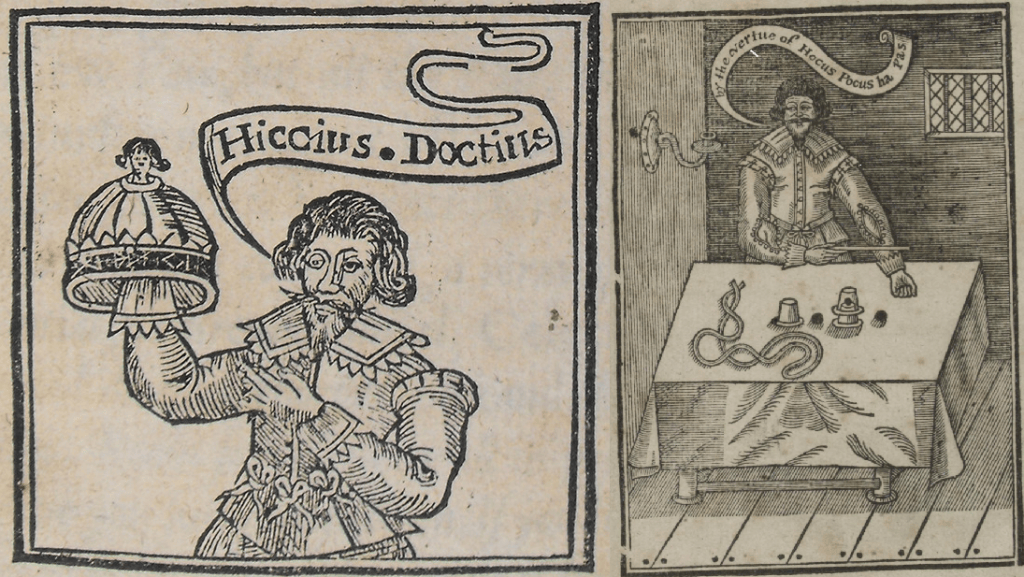
By the late seventeenth century, both John White’s A Rich Cabinet (1651) and Thomas Hill’s Natural and Artificial Conclusions (1581) were being sold as whimsical collections of magic tricks — both under the title of Hocus Pocus, a term which was associated with sleights of hand and deceptive trickery. The woodcuts above could be found in various copies of a popular pamphlet titled Hocus Pocus Junior (1634) which went through many editions. The one on the left shows the “bonus genius” trick whereby a small wooden doll can be covered with a cape and appear to vanish. The cups and balls in the right illustration are a familiar sight at magic shows today.


