Any radical thinker would like to take credit for the American Revolution, that most noble of political uprisings which set off a chain reaction of rebellions in the name of liberty. But the messy moral equation behind the Founding Fathers’ cause does not lend itself to any easy calculation of variables.
Certainly John Locke, the “father of liberalism” and great expounder of accountable government, is in there. With a magnifying glass we might discover, scattered about our formula, the small army of British Whig writers to whom he was an intellectual hero. Lesser than Locke, but by no means negligible, is John Milton, whose poetical genius was rivalled only by his talent for penning pamphlets justifying the right of the people to depose, and even execute, a tyrannical monarch.
The equation is self-referential, too. The Founding Fathers were not merely intellectual receptacles, but thinkers in their own right, who influenced themselves and one another. Thomas Paine, of Common Sense fame, was among them — and must be near the heart of our calculation. Franklin, Jefferson, Hamilton, Madison, and Mason are surely not far away.
Born in Virginia in 1725, George Mason is not among the best-known Founding Fathers. With George Washington he wrote the Fairfax Resolves in July 1774, encouraging the colonies to unite against British oppression. Two years later, after rebellious fighting against King George III had broken out, Mason drafted the Virginia Declaration of Rights.
This document, which influenced the famous Declaration of Independence ratified on 4 July 1776, opened with a now-familiar idea: “That all men are by nature equally free and independent, and have certain inherent rights … namely, the enjoyment of life and liberty … and pursuing and obtaining happiness and safety.”
Among the papers, petitions, and tomes scattered around Mason’s desk — or lurking in the memory of his revolutionary mind — were a few combative pamphlets by a man who, more than a century earlier, had been England’s foremost political radical: John Lilburne.
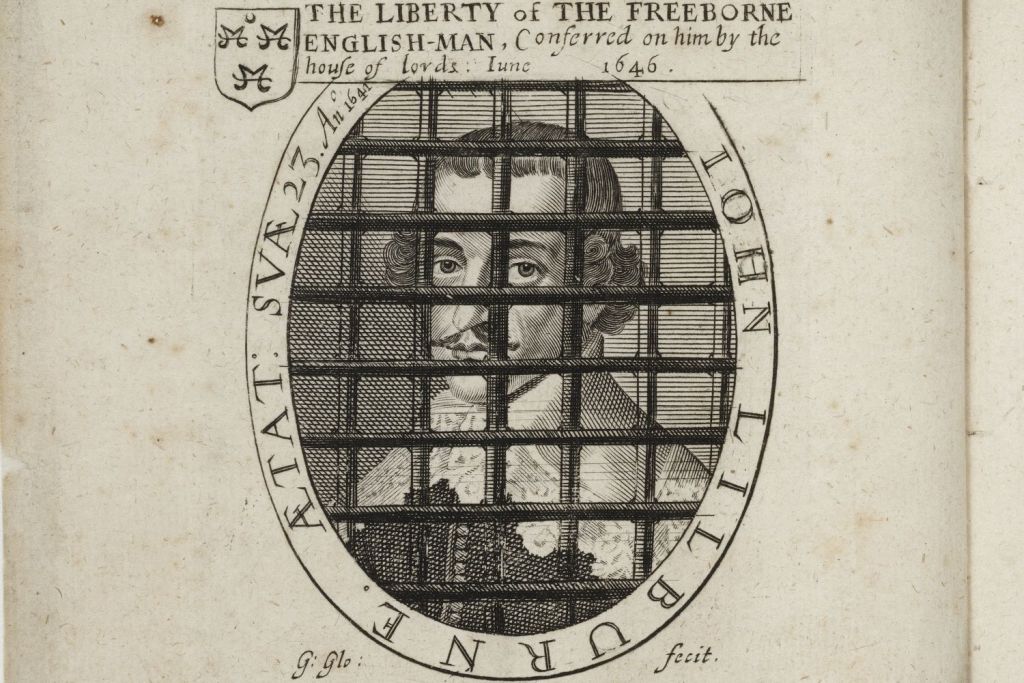
John Lilburne (c. 1614–1657) was one of the leaders of the Levellers, England’s first organized popular political movement. Consisting of yeomen farmers, disillusioned soldiers, and London tradesmen, these radical egalitarians took advantage of the opportunity for political upheaval which the chaos of the English Civil War offered.
Lilburne was the most vociferously controversial of a small gaggle of Leveller writers and regularly took aim at the leaders of the New Model Army. Possessing what one historian once called “a vocation for martyrdom”, most of his pamphlets were penned from the Tower of London and were accompanied by printed pleas for his release written by his friends.
He was imprisoned seven times; thrice put on trial for his life; twice prosecuted for treason and acquitted, to popular applause; and on one occasion banished from England for life — an exile which lasted not even two years before he illegally made his return.
Even Lilburne’s earliest brush with the law had profound consequences. In 1637, he was arrested for importing seditious Puritan pamphlets from Holland, but refused to testify under oath before the Star Chamber, protesting that “it is absolutely against the law of God; for that law requires no man to accuse himself”.
For this contempt of court, Lilburne received 500 lashings from a triple-corded whip as he was dragged by a cart from Fleet Prison to Westminster Yard and put in the pillory. He was then returned to prison — but not before embarrassing his captors by handing out to the crowd copies of the very books he had been accused of importing.
Lilburne’s refusal to swear the oath in court is now recognised as a key inspiration for the Fifth Amendment to the United States Constitution, which gives people the right to refuse to answer questions that might incriminate them.
After a stint in the Parliamentary army at the outbreak of the Civil War in 1642, during which he was promoted to the rank of lieutenant colonel, Lilburne joined the ranks of the Levellers. He churned out a stream of pamphlets in the latter half of the 1640s demanding religious freedom, the expansion of voting rights, reforms to taxation and the legal system, and the protection of ordinary people’s rights.
This was possible thanks to an underground network of clandestine printing presses operated by men sympathetic to his cause. The authorities tried their hardest to silence him nonetheless. Historian Ariel Hessayon writes that Lilburne “had more of his writings burned in England between 1640 and 1660 than any other author”.
In England’s Birth-right Justified (1645), Lilburne denounced monopolies and demanded laws be enacted in English, rather than Latin or French, so ordinary people could understand them; he railed against the militarized and tyrannical Rump Parliament in The Legal Fundamentall Liberties of the People of England (1649) and insisted the legal system have due process; in the opening salvo to The Free-man’s Freedome Vindicated (1646), Lilburne calls on his readers to lay down their life “for the defence of your just Liberties and Freedomes”.
Lilburne’s ideas made up a substantial part of the Levellers’ eventual proposal for a written constitution of England, titled An Agreement of the People. But this dream was never realised, and the Levellers’ influence diminished rapidly following the execution of Charles I in January 1649 as the Commonwealth government consolidated its power.
Lilburne remained a prisoner for most of the last 20 years of his life, though he was granted parole in his final months as his health deteriorated. He died on 29 August 1657, only in his early forties.

But Lilburne’s influence did not die with him, or cease with the collapse, only three years later, of the Cromwellian regime which had so relentlessly persecuted him. His ideas, and others articulated by the Levellers, retained a diminished currency in English political thought — and even crossed the Atlantic.
George Mason was clearly influenced by John Lilburne’s coining of the term “freeborn rights”, which is echoed in the Virginia Declaration of Rights (1776), and for which the English Leveller was affectionately known to contemporary supporters — and later intellectual admirers — as “Freeborn John”.
Mason was not alone. The historian F. K. Donnelly has observed that “Lilburne’s tracts were often cited in eighteenth-century American political pamphlets”.
He goes as far as suggesting that the famous last words of American spy Nathan Hale, who was hanged by the British in 1776 — “I only regret that I have but one life to lose for my country” — may have been inspired by a remark made by Lilburne at one of his many trials: “I am sorry I have but one life to lose, in maintaining the truth, justice, and righteousness, of so gallant a piece [i.e. one of his political tracts].”
The legal scholar Geoffrey Robertson writes that the Leveller manifesto The Agreement of the People — in which Lilburne’s pen played no small part — was “a draft constitution for a government as democratic as the times could conceive, comprising a sovereign parliament free of King and God, and bound only by the inalienable right of all citizens to equality and religious liberty”.
This prescient document, he adds, “has echoed down the corridors of history, offering inspiration to the drafters of American constitutional documents”.
Supreme Court Justice Hugo Black agreed, invoking Lilburne in a 1959 dissenting opinion which defended the freedom of speech of a college professor who had been convicted of contempt of Congress after refusing to answer questions about his affiliations with the Communist Party.
“The memory of John Lilburne — banished and disgraced by a parliamentary committee on penalty of death if he returned to his country — was particularly vivid when our Constitution was written,” the jurist observed, suggesting the House Un-American Activities Committee was trying to punish, humiliate, and publicly shame suspected Communists.
“His attack on trials by such committees, and his warning that ‘what is done unto any one may be done unto every one’, were part of the history of the times which moved those who wrote our Constitution to determine that no such arbitrary punishments should ever occur here.”

It cannot be denied that Lilburne’s political radicalism had an influence on the American War of Independence. His century-old works were probably read by some of the revolutionaries, or accessed in snippets in texts which referred to his tracts. And his ideas were undoubtedly diffused throughout the intellectual landscape of the eighteenth century.
But some caution must be exercised. British journalists and commentators of the 1770s made direct reference to Lilburne — typically when admonishing revolutionary thought — much more frequently than their counterparts across the pond.
Indeed, as John Rees has discovered, one American correspondent complained that legislators critical of Britain were presented as “so many Col. Lilburnes”. The Duke of Richmond, who supported the Patriots in their struggle for independence, was likewise branded the political descendant of “John Lilburn of notorious memory” by the loyalist press.
Comparisons could be favourable. When the radical English clergyman and politician John Horne was prosecuted in 1777 after encouraging funds to be raised to help the American soldiers injured at Lexington and Concord, his behaviour in court was likened by one newspaper to “the celebrated Col. John Lilburne … a man whose daring spirit gave Cromwell and his Council the greatest apprehensions”.
It may have been that the vanity of the British only allowed them to understand the disobedience of their colonies as the product of an equally disobedient Englishman. Or might the absence of Lilburne in some American accounts owe to their desire to be seen as forging a radical new path, and not following one long-ago trod by another man — and a man from England, no less?
The preeminent historian of the politics of the English Civil War, Christopher Hill, once wrote, probably too cautiously, that “it is unlikely that the ideas of the seventeenth-century radicals had no influence on the … American Revolution.” But, he warned, “such influence is difficult to prove”.
Perhaps, as Hill maintained in a 1976 lecture, it is safest to simply observe that “the American Revolution and post-revolutionary American politics strike the historian of seventeenth-century England as rather like a story he has read before”.