
Richard Brandon was no stranger to death. As the common executioner of London for ten years from 1639, he sent many a felon to an early grave — whether by noose at the Tyburn gallows or axe upon the scaffold. He had followed in the footsteps of his father, Gregory Brandon, whose fearsome reputation as the city’s hangman so outlived him that Richard was known as “Young Gregory”.
Common criminals feared Richard Brandon’s company would be their last. So did prominent political figures. He beheaded Charles I’s close ally the Earl of Strafford in 1641 and dispatched the controversial Archbishop of Canterbury William Laud four years later. Brandon may well have been the masked figure who, before a horrified crowd, struck the fatal blow to the King’s neck on the afternoon of 30 January 1649.
No man could have been better acquainted with the macabre. And yet, after Brandon died in June 1649, a popular ballad circulated the alehouses and markets of London alleging that the executioner had faced death not as an old friend but an angry, spurned foe. “Stay, Death, thou’lt force me stand upon my guard,” Brandon threatens, brandishing his axe in futile defiance of the attempt to claim his soul.
But the executioner could not hope to escape the metaphorical scaffold he now found himself treading. Some of those who had only a few months earlier looked on aghast as Charles I’s head was chopped off now surely relished the squirming of the man widely thought to have been responsible. Indeed, the balladeer has Brandon desperately appeal to this act of extraordinary loyalty:
I gave the Blow caus’d thousand hearts to ache,
Nay more than that, it made three Kingdomes quake
A Dialogue, Or, A Dispute betweene the late Hangman and Death (1649)
Some of those aching hearts belonged to writers and poets, who launched a small-scale literary assault on the late executioner’s character. A pamphlet purporting to be The Last Will and Testament of Richard Brandon (1649) claimed he had bequeathed his “soul to the Parliament” and his hemp rope — from which nooses were tied — to its MPs, “that they may wear the same”. A spiteful postscript branded him “a lewd and notorious villain”, repeating a long-standing accusation that, as a youth, he had “beheaded Doggs and Catts”.
The pamphlet, like the ballad, asserted that which Brandon had always steadfastly denied: that it was he — disguised behind a mask, fake beard, and wig — who had beheaded Charles I for a sum of £30. A third tract, The Confession of Richard Brandon (1649), alleged the executioner had admitted, on his death bed, that at the very moment he raised the axe above his head, he felt “a great pain & ache round the necke” which would not go away. He was, ever since, troubled by visions and the incessant nagging of a guilty conscience.
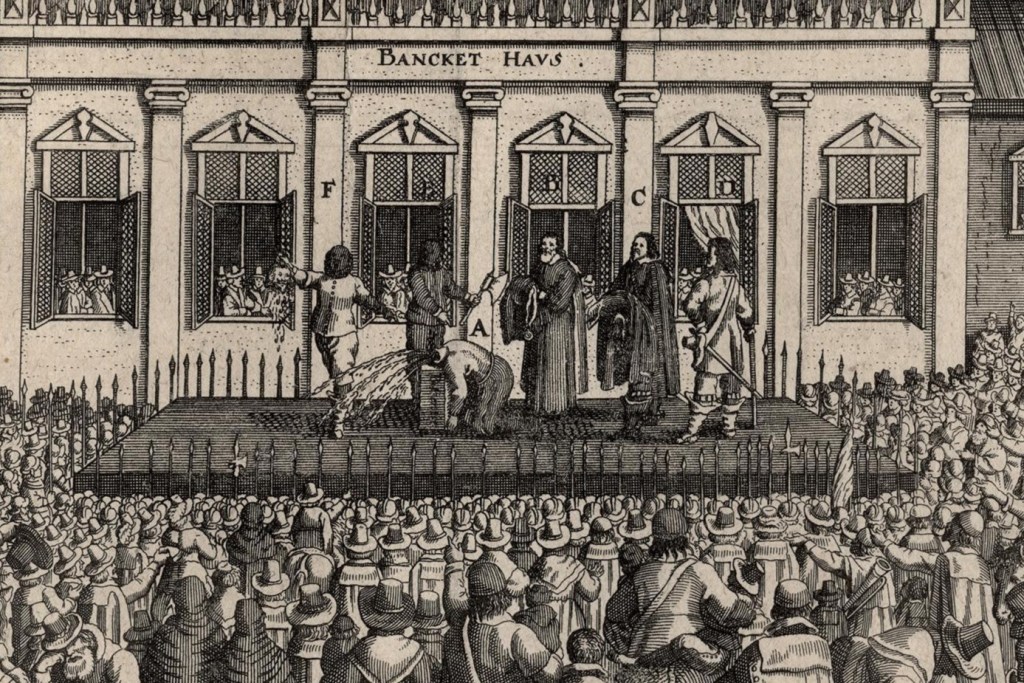
Whether Brandon really was the man who ended the monarch’s life outside the Banqueting House in Whitehall was, and is, a matter of intense speculation. There could have been no issue of competency; Brandon, according to his own testimony, rejected the task on moral grounds and resisted whatever attempts may have been made to persuade or coerce him.
Fingers were quickly pointed at various Parliamentarians, from politicians to preachers to soldiers, and even at Oliver Cromwell and Thomas Fairfax. Others thought a skilled headsman from abroad had dealt the blow. And as if the matter was not contentious enough, the executioner had been accompanied by a similarly concealed assistant.
One soldier, Sergeant William Hulet, rather suspiciously shot up the military ranks in the wake of the execution, and was curiously absent when his unit was commanded to guard the execution scaffold. In 1660, a jury found Hulet guilty of involvement in the King’s decapitation. But he appears never to have been executed and probably received a reprieve because of the insufficiency of the evidence on which he was convicted.
Even if Brandon was not present on the scaffold that day, he apparently had no compunctions in returning there shortly afterwards for the executions of several prominent Royalists, including the Duke of Hamilton and Lord Capel. Those mourners on the fence about Brandon’s complicity in Charles I’s demise may have been tempted to see the executioner’s death only a few months later as damning evidence of divine retribution. A balladeer imagined his grave containing the following cruel epitaph:
Who, do you think, lyes buried here?
One that did help to make Hemp deare,
The poorest Subject did abhorre him,
And yet his King did kneele before him;
He would his Master not betray,
Yet he his Master did destroy,
And yet no Judas; in Records ’tis found,
Judas had thirty pence, he thirty pound.


