It is entirely coincidental that this is the second newsletter in a row to centre around decapitation. For a society much more familiar with public executions than our own, and generally surrounded by death, the sight of a decapitated, quartered, or otherwise mutilated corpse was not altogether notable. It was when one appeared to come back to life that the interests of Tudors and Stuarts were piqued.
Please subscribe, for free, by entering your email address into the box above if you would like to be notified of new articles/newsletters.
Featured Woodcut
There is a section of Reginald Scot’s The Discoverie of Witchcraft (1584) dedicated to exposing how certain apparently supernatural or miraculous feats were accomplished. These include how to “thrust a bodkin [i.e. dagger] into your head” but survive unharmed, thanks to a retractable false blade, how to appear to kill and revive a chicken, and — as the below image shows — how to seemingly decapitate a person, only for them to be perfectly alive a few minutes later.
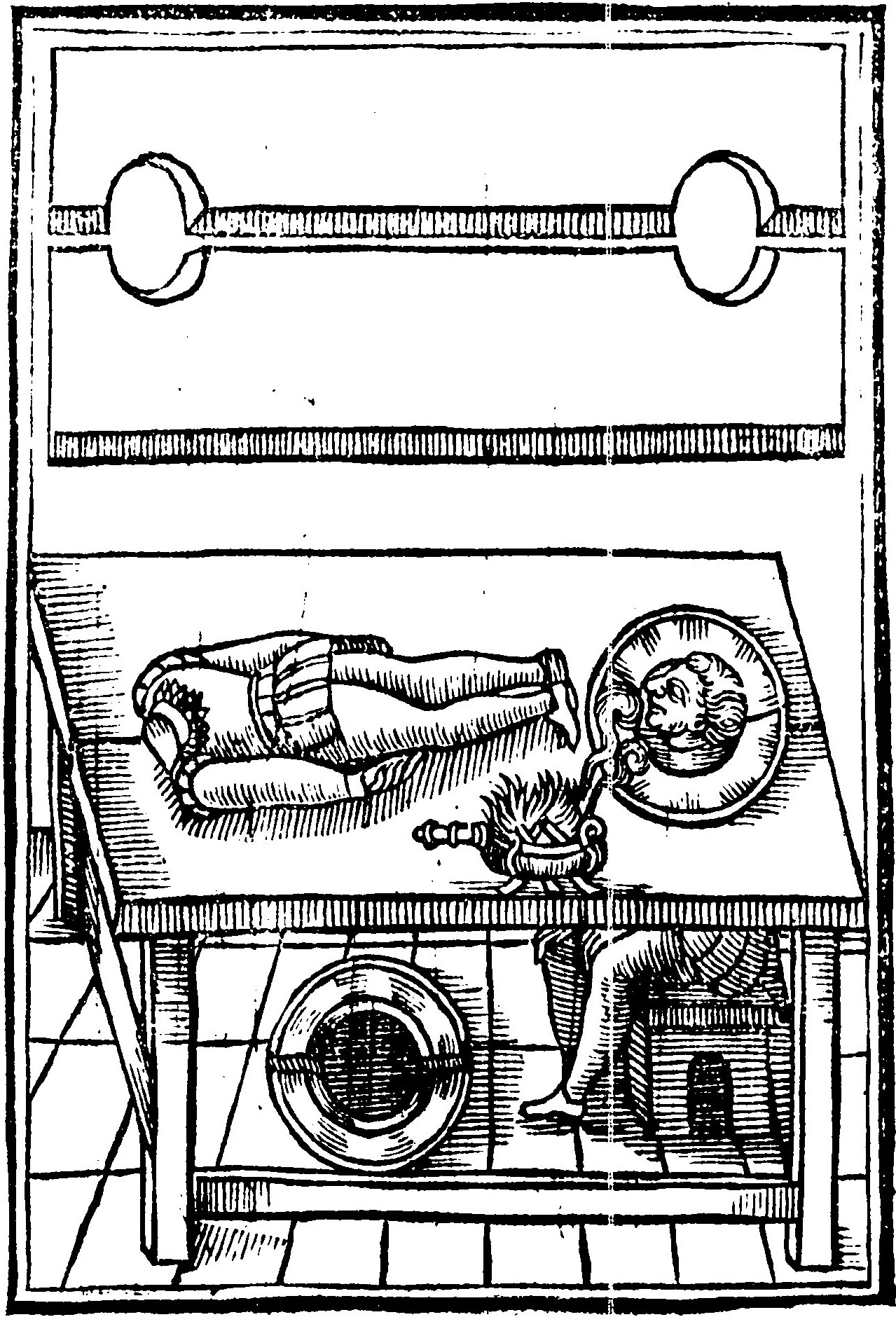
This trick was sometimes known as the “decollation of John the Baptist”, a Christian saint who, according to the gospels, had been beheaded under the orders of King Herod and whose head was subsequently displayed on a platter.
The cruxes of the illusion were two holes cut into the table on which the head and body would be presented, achieved by having the table’s top comprise two separate parts which made one whole when attached (see the top part of the woodcut).
One person — Scot recommends a boy, because their small stature more easily allowed them to fit under the table — would put his head through a hole on which a plate (also with a hole in it) was positioned. This made it appear as if his severed head were on display. A second person of a similar build would lie atop the table and stick their head through a hole, in the other direction, to give the impression of a headless body.
This was not a particularly difficult stunt to pull off and it may surprise a modern reader that people fell for such a basic ruse, which if posted online today would surely invite a flood of comments smugly explaining how it was performed. The religious significance of the scene may have gone some way in overwhelming the senses of the audience, who might otherwise have been more sceptical. But people probably were sceptical of this cheap trick, since Scot includes a few of the measures taken by tricksters to make it more convincing — including putting “a little dough kne[e]ded with bullock’s blood” around the second participant’s neck, which resembled dead flesh and, when pricked, would appear to bleed.
The Discoverie of Witchcraft (1584) is more popularly known as an early printed refutation of belief in witchcraft and was sold by the bookseller William Brome. It was reprinted twice in 1651, again in 1654, and reissued in an expanded folio edition in 1665. Reginald Scot was a politician and rural gentleman who had authored a single previous work, titled A Perfite Platforme of a Hoppe Garden (1574), which was the first treatise on maintaining a hop garden, an important part of the brewing process. This, like his Discoverie, was printed by the industrious Elizabethan printer Henry Denham, who was also a business partner of Brome’s.
There is a popular legend which claims the controversial book was banned, and existing copies ordered to be burnt, by King James VI/I upon his ascension to the English throne in 1603 (he had, after all, written Daemonologie in 1597, which heartily condoned witch-hunting) but there is no direct evidence to support this claim.
The art of the pseudonym
Pseudonyms are a little bit boring nowadays, but still in use. J.K Rowling adopted the pen name “Robert Galbraith” after the immense success of her Harry Potter books — and associated movies — in order to write crime fiction (albeit her cover was almost immediately blown). The Long Walk (1979), which has just been adapted into a film, bore the name “Richard Bachman” on its earliest covers, though the mind of Stephen King was really at play. “Mark Twain” and “George Eliot” are pseudonyms so famous that they overshadow the real names of Samuel Clemens and Mary Ann Evans, respectively.
Pseudonyms, back in the day, were frequently very clearly fake. No one would have really thought that the author of the misogynistic The Arraignment of Lewde, idle, froward, and unconstant women (1615) was called “Thomas Tell-troth”. The name was a protestation on the part of the writer that (1) their work was truthful and (2) that, for whatever reason, anonymity was preferred. In this instance, Joseph Swetnam (whose identity was shortly revealed) quite rightly feared the wrath of London’s women, who attacked him in print for his sexist remarks, and must have cheered from the audience as he was lambasted in a contemporary play.
Pseudonyms could take the form of stock characters whose names were self-descriptive — Simon Smell-knave was another moniker which suggested the lies of scoundrels were going to be detected and exposed.
The poet John Taylor didn’t mind muddling up his name, though he usually used pseudonyms which identified him. In one 1646 work he went by “Antho. Roily”, an anagram of his name (bear in mind that, in print, “i” and “j” could be interchangeable).
Samuel Rowlands on “a Gentleman foole”
It seems a shame to allude, as I did in my article on Elizabethan pamphleteers and a previous newsletter, to the satirical mini-poems targeting London’s strangest characters which the poet Samuel Rowlands penned regularly between 1598 and 1628 without giving a few examples. I’ll pepper them throughout a few of my upcoming newsletters; here is one directed at “a Gentleman foole” — i.e. an incompetent man born into comfortable wealth who has achieved nothing himself but trades on the merits of his pedigree:
Thou boasts of scutchions, armes, & high descent,
That on fooles legges euen from thy cradle went.
What credite to an idiot will arise,
To heare him say he had a father wife?
What honour can from Ancestor proceed
To foole his son, that ne’re did vertuous deed?
Samuel Rowlands, The Knaues of Spades and Diamonds (1613), sig. E2r