There are more than 146,000 works on Early English Books Online (EEBO), according to the database’s provider ProQuest. That’s a lot, even if the figure includes some duplicates, subsequent editions of the same work, and a few titles which survive in so fragmentary a state as to barely exist at all.
I like to think that I have a good general picture of the early modern English news market (because it is the subject on which I based my master’s thesis and from which this website was ultimately born) but still regularly stumble — completely by chance — on intriguing and unfamiliar pamphlets.
Likewise, though I think I am familiar with a great deal of the most interesting woodcuts, which were passed between printers and publishers and naturally draw the eye when scrolling EEBO, this week’s Featured Woodcut is one which had somehow evaded me until now.
Enter your email address in the box above if you’d like to be notified whenever there’s a new article or newsletter!
Featured Woodcut
The image below comes from The French Whipper (c. 1620), an anti-Catholic ballad penned by the prolific writer of verse Martin Parker and published by the prolific London bookseller John Trundle. The work is in essence an attempt to survey the state of England and its people, identifying and denouncing those members of society who abused their offices, acted only in their own self-interest, and generally deserved criticism.
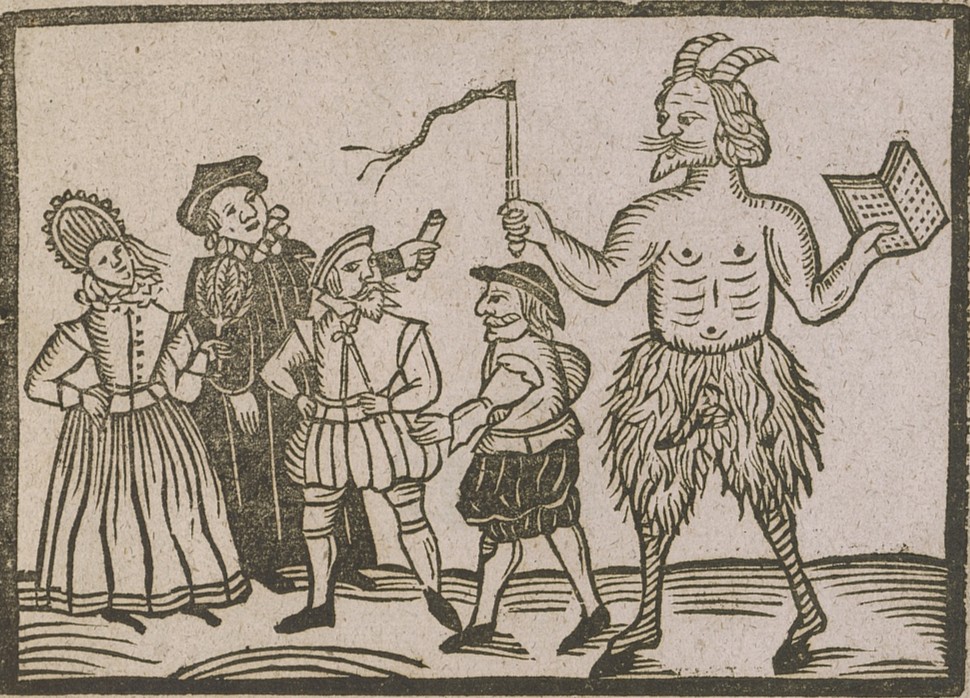
We can see the woodcut depict a few of these choice malefactors accompanied by a horned devil with a whip in one hand and a book in the other. It’s not entirely clear what theological point is being attempted here — perhaps he is their harsh schoolmaster, bearing the instrument of discipline which has allowed him to compel them into their evil ways. Or he may be there to punish them for their sins.
One character (second from the left) is clearly a lawyer. In the ballad, Parker writes of a “raedie tongued Lawyer […] so full of demurrs and delayes”, presumably to milk the legal fees he charges, and whose “tongue like to a feather will wave any way for a fee”.
I’m not sure who the man to his right is supposed to be — plausibly the “briske Sickafanticall Courtier” whose wealth came from lucrative, but utterly anti-competitive and unfair, monopolies. But he may also be a “Country Justice [whose] fingers [are] in every mans cause” and who weaponizes the law against his own neighbours to make money.
The man even further to the right looks more like an ordinary tradesman, one of many that Parker condemns as tricking customers into thinking they are getting incredible bargains when in fact they are paying extortionate prices. There’s also a reference to a “paraphrasticall Taylor”, which is a description I cannot parse in any literal context. I half wonder if this is some not-so-subtle dig at Parker’s contemporary John Taylor, the self-proclaimed “Water Poet”. The two are usually (and I think rightly) seen as literary allies who were aligned politically, so maybe this was the product of some minor falling out between the two. More on their relationship can be found in this newsletter from July.
As for the woman on the far left, wearing a petticoat and an impressively tall piece of headwear: she can be no other than one of the “fine Gentlewoman and Ladies that paint when their beauties decay” (i.e. wear makeup to cover blemishes and signs of age), which seems a little less deserving of Parker’s rebuke than the men committing actual crimes, or at the very least morally reprehensible acts.
The woodcut would go on to accompany an anti-Catholic ditty written by the prolific balladeer Martin Parker and published by Trundle in about 1624. About five years after that it adorned a ballad much more similar in content to The French Whipper, warning readers about the “great store of abuses” enacted by various professions and types of people in England — from quack physicians whose supposed medicines were “white dogges turd” to “false Jesuites” that tricked worshippers into putting their “soules in great danger”.
Wandering woodcuts
I wrote in April about the apparent haunting of a house in Oxfordshire between 1591 and 1592 by a poltergeist which chucked stones into the central hall, made strange and colourful fires, and eventually manifested a peculiar dog-ape hybrid without feet, ears, or a tail. The article, which includes two other supernatural stories, can be read here.
The pamphlet includes a woodcut (below) which was clearly commissioned for the narrative, depicting the house’s owner, George Lee, lying in bed as one of his maid’s attempts to stop the bedsheets being pulled off by the ghost. The woodcutter has crammed in some other details — a sword thrust through a window (which was actually found in a room upstairs) alongside a hawk’s talon and bear paw on the ground (which relates to the apparent discovery of the relevant footprints in the parlour.
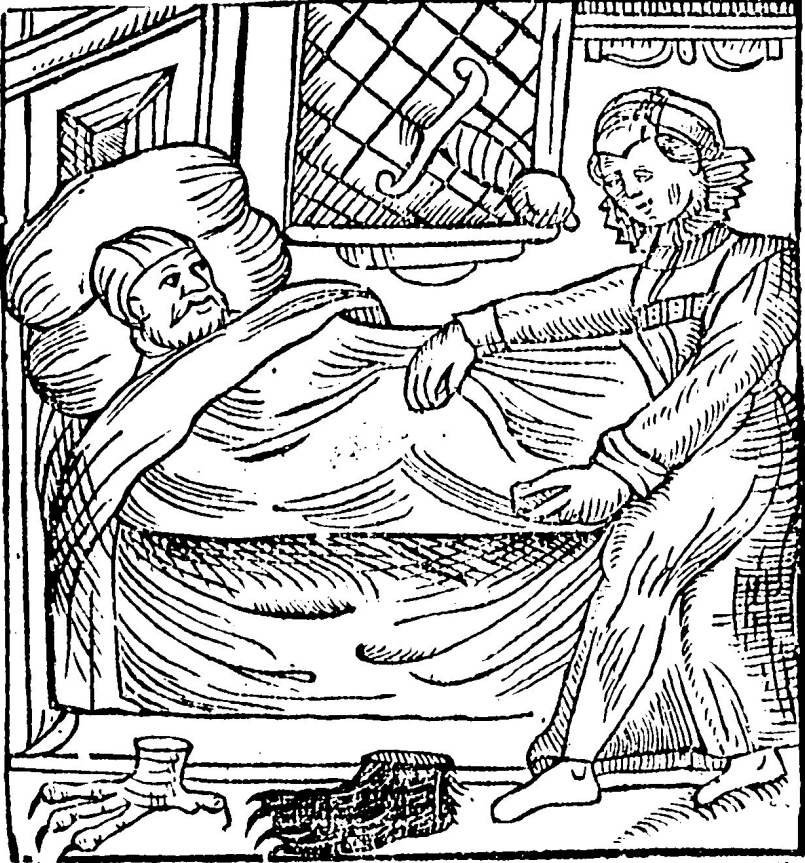
By pure coincidence, I discovered a few days ago that the woodcut was re-used a whopping 49 years later on the title page of The Doctors Last Will and Testament (1649), a dialogue between two physicians about the state of their trade. It must have suited the printer, wanting a ready-made illustration to adorn the work, that the image can quite easily be re-interpreted as a deathbed scene. Just ignore the sword and animal feet, I suppose…
There’s another instance of woodcuts travelling over time (and indeed space, given that they were passed between different printers) which I have known about for a few years. Below is the title-page illustration of The Araignement & burning of Margaret Ferne-seede (1608), which reported the execution of the titular brothel-owner Fernseed for murdering her husband, whose body was discovered in a field near Lambeth.
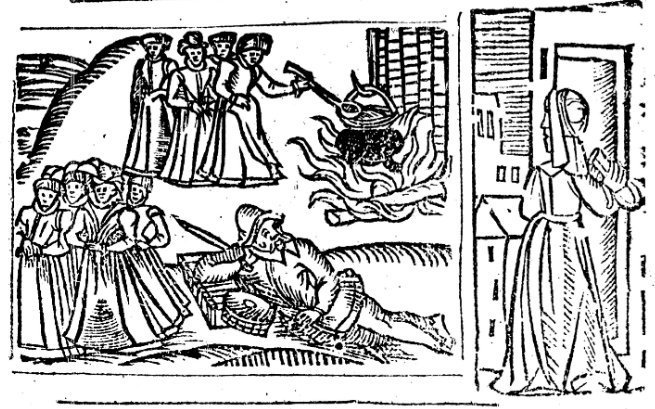
There are two woodcuts here, not just one, but they are positioned side-by-side to construct a kind of scene. The woodcut on the right is in a visibly older style than the one on the left (it may well be from the very early 16th century if not older) and shows a woman in an urban setting — this must be Fernseed. The illustration on the right is of a two groups of women next to a reclined man; this must represent a brothel.
The printer, Edward Allde, had chosen these woodcuts, despite the fact that they require a little interpretation to really fit the narrative, because it was much cheaper and quicker to mix-and-match existing images than it was to commission the production of an original one.
If the left image looks at all familiar, it’s because it is actually a section of a fairly famous woodcut illustration — one from the very significant pamphlet Newes from Scotland, which Allde printed in 1592. This was essentially a piece of propaganda, commissioned by King James VI of Scotland, telling the very biased tale of the North Berwick witch trials. This is the story for which the woodcut had in fact been produced; the women were not sex workers but a coven of witches (though witchcraft and sexual transgression were seen as going hand-in-hand by many people at that time).
And what about the woodcut of the woman on the right? For a while I had hoped to find its origin, if only to confirm that is indeed a much older woodcut. I have been unsuccessful in that endeavour, but (again by complete chance) did manage to find a subsequent use of the image in a ballad titled The wicked midwife (1640), printed more than 30 years later.
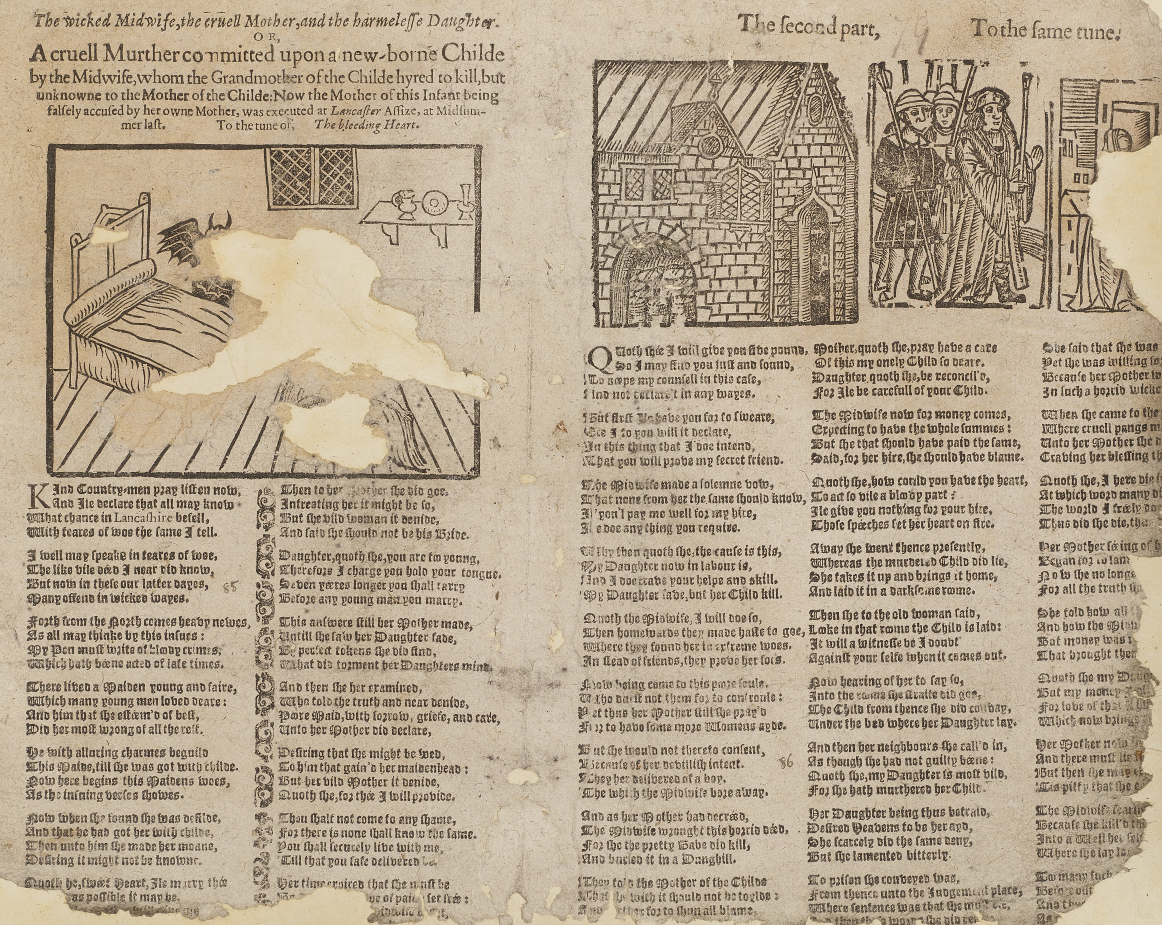
This ballad is remarkable, not least because its most prominent woodcut illustration — which depicts the act of infanticide for which the work is named — has been vandalised in so apparently deliberate a manner as to suggest that some reader (perhaps from about the time of its publication) tried to destroy the visual scene, so offensive was it to their sensibilities. We can still make out a partially-intact devil on the left; at the bottom-right can be seen two small arms (presumably those of the poor infant being killed).
And at the top-right of the ballad our city woman can be seen, though the woodcut is heavily damaged — this time seemingly by natural wear and tear.