“UFO.” There are perhaps no other three letters which more readily connote superstition, fascination, conspiracy, and technology. The classic UFO is the ‘flying saucer’ or alien spaceship which many claim to have seen, or even recorded. But if such machines exist, shouldn’t we expect to see them pop up in early modern history?
The obvious answer should be: yes. For an alien species so technologically advanced as to have successfully developed space-flight between galaxies, whether the year on Earth is 1942—the year of the so-called ‘Battle of Los Angeles’—or 1642 should make little difference. In fact, the Wikipedia page for UFO sightings in the UK gives three individual sightings in the 12th and 13th centuries, one a dragon, one a floating light, and the other a “round, shiny object” which it is then clarified emerged in the 1950s as a hoax. But then there’s a gap. A 700-year gap, in fact, since the next recorded sighting is in 1942. So, did the average Joe of 16th-century London simply look up to the sky and see nothing there because there were no UFOs? Here’s where things get interesting. There weren’t ‘UFO’ sightings, per se, but there were accounts of what we might refer to as ‘Unidentified Aerial Phenomena’.
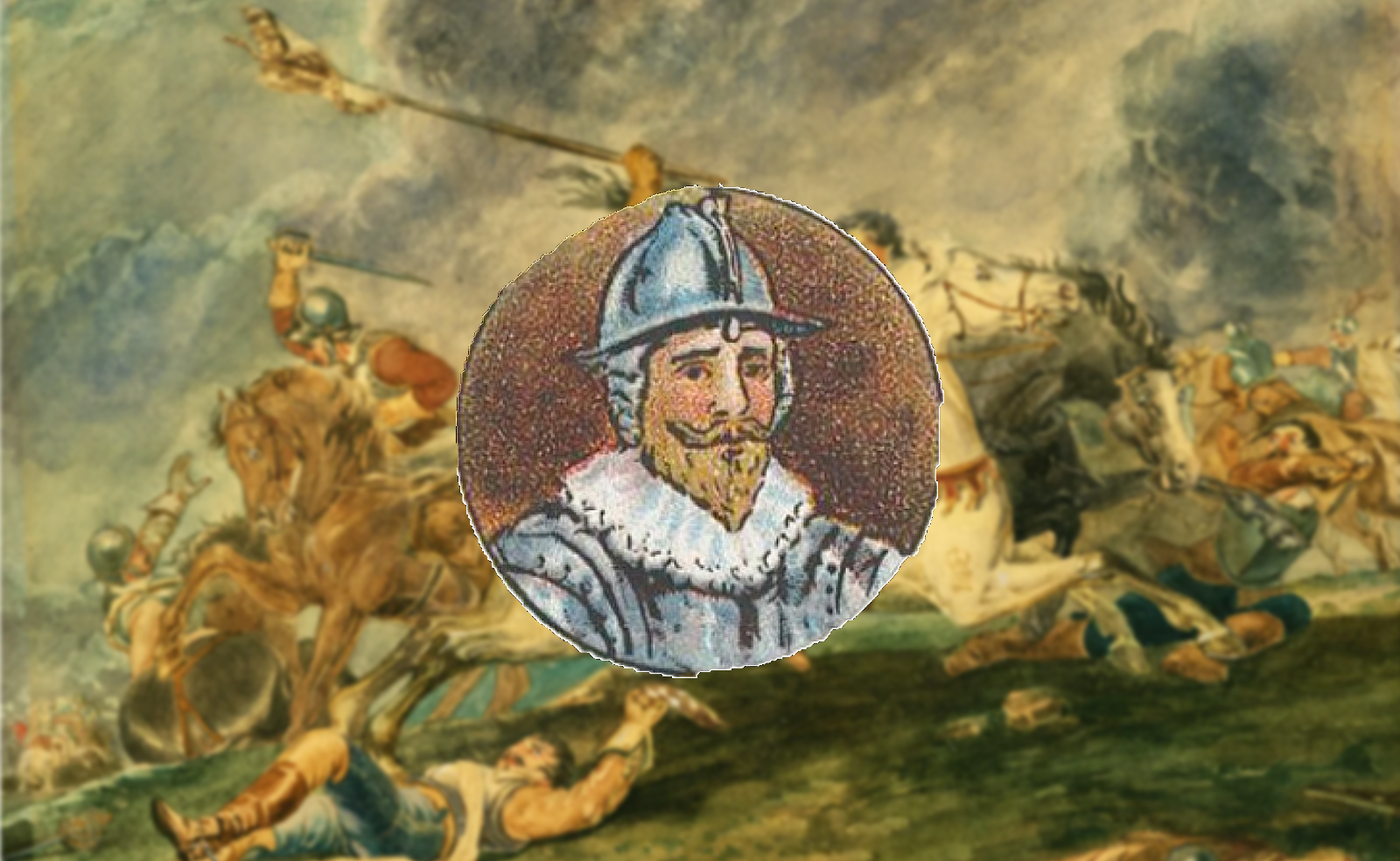
For the inhabitants of Hatford, the 6th of April began as any other. It was quite an ordinary day, perhaps even a little boring. It wasn’t too hot, nor too cold, and the sky was overcast, although the sun was still able to break through the clouds. Yet suddenly everything changed. A ‘hideous rumbling in the Ayre’ was heard and an onslaught of thunder terrified the villagers. But this was no ordinary storm. It appeared to those who witnessed it that it was a battle in the sky. Cannons could be heard firing up to 20 times, if not more, as could drum-beating and the firing of bullets. The amazed villagers fell on their knees, fearing that the day of judgement had arrived. This according to a pamphlet published that same year, anyway.

Although this sky battle seems like an absurd thing to even fathom the possibility of, it was far from the only one which allegedly took place. The pamphlet, entitled Looke Up and See Wonders, begins with a long preamble about how strange happenings are signs from God to command us to change our ways. ‘Into what a miserable Sea of calamities does a man then throw himselfe, when in this his earthly Navigation, hee sayles he cares not how, nor knowes where to fine a safe Landing-place’, ponders the anonymous author as part of a religious lesson he gives us against embracing sin and ignoring the ways of God. In fact, unlike online UFO stories which are often no more than cheap clickbait designed to exploit our fascination with the unknown, this author spends surprisingly little time actually describing the strange events.
The instruction included at the start of the pamphlet to ‘Let not this Knowledge vanish away like a Dreame’ is particularly interesting. A similar commandment issued by Thomas Cooper in a 1620 pamphlet (who claims he ‘wrote it not for a nine days wonder to vanish like a dreame’) leads historian Lynn Robson to conclude that ‘a critical commonplace about the ephemerality of cheap print: that it was no sooner read than forgotten’ is challenged. It certainly proves that those two authors did not desire their work to be soon forgotten (and perhaps implies that this was the desire of many other authors) but we might question why such a request is included in the first place. The implication is that readers do often read things which they don’t take to heart and perhaps even implies that many authors have no objection to this (or even exploit it for profit).
For as much religious rambling as there is—a whopping 12 pages in fact—the providential framework of the pamphlet is surprisingly loose. The phenomenon in the sky must be a sign from God, presumably a discouragement of sinning which targeted the people of Hatford, but that’s as far as the author feels he can go; He notes that ‘it is not fit that any man, should take uppon him, […] to pry into the closet of Gods determinations. His works are full of Wonders, and not to be examined’ in what amounts to a recognition (and embrace) of his own ignorance.
If you thought that wild speculations and contradictory reporting of UFOs were qualities reserved only to the modern day, then think again. According to the author, some people claimed that ‘the shape of a Man, beating of a Drum, was visibly seen in the Ayre’ and others that a man had been ‘instant stricken lame’ after touching a thunderstone produced by the storm. The author gives them no credence, however, and wisely asserts that:
Report in such distractions as these, hath a thousand eyes, and sees more than it can understand; and as many tongues, which being once set a going, they speake any thing.
The natural explanation, of course, is simply that it was a particularly strong thunder storm which sounded vaguely like a battle. It would be extremely condescending to assume that 17th-century English people were so primitive as to ascribe divine significance to thunder-storms because they did not understand them. Rather, the sudden appearance of particularly dramatic weather (especially at times of national stress) rendered natural explanations unsatisfactory.
An English soldiers account of ‘a strange apparition in the air’ from a 1654 pamphlet is more telling of superstition stemming from ignorance. The soldier, situated on the border of the Scottish highlands, claimed to see strange lights which appeared to move around as though marching. Next, the lights started to resemble ships’ masts. He concluded that ‘certainly it did betoken some great Sea Fight’ and his captain confirmed that he had seen the same. The most obvious explanation is that, being in Scotland, they may have been witnessing the Northern Lights. The fact that all this occurred in August does make a Northern Lights sighting odd, because it’s unusual to see them, but it’s the most obvious natural explanation.

The flight of birds was another area which saw a lot of religious symbolism emerge out of otherwise normal, natural events. A ‘battle’ of starlings fought in Ireland in 1621 is recorded in at least one ballad and at least one pamphlet. The pamphlet, which includes a detailed woodcut, states that ‘the wonderfull workes of Almighty God yet it doth import all Christians not to bee carelesse [and] doth prognosticate either Gods mercy to draw us to repentance, or just justice to punish our sinnes and wickednesse.’ The ballad begins with a request to ‘Marke well, Gods wonderous workes’ and ends with a similar moralising message about obeying God. Early modern ornithology was already familiar with the concept of the murmuration (or ‘swarm behaviour’) of starlings so the decision to add divine providence is not one which stems out of ignorance. The authors are exploiting the event to further a religious argument, and admittedly the mass flight of small birds would have been very impressive to the average early modern Englishman, as it would to the average person nowadays.

I won’t explore any more specific stories, but it’s fair to say that they were commonplace throughout the seventeenth century. A comet of 1677 supposedly foreran the (fake) Popish Plot which began the next year; Two armies were seen battling in the air at Exeter in 1681; Holland apparently saw ships, men, and horses, fighting in the sky alongside a lion and a dragon; And in Chester in 1651, a Mrs Holt also witnessed a battle in the sky, although her maid was only able to see it after uttering the words ‘Mistris, it may be the Lord will not suffer me to behold what you do.’ Unsurprisingly, these apparitions were not viewed as being mind-independent, physical phenomena but were rather inventions of God which could only be viewed by the people he willed to.
But why don’t we see battles in the sky right now? Well, some people still claim they see cities or creatures in the sky, but not armies firing cannons or on horseback. Of course, God would have updated these apparitions to include tanks and advanced military technology, but we don’t even see that. Nor did early modern, or medieval, people claim to see spaceships in the way that most UFO sightings today claim.
The explanation which Keith Thomas gives in Religion and the Decline of Magic is probably the most appropriate. UFO sightings today and ‘apparitions in the ayr’ hundreds of years ago are all sorts of hallucinations or misconceptions of reality. ‘In hallucination, no less than in ordinary vision,’ argues Thomas ‘human perception is governed by stereotypes inherited from the particular society in which men live.’ Seventeenth-century witnesses saw great battles because they lived at a time when war was commonplace. Today, people see flying saucers because years of science fiction (and popular stories of other UFOs) have conditioned us into assuming that this is what a UFO would look like, in a sort of self-fulfilling prophecy.
This doesn’t mean that UFOs can’t possibly indicate alien life, but it certainly suggests that many UFO sightings are just a modern rationalisation of unexplained, but completely natural, phenomena. Moreover, it means that those seeking to spot UFOs in English historical texts will need to wade through a mass of airborne apparitions because if an alien flying saucer did appear to a seventeenth-century person, it would probably go down as something other than a UFO—if the sighting was even recorded at all.