When did you last fall victim to “clickbait”? Perhaps you suffered through a list of ’90s celebrities who are UNRECOGNISABLE today, only to discover that number 13 really doesn’t look all that different. Or maybe it was an article about a MAJOR BREAKTHROUGH in identifying Jack the Ripper, which turned out to be no more than a thoroughly debunked theory. Someone thought that headline would reel you in; they were right.
For the printers and publishers of early modern Europe, the task was much the same — even if the objective was to convince people to buy books, rather than click links. As soon as the earliest news pamphlets left the printing presses, concerns began to be raised about misleading titles, deceptive woodcut illustrations (the equivalent of today’s thumbnails or cover images), and rampant misinformation.
In England, topical pamphlets only sold for a penny or two, but could be printed in their hundreds. For the first time, news of goings-on at home and abroad was widely accessible. This was very exciting for people in search of interesting reads — and for booksellers who could profit from this excitement. The bookshop, however, was a site not only of commercial exchange but also informational traffic, and not always accurate information.
The preacher Thomas Adams complained in 1616 that publishers had the ability to deceive “innumerable fools”. Six years later, the poet Samuel Rowlands lamented that there “was never such an age for telling lies”. Here are five examples of early modern fake news which suggest both men were on to something.
A venomous dragon prowls Sussex (1614)
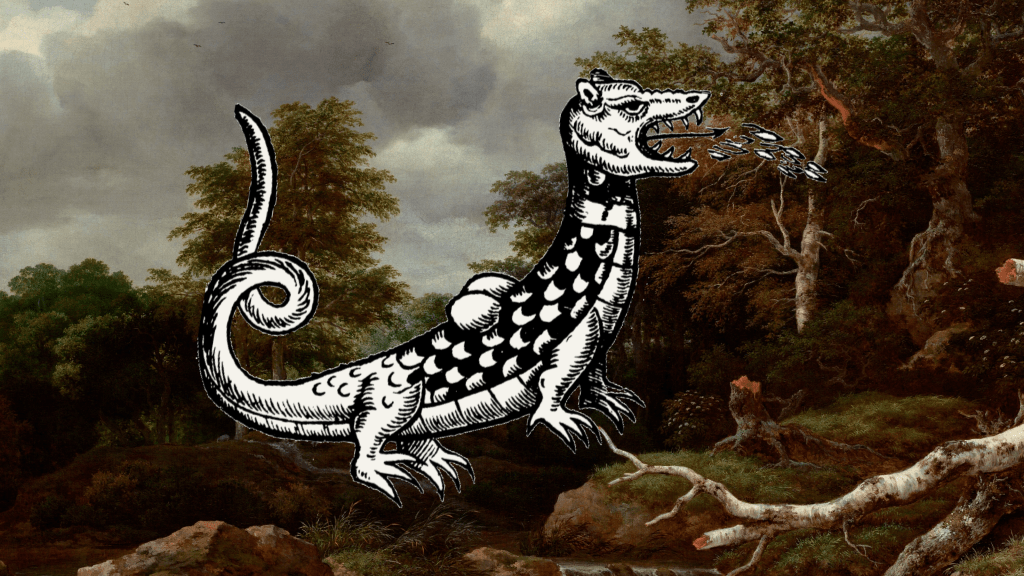
According to one of London’s most notorious news publishers, people living in Sussex needed to be on the lookout for a dragon roaming the local woodlands and spewing deadly venom. The nine-foot-tall, scaly, serpent-like creature killed two people, three dogs, and a number of grazing cattle, according to the pamphlet True and Wonderfull (1614). This fairly dull title was accompanied by an eye-catching woodcut illustration of the monstrosity.
The dragon did not eat any of the people or animals it killed, so what was its purpose? The pamphlet’s author, known only by the initials A. R., believed the beast should “be fear’d as an Eclips or fearefull Comet, whose prodigious effects do always follow”. It was, he thought, a warning from God “of some Serpentine sinnes that live amongst us, which will destroy us”.
The story of the Sussex Dragon was to become a notorious example of sensational, supernatural news reporting — and cemented for its publisher, John Trundle, a divisive reputation. In 1626, the author Henry Parrot punned on his name when denouncing false news: “the Presse begins to sweat when monstrous newes comes Trundling in the way”.
For years, news writers made explicit reference to the Sussex Dragon when claiming that their reports, unlike Trundle’s, were true. Others mocked the story. Nearly 20 years later, in 1633, a balladeer lampooning ridiculous rumours quipped: “There’s many travellers find newes to brag on,/That are as true as Trundles Sussex Dragon”. No wonder a 20th-century scholar summed the publisher up as a “busy miracle-monger and father of lies”.
And what of the dragon’s fate? A second bookseller registered a ballad “of the manner of the killing of the serpent in Sussex” only a little over a week after the story first broke, suggesting it had been vanquished. Half a century later, a character in the comedic play The Marriage Broker (1662) bombastically boasts that “my Master’s of approved might;/He slew the Sussex dragon in the field.”

The Hopewell of London is sunk by a mysterious ghost (1671)
In March 1671, a boat sailing off the east coast of England came across a small raft of ten men floating in the water. The men were in a panicked and dishevelled state. One, who claimed to be their captain, had visible burns on the left side of his face. With the help of a rope, the raft was towed for a while and then set upon the shore at Grimsby, whose mayor sent the men on their way to London.
In the city, they testified before a judge that their ship, The Hopewell of London, had been sunk by a “strange and dreadful apparition” not long after leaving a port in the capital, bound for Newcastle. It came in the form of a figure wearing a coat, a striped neck-cloth, and a black hat — which sat atop a head of shaggy hair hanging over his “sour down-looking countenance”.
The ghost appeared firstly to the captain, John Pye, as he was lying down in bed ahead of their departure, but vanished into thin air at the mention of God. A few days later, the Hopewell began to resist its crew’s control. The helmsman struggled to steer the ship (which tilted perilously to one side), its candles gave off almost no light, and its sails appeared to unravel on their own.
Pye went below deck, where he again saw the apparition, which “came violently to me, saying, Be gone, you have no more to do here“, before throwing him against a table. When the captain demanded to know its purpose, the ghost “vanished away in a flash of fire” which singed his face. The ship now began to fall apart and sink. The sailors quickly evacuated onto the small raft they would later be found on.
Captain Pye’s first-hand account was published as A True and Perfect Account Of a Strange and Dreadful Apparition Which lately Infested and Sunk a Ship (1672). The bookseller Robert Clavel had been sent it by a friend of his who had been aboard the doomed vessel — and all ten survivors gave consistent testimony to the judge in London. Whether there was even a crumb of truth to the story, or the crew simply wanted an excuse for sinking their ship, is impossible to say.

Unruly atheists gather in a London pub (1650)
The “Ranters” were a small religious fringe active in London in the 1640s and ’50s who believed that because God was present in all things, then all living creatures, whether human or animal, were fundamentally equal. This is a very progressive outlook even by today’s standards, but quite harmless and well-intentioned.
According to Puritan writers, however, these Ranters were in fact a dangerous underground network of atheists or Satan-worshippers (depending on who you asked). They rejected all forms of organised religion and social hierarchy, and engaged in blasphemous frolicking.
There was something of a cottage industry in Commonwealth England of godly whingers cranking out pamphlets which “exposed” the devious acts of sectarians. The Ranters Ranting (1650) was one of them, and must have startled readers with its provocative woodcut illustration, presenting four different scenes — almost like an early cartoon.
A female Ranter is seen welcoming an initiate into the congregation, while a group of men greedily feast. Behind them, four Ranters dance naked in a half-circle around a man playing music. Elsewhere a woman kisses the buttocks of a man whose breeches are down below his knees.
This was apparently just another Tuesday evening for the Ranters who met at the David and Harp alehouse in St Giles Cripplegate. An undercover agent had been sent to attend a gathering by a local constable and witnessed a night of raucous singing, dancing, and feasting — accompanied by plenty of swearing and blaspheming. All of this he reported back to the authorities, who, the pamphlet says, arrested those involved.
No more quintessentially sinful a scene could exist to satisfy the literary appetites of London’s Puritan readers, who sought after pamphlets decrying deviant behaviour with a guiltier pleasure than any one of them would surely have liked to admit.
The mole had been welcomed by one Ranter with a kiss on the neck. When a joint of meat was set on the table, “they flockt like brute beasts, without any order” and one of the Ranters “laid hold on the meat and [tore] it to pieces like a dog”, before letting out “a great Fart”. In his defence, the Ranter quickly declared: “Let every thing that hath breath praise the Lord.”

A battle in the sky over Berkshire (1628)
It speaks to the wondrous news climate of the 17th century that the author of a pamphlet reporting the crashing down of a meteorite in Berkshire felt compelled to plead that his readers “let not this knowledge vanish away like a Dreame, but keepe it as a Monument ingraven in Brasse or Marble”.
The villagers of Hatford, at least, were hardly likely to forget the happenings of 9 April 1628. That afternoon, quite out of nowhere, a “hideous rumbling in the Ayre” was heard. Then came an onslaught of deafening thunder which “maintayned the fashion of a fought battle”, as if cannons were being fired in three staggered volleys.
Witnesses reported hearing a “hizzing Noyse” in the air after each of these waves, “not unlike the flying of Bullets from the mouthes of great Ordnance”. Onlookers saw a “thunderbolt” strike a nearby place called Bawlkin Green. Finally, “the sound of a Drum beating a Retreate” descended from above and the terrifying event ceased.
But this had been no ordinary thunderbolt, as those who witnessed its violent descent knew full well. It was, in fact, a meteorite — shattered into fragments on impact — which they dug up from the ground: “In colour outwardly blackish, somewhat like Iron; crusted over with that blacknesse about the thicknesse of a shilling. Within, it is soft, of a gray colour, mixed with some kind of minerall, shining like small pieces of glass.”
What was to be made of such an event? Was there genuinely some celestial skirmish being fought overhead — the meteorite really a cosmic cannonball? Some said that “the shape of a man, beating a Drum, was visibly seene in the Ayre”. The pamphlet’s author cautioned that this had not been corroborated — observing, in a commendably sober fashion, that “Report in such distractions as these, hath a thousand eyes, and sees more than it can understand”.
None of this, however, stopped the publisher Roger Michell from titling the pamphlet Looke Up and see Wonders, as if the heavenly battle was plain for all to see. Or from commissioning a striking woodcut illustration — cannons blasting in the sky behind two clashing armies of cavalry, accompanied by the drummer whose existence the report’s very author doubted. Below, a mob of villagers gawk in awe at the supernatural conflict, one having fainted, as another man unearths the peculiar rock.
Meteorologists have long been interested in “The Bawlkin Green Thunderbolt”, as Scientific American dubbed the incident in 1879. It is now thought that the thundering cannon fire was actually a double sonic boom accompanying the meteor’s descent through the atmosphere.

Charles I prematurely executed in a Royalist newspaper (1648)
England’s reading public could not complain about a dearth of news during the Civil War. It was handy to know where battles were being fought, who was winning them, at what cost, and to what effect. By the conflict’s conclusion, a news-hungry reader could choose between a number of publications.
These early forerunners to the newspaper — and the people who produced them — were often referred to as “mercuries”, in reference to the messenger of the Roman gods, Mercury.
On the Royalist side were such titles as Mercurius Aulicus, Mercurius Pragmaticus, Mercurius Melancholicus, and Mercurius Rusticus — which were sometimes only purchasable in Oxford, the Cavaliers’ territory. The Parliamentarians in London had Mercurius Britannicus, The Moderate Intelligencer, The Kingdomes Weekly Intelligencer, and Mercurius Civicus.
Each publication had a different tone and approach to news reporting. Most were weekly, though the day they were published differed, so readers were rarely left wanting. Some lasted years; many ceased printing after only a few months. Nearly all were incredibly partisan and hurled a mass of information at eager readers who were hardly likely to discern the true from the false.
But there were limits to the lies that newsbooks could expect their patrons to uncritically accept. In 1648, the royalist newsbook Mercurius Bellicus crossed this line by reporting that King Charles I had been executed. The news was broken in an editorialising and emotive dispatch at the very end of the issue:
I can scarce hold my pen, such an earth quake rockes my pile of flesh, while I am writing news is brought me that his Majestie is dead. How dare the Devills at Westminster that they can wash away their guilt in his innocent bloud; the Rogues perhaps have murdered him. I will say no more till I heare further.
Mercurius Bellicus (16 May, 1648)
This was quite a break from the kind of false optimism and inspiring lies peddled by newsbooks on both sides, who did not want their readers to lose morale. It was, in fact, to be more than eight months before Charles I lost his head.