
During the early modern period in England, printed ballads and pamphlets regularly proliferated misinformation, be it to push an agenda or simply for convenience—and people knew it.
People who wrote ballads were often the victims of harsh criticism from their contemporaries, who viewed their work as of low quality. In 1676, Walter Pope described them as ‘the worst Rimers in the world’ with Quadratus of John Marston’s What You Will (1607) remarking that ‘every ballad-monger/Can cry his idle foppish humour.’ Besides the flowery tales of lovers, ballads about crime were particularly popular.
In 1642, when protesting against a speech he was instructed by parliament to deliver to his congregation, Minister Benjamin Spencer apparently refused on the grounds that he ‘could not avouch to have received it from any other authority than a Pamphlet seller, or a Ballad-monger.’ When justifying his book about New England in 1634, William Wood explains that he wishes to provide correct information in response to ‘many scandalous and false reports […] even from the sulphurious breath of every base ballad-monger.’
During the 17th century, the trials of witches were of particular interest to the public, if the quantity of them is any indication, and thus it is unsurprising that in John Fletcher’s The Night Walker (first performed in 1633), ‘A ballad of the witches hang’d at Ludlow’ is referenced when a conversation about the medium arises.
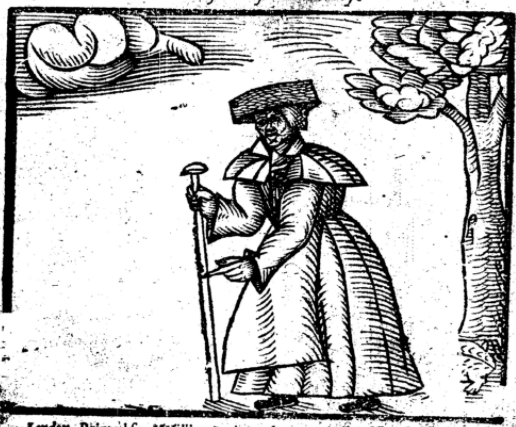
The case of Elizabeth Sawyer in 1621 was no exception. An elderly woman who had long been suspected of witchcraft, Sawyer was accused of causing the death of two children and a woman called Agnes Ratcliefe. Found guilty, she was hanged at Tyburn on 19 April 1621. The primary source of information is clergyman Henry Goodcole’s account of the case along with Sawyer’s confession (The Wonderful Discoverie of Elizabeth Sawyer), published later that same year.
The pamphlet is apparently accurate, even if it perpetuates obvious falsehoods, such as the apparent discover of a witch’s teat. The pamphlet even denounces some superstitious practices, such as the ‘ridiculous custome’ of burning thatch from a supposed witch’s roof to force her to appear if she is a witch. Goodcole also derides the ‘ridiculous fictions of her bewitching Corne on the ground, of a Ferret and an Owle dayly sporting before her, of the bewitched woman brayning, [and] of the Spirits attending in the Prison.’ It is these lies which he intends to debunk, to ‘defend the truth of the cause.’
According to Goodcole, the origin of these fake stories are none other than ‘lewde Balletmongers’ which he claims have wounded the truth of the case. In particular, Goodcole adds a side-note that he felt compelled to question Sawyer on whether or not the Devil appeared to her while she was in prison ‘because it was rumoured that the divel came to her since her conviction and shamelesly printed and openly sung in a ballad, to which many people give too much credite.’ This single sentence gives us several insights into the propagation of misinformation, using ballads as a vehicle.
The fact that these ballad-based rumours have emerged before Sawyer has been hanged shows just how quick the producers of such ballads were to exploit the case; The reference to the ballads being sung is a nice reminder that ballads were intended to be sung publicly, rather than privately read, and could spread misinformation to an illiterate audience—as well as those who could not afford to purchase them; Goodcole’s claim that ‘many people give too much credite’ to this false gossip is particularly interesting.
It suggests that although ballads were regularly criticised by authors for being low quality and lacking authority, they were seen as a genuine news source by a significant number of people.

The baloney balladry surrounding Sawyer’s crimes, trial, and execution appears to have been especially rampant. In Cures for the Itch (1626), Henry Parrot outlines his opinion on people who wrote ballads:
A Ballad-Maker is a kinde of Owle or Batt that flyeth in the night, and dares not his deformities should appeare by day. […] His choisest plots or grounds to worke upon, are drawn most commonly from theeves and murderers, or such notorious malefactors, as puts him in great hope to purchase forty pence. His highest ambition he aymes at, is, to be intituled, The Times intelligencer, or Nuncius of Newes at the second hand.
Parrot goes on to further insult ballad-makers and their practices. One such criticism is that:
If any witch bee by chance condemned, hee’l have a ballad out in print before such time as she goes to Tyburne; wherein all her confession and the manner of her death shall be described by way of Prophesie, witnesse the famous witch of Edmonton, condemned at New-gate about foure yeares past.
That Sawyer’s case is explicitly mentioned suggests that it is a particularly egregious case study of the spread of misinformation through cheap print literature. None of the ballads about Sawyer are extant (to my knowledge), though some of their content can be indirectly inferred through Goodcole’s criticism of them.
17th century ballads were certainly prone to the perpetuation of falsehoods—be that deliberate or through apathetic ignorance—but this does not devalue them at all. In fact, in cases where the facts are fairly clearly settled, it can be helpful to know what misinformation was in circulation. If you want to know the cultural stereotypes surrounding witchcraft in 17th century England, then examining what fake details ballad-makers chose to include in order to boost sales can prove invaluable, even if the truth gets lost somewhere in the process.
[This is the first post in a series which will focus on the 1621 case of Elizabeth Sawyer, commonly known as ‘The Witch of Edmonton’.]
[1. The Witch of Edmonton, Ballad-Mongers, and Early Modern Fake News]
[2. Witchcraft, Demonism, and Agency in ‘The Witch of Edmonton’ (1621)]


