There are some books, videos, and articles which immediately catch the eye. The subject matter is too fascinating, the title too arresting, or cover image too gripping to ignore. This 17th-century pamphlet has all three.
Entitled A True Relation of a most desperate murder, committed upon the Body of sir John Tindall Knight[…], and written anonymously for a popular audience, the publication is a typical murder pamphlet: The veracity of the account is attested for by its very title, the reader is promised a gory murder, and the audience’s appetite for justice is at least partly satisfied by the death of the murderer.
Printed in 1617, though entered into the Stationer’s Register the year prior, the pamphlet is concerned with the murder of Sir John Tindall, a lawyer and Master of Chancery at Lincoln’s Inn, who was shot and killed by John Barterham in 1616 while he was returning to his chamber at night. The pamphlet is not the sole account of the murder as an earlier report had been published, which included a less sensational, more objective, account of the causes, events, and consequences of the murder, including a brief interview with the culprit which was carried out by Henry Yelverton and Francis Bacon.

In introducing the murder, the anonymous author follows many of his contemporaries by essentially justifying the pamphlet itself. ‘These daies of ours’, he laments, ‘are so busie, and offer so many wondrous occurrences to fill the mouth of rumour that it seemes almost a thing impossible, that any noveltie should happen in anie Christian Kingdom more strange, and remarkable, than those which have latelie falne out in this of our owne.’ The author presents his account, the murder of a learned lawyer by an ordinary citizen, as an existential threat to the social fabric of England, and Christendom at large. This sentiment is reflected later in the pamphlet when, after Barterham kills Tindall, the author asks ‘Was all Law, Justice, and Religion, shutt up in the whole Kingdomes bosome?’—By taking the law into his own hands, the murderer poses a threat to the very existence of law and order itself.
He compares the great men of the world to ‘Chesse-boord men, mooved and remooved from place to place’ and invokes the common motif of the world as a stage (most famously expressed by Shakespeare). When he describes ‘poore men’ as ‘Fortunes Tennis-balls, bandied with bounds and rebounds’, he echoes the concerns of John Webster’s Bosola in The Duchess of Malfi, who views himself and others as ‘merely the stars’ tennis-balls, struck and banded/Which way please them.’ But despite this depressing tone, the pamphlet adheres to a very conventional providential framework (which I’ll return to later).
In short, Barterham was a 70-something-year-old litigant who frequently engaged in lawsuits. Tindall had presided over a case of his and given a verdict with which Barterham was not satisfied. Determined to seek revenge, Barterham planned to shoot Tindall in the street but, being unable to do so, followed him back to his chamber at Lincoln’s Inn where he confronted and then shot Sir John Tindall. Subsequently, Barterham is arrested and, failing to commit suicide by stabbing, is brought to King’s Bench Prison, where he’s kept under constant surveillance. A few days before his trial, knowing he’ll be found guilty, he asks for a Bible and then pen, ink, and paper. As the guard leaves to fetch the latter items, Barterham uses a ‘peece of a Bed-cord’ and a tenterhook to hang himself. The guard returns to find him hanging and, despite the efforts of others to revive him by ‘beat[ing] the soales of his feet, chaf[ing] his wrests, [and] powr[ing] Aqua-vita into his mouth’, Barterham dies by own hand.
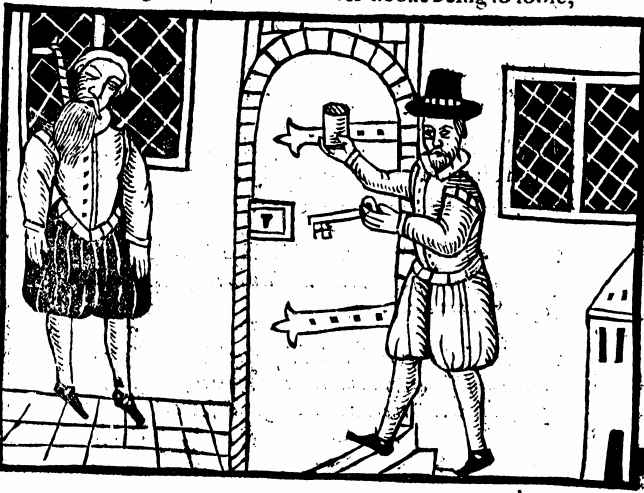
Although the title places an emphasis on Tindall’s murder, Barterham’s suicide receives about as much attention (if not slightly more). The suicide is unsurprisingly condemned and is introduced as ‘The wilfull Murder of Master Barterham, done upon himselfe’ rather than simply as an act of ‘self-murder’, which further emphasises the writers denunciation of the act.
The events leading up to Tindall’s demise are presented as a running narrative with some, though not much, moral commentary. The devil’s role in Barterham’s actions is emphasised (the moment a criminal allows the devil to influence them is a crucial part of the providential chain) and the relationship between the two is presented as ‘a ready schoolemaster to a quicke scholler.’ The murder itself happens quickly. Barterham shoots Tindall three times and he dies nearly instantly, ‘his last farwell to the world being onely a deepe-fetch’d Groaned.’ Probably the most interesting facet of the pamphlet is the woodcut which depicts the murder. It is shown on both the title page and the page following the description of the murder (B2r).
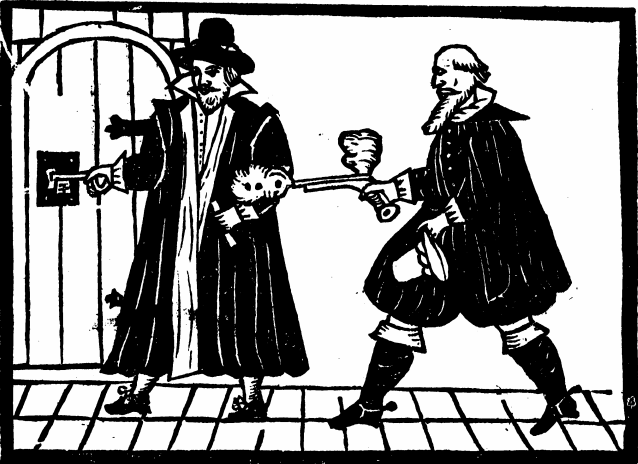
To my knowledge, there’s little reason to doubt that this woodcut was made specifically for this publication (perhaps it’s one reason it was printed slightly later than what might be expected of an ephemeral murder pamphlet). Consistent with the text, Barterham, is shown as an elderly man with little hair on his head but ‘a long and comlie beard’ and is shown shooting Tindall with three separate bullets while he goes to unlock a door (the one to his chamber). The woodcut shows the reader the very moment Barterham takes action, rather than the moment before or afterwards, which isn’t unheard of by any means but is an interesting conscious decision by the woodcutter which really does immerse the reader into the action.
The only discrepancy in the woodcut is the fact that Tindall is looking away from Barterham and is apparently taken by surprise, whereas the text heavily implies that Tindall would have been facing his attacker (having just been verbally assaulted by him). This inconsistency is by no means a mistake and, far from detracting from the value of the pamphlet, adds additional meaning. The fact that Tindall is murdered from behind makes the act a much more cowardly and despicable one on Barterham’s part, prompting the reader to sympathise with the former and further condemn the latter.
Condemnation dominates the latter half of the pamphlet, as Barterham’s suicide takes centre-stage. In the 17th century, suicide was seen as a damnable sin which ensured entry into hell (and it was only decriminalised in England in 1961). No attempt was made to try and understand why a person might decide to take such an action, and there was never any sympathy or thought given as to how they could be dissuaded emotionally—the counter-argument was simply, “you’ll go to Hell.”
The author’s primary concern with Barterham’s suicide is that although he was due to be executed, a trip to the gallows would have given him an opportunity to repent and save his soul, something which suicide rules out. This fractures the providential framework. Ideally, it would go something like this:
The criminal is tainted by the original sin (of Adam and Eve). The criminal’s decisions take them down a dark path where petty sins become larger and larger, as devilish temptations overcome them. The criminal then commits some great offence, usually murder, and is found guilty and sentenced to death. The criminal repents their sins, thus saving their soul, and is executed which returns them to God, their saviour.
The crucial roles of repentance and execution cannot take effect if the criminal commits suicide beforehand. Although the anonymous author of this pamphlet may genuinely care about Barterham’s decision to kill himself, his main concern is with his readers. The larger purpose of the providential framework of murder pamphlets, execution ballads, etc… was to hold a mirror up to the reader and deter them from following in a criminal’s footsteps. It’s therefore paramount that the author, in lieu of a pre-execution repentance, finds another way to influence the reader.
In this case, the author goes all in on criticising suicide. It’s an act of ‘basest cowardice’ to which not even ‘brute’ creatures will stoop. Any person who commits suicide is presented as worse than a mere ‘villaine’ (self-murder is presented as worse than murder because all parties involved are damned) and any trace of goodness with which you might hope for God’s forgiveness is rendered null and void. The decision is even presented as down-right idiotic: ‘Foole that he was, to avoid a hanging he hung himself’. Most importantly, the author re-establishes God’s providence by presenting the suicide of the criminal as an act of God’s ‘divine vengeance’, so any notion that suicide allows you to outsmart, avoid, or otherwise deceive God and his judgement is dismissed.
This pamphlet is fascinating for many reasons. On the most basic level, it makes for an interesting read about a shocking murder which took place over four hundred years ago. But more than that, it reflects contemporary views on social order, suicide, and the role of divine providence in criminal executions. It also features two detailed and lively woodcuts which are designed to draw the reader’s eye and immerse them in this tragic tale, which shocks a 21st-century reader just as it would a Londoner in 1617.