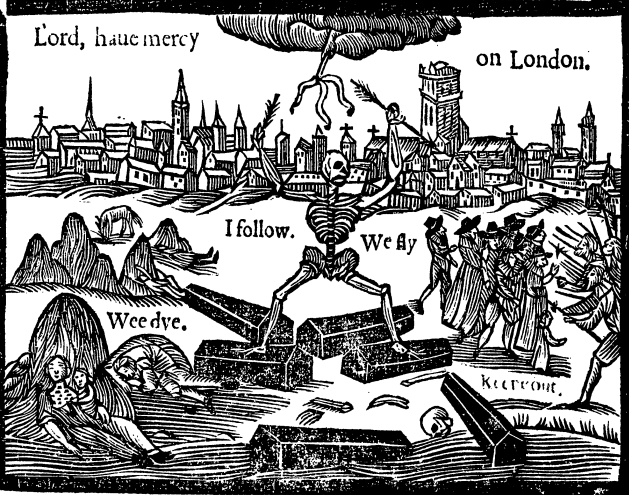
The title page woodcut of Thomas Dekker’s 1625 work A Rod for Runaways is striking; Death stands triumphant, wielding arrows and stood atop four coffins. To the left, people lie by heaps of hay—one person (probably a woman, with her child) bears the terrible mark of the plague in the form of buboes. To the right, citizens of London attempt to flee but are told to ‘keepe out’ by country-men. In the background, a plea of mercy is begged for by London, above whose cityscape the hand of God can be seen administering punishment.
The woodcut was clearly effective because when John Taylor’s The Fearefull Summer (1625) was reprinted in 1636, the same woodcut was chosen for its title page. In many ways, the two works are similar. Both draw a direct link between sin and plague, arguing that the plague is a punishment.
Dekker gives ‘Pestilence’ as one of the ‘three Whips’ which God uses against mankind if they sin, alongside ‘the Sword’ and ‘Famine.’ Similarly, Taylor exclaims that ‘Both [citizen and country-man] feare the Plague, but neither feares one jot/Their evill wayes which hath the plague be got.’ Francis Herring, a renowned physician, likewise lamented that those who fled the plague should not ‘thinke to escape Scotfree’, because ‘so long as they carry their sinne with them, the Lord will find them out.’
The relationship between divine punishment and human agency is always awkward. If God is omnipotent then how is it possible that rich sinners could simply flee the plague, an option unavailable to the poor? Or perhaps God simply does not care, in which case it is his benevolence which must be called into question—this is essentially just the ‘problem of evil.’
It might seem surprising that Dekker, despite the title of his pamphlet, does not seek to discourage anyone from fleeing. ‘We are warranted’, he argues, ‘by holy Scriptures to flie from Persecution, from the Plague, and from the Sword that pursues us.’ He quickly follows this up, however, by criticising the abandonment of the poor.
This is the crux of Dekker’s argument with regards to running away from the plague—the act of fleeing is justified, but to do so without leaving any money or food for the poor, or to think that in doing so you can escape God’s judgment, is not.
This nuanced view is implicitly present throughout the entirety of the text but is most clearly elucidated when Dekker asks ‘Why should any man, (nay, how dare any man) presume to escape this Rod of Pestilence […] There is no resisting this authority, such Purseuants as these cannot be bribed.’ The mention of bribery is in reference to the practice of paying off searchers, who could be bribed in order to ascribe a non-plague cause of death to a corpse (this was desirable because if a family member died of the plague then the entire family would be quarantined).
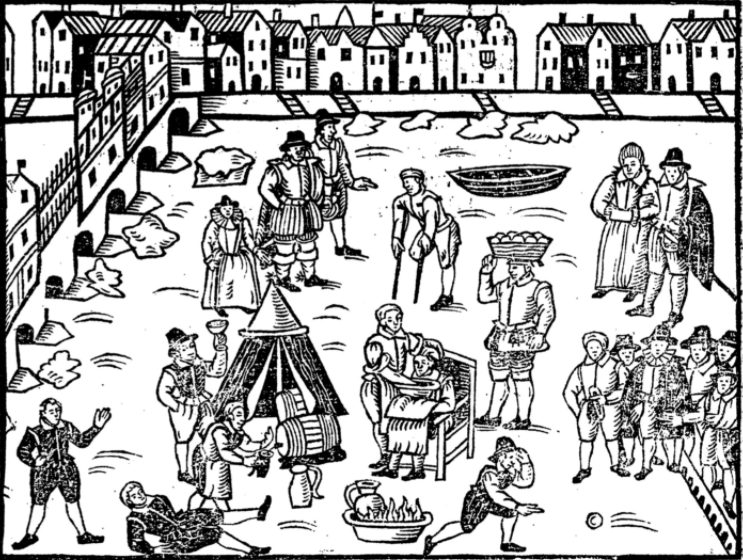
It wasn’t only plague, however, which caused great suffering and was viewed as having a divine cause. In 1608 and 1613, England saw incredibly cold and snowy winters which had significant effects on London. In 1614, a pamphlet entitled The Cold Yeare was published which lamented the loss of life but also the impact it had on trading. ‘The tyranny of this Season, killes all trading […] so that all commerce lies dead.’
John Taylor mirrored this idea when writing about the 1625 plague, asserting that ‘All trades are dead, or almost out of breath.’ The concern with trade in The Cold Yeare (1614) echoes Dekker’s concern with commerce in A Rod for Runaways (1625) and London Looke Back (1630), and The Cold Yeare also draws a link between human sin and the coldness. It’s possible that Dekker authored all three, but The Cold Yeare was published anonymously and the writing is not flowery enough, nor the link between sin and frost sufficiently emphasised, for that assertion to be safe.
The collapse of London trade is not meant to be seen as worse than human suffering and death by any means, but rather a large contributor to it. The ramifications of London’s abandonment are as clear in the number of shops which ‘stand shut up’ as they are in the mortality figures published weekly in the bills of mortality.
But more than simply criticise those who have left London, A Rod for Runaways highlights humanity at its lowest, if Dekker’s anecdotes are to be believed, even among those people who remained in the city (presumably because they could not afford to leave).
In one particularly striking incident, a sick woman sat down on the side of the street, asking to be given ‘a little drinke’ but was denied it by the ‘uncharitable Woman of the Ale-house’ for fear of infection. Once the woman dies, the crowd who had previously kept their distance disperses but some people ‘like Ravens’ strip her of her clothes and belongings. This reaction is unsurprising, because there was a popular notion that the plague was transmitted by ‘infected airs’ (miasma) which dispersed once the individual was dead, but is supposed to be shocking nonetheless. Dekker continues:
How many euery day drop downe staggering (being strucke with infection) in the open Streets? What numbers breathe their last vpon Stalles? How many creepe into Eatries, and Stables, and there dye? How many lye languishing in the common High-wayes, and in the open Fields, on Pads of Straw, end their miserable liues, vnpittyed, vnrelieued, vnknowne?
This depressingly bleak description of plague-ridden London is aimed at those who have fled. This is the devastation that they have avoided but also the suffering to which they have contributed through neglecting to provide money and/or food to the poor. Dekker’s response is emotional because he views London as the ‘Mother of my life, Nurse of my being’ and sees these ‘run-awayes’ as having abandoned her.
Within Dekker’s emotional and scathing denunciation of the wealthy run-aways is a work which reveals broader views on the relationship between periods of mortality and decline in commerce, the ways in which the plague caused citizens to behave cruelly to each other, and the relationship between human sin and divine punishment.