
Visual illustrations are some of the most informative primary sources when it comes to understanding ordinary practices. Occasionally this is because the author chooses to highlight these customs, but images also force their creator to include minor details which they may not view as significant—and thus might elude writers—but without which the image would not make much sense. The clothes worn by people, the unimportant activities in the background, and the prosthetics used by some disabled people are all small details which appear in Bruegel’s The Fight Between Carnival and Lent (1559) but might elude a writer, unless he was particularly concerned with them. Woodcuts fulfil a similar function, albeit performed in a cruder manner.
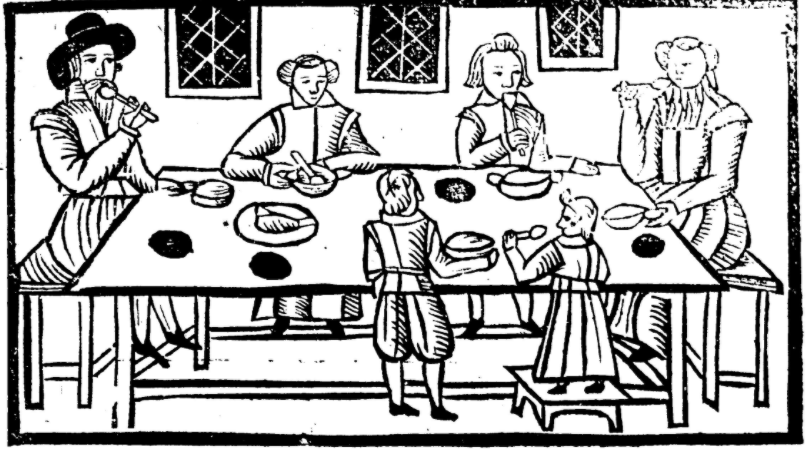
This woodcut features in a circa 1625 ballad, A pleasant Countrey new Ditty: Merrily shewing how To drive the cold Winter away. The “H. G.” for which the ballad was printed is presumably Henry Gosson, one of the most successful booksellers of 17th-century London. The woodcut offers a generic depiction of a family eating a meal. Presumably the two people at the left and right ends of the table are the father and mother, respectively. The two people seated between them in the background would then be their eldest daughter and son, with a younger son and daughter visible (from behind) in the foreground. The younger daughter’s use of a small stool of some kind to reach the table is a nice little detail, although there’s no obvious clue as to what exactly it is that they’re eating.
The woodcut contains no reference to Christmas, or any time of the year, but the ballad is very explicitly focused on Winter. There is a single reference to Christmas on the second-to-last verse:
When Christmas tide,
Comes in like a Bride,
with Holly and Iuy clad:
Twelue dayes in the yeare,
Much mirth and good cheare,
in euery houshold is had:
The Countrey guise,
Is then to deuise,
some gambole of Christmas play:
Whereas the yong men,
Do best that they can,
to driue the cold winter away.
The ballad is quite cheerful overall, promoting the consumption of alcohol and food—alongside good fellowship—as a way to ‘drive the cold winter away’, which is itself a reminder of the nutritional importance of these beverages, not just in filling someone up but also in keeping them warm at a time when central heating wasn’t a thing. Although there is no woodcut depicting an alehouse, and no specific reference to them in the text itself, the ballad would likely have been sung in them and possible stuck to their walls.

The second woodcut is one I’ve written about before, from the pamphlet The Cold Yeare (1614), perhaps written by Thomas Dekker but, in any case, anonymously published. There is only a passing reference to Christmas itself in the text but the inclusion of snowballs on the title page’s woodcut makes any modern reader draw a connection to the festive period. At one point a character complains that people are not taking God’s warning (the bombardment of snow) seriously, criticising those who are ‘fashioning ridiculous Monsters of that, which God in vengeance poures on our heades.’ Perhaps this is a reference to the creation of snowmen (‘monsters’ signifying a deformed but human-like figure), which had certainly been made in Europe by this time.

The third, and final, woodcut is from The Great Frost (1608) which seems to have directly inspired whoever authored The Cold Yeare. The Countryman’s plea that ‘God help the poore Fishes; it is a hard world with them, when their houses are taken over their heads’ is repeated, almost verbatim, by The Cold Yeare’s Northerner character, who similarly notes that ‘when I beheld it I prayed God to helpe the fishes; it would be [a] hard world with them, if their houses were taken o’er their heads.’
The woodcut is full of various activities, some of which are explicitly referenced in the text itself. There are barrels of alcohol, a man is bowling, and someone has slipped and fallen over—a not-uncommon occurrence which the text references (‘some runne, and he that does best is aptest to take a fall’). One man appears to be selling fruit from a basket while another looks as though he may be cutting a person’s hair. The inclusion of a one-legged man using crutches is interesting, even if he is never referenced in the text, and a reminder that despite their lack of presence in many primary sources, not everybody was able-bodied. The text alludes to other activities which are not included: ‘Archers shoote at prickes, whilst others play at foote-ball [… and] some wrestle.’
There is a clear tension established between the fun-and-games played atop the frozen river, and the ‘most assured danger’ which lies under the ice, only a small temperature-rise away. While there is ale and beer to be had, served on the frozen Thames itself, the Citizen relays the tragedy of a ‘poore fellow’ who, ‘having heated his body with drinke’, walked atop the ice but tripped and died. And whilst there is archery and shooting at targets to be enjoyed, there is a report that:
A couple of friendes shooting on the Thames with birding-péeces, it happened they strooke a Sea-pie, or some other fowle, they both ran to catch it, the one stumbled forward, his head slipt into a déepe hole, and there was hee drownd.
To view snow simply as a beautiful quirk of nature which adds to the spirit of Christmas is, after all, a fairly privileged view to have. To have to worry about the cold (to a serious extent) is a relic of the past to many, even though many people nowadays still spend Christmas outside in the cold, and although 17th-century Londoners may have partaken in snowball fights and ventured onto the icy Thames for recreation, the stories of terrible accidents and miseries caused by snowfall and coldness would have accompanied these festivities. The Cold Yeare‘s woodcut presents a jolly snowball fight in the same frame as the sinking of unfortunate cattle into the snow, all on the title page of a pamphlet which views snow as a ‘lashe’ designed to punish England. And for all that the warm-hearted words of A pleasant Countrey new Ditty might to do promote ale as a defence from the cold, The Great Frost‘s ‘poore fellow’, undone by the drunken courage aroused by that same ale, reminds us that in 17th-century England, the merry and the morbid went hand-in-hand.



Delightful piece and I learnt something new. Thank you!
Thank you!