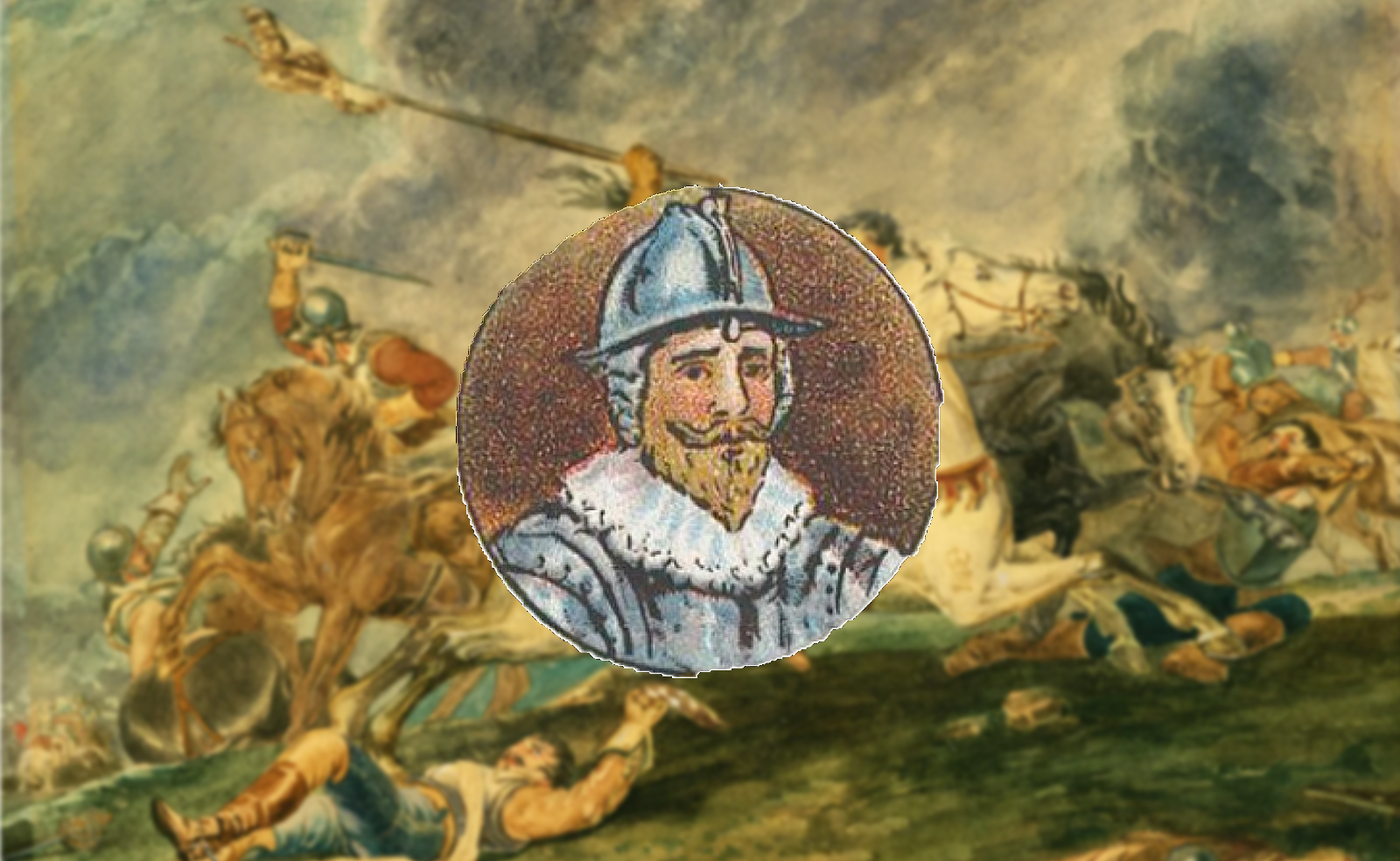
In his deeply critical review of Channel 5’s Anne Boleyn (2021), the Daily Mail‘s Christopher Stevens took issue with a variety of things—among them, was the historical accuracy of the show regarding firearms. In one scene, Anne Boleyn (played by Jodie Turner-Smith) is so bothered by peacocks’ squawking that she requests them to be shot. Stevens was not having any of it: ‘With what — cannon?’, he rhetorically asks. ‘Handguns’, he dutifully informs the reader, ‘were unknown in England in 1536.’
It is an unfortunate coincidence, I suppose, that not only is Stevens incorrect (handguns and other firearms were most definitely present in England at the time) but that 1536 was an incredibly important year for the English firearm. It was in that year that the first recorded murder by firearm in England took place.
The victim was a wealthy Mercer, Member of Parliament, and stalwart supporter of comprehensive religious and clerical reform by the name of Robert Pakington. He was shot in the street as he walked to Mass in the early hours of the morning, a ‘great mistie morning, such as hath seldome bin seene’—the limited visibility undoubtedly aiding his assassin. John Foxe remembers him as a Protestant martyr, supposedly the victim of a contract killing devised by conservative John Stokesley, the Bishop of London.
Or was it the former Dean of St. Paul’s, John Incent, who employed an Italian to do his bidding (revealing as much on his deathbed)? Foxe concludes the latter in his final editions of Actes and Monuments but it is clear that neither is an entirely credible theory. The chronicler Raphael Holinshed reports that ‘At length the murtherer in deede was condemned […] to die for [the] felonie’ but it is unclear if this was really the case.
Were the Tudors a little more hasty in their embrace of firearms, Stevens might have been even more red-faced; Henry VIII’s imposing ‘Matchlock breech-loading gun’, a pioneering invention at the time, was created the very next year, in 1537. It was that same year that Sir Thomas Elyot lamented the destruction of ‘the noble defence of archery’, brought about by ‘crosbowes and handgunnes […] brought into this realme’—hardly indicative of a country unfamiliar with their presence.
It is from the mid-sixteenth century that handguns became a particular concern of the Monarch and local authorities, alike. It was all well and good for the population to bear arms ‘for the defence of this his hignes realme’ when England was at war, but a royal proclamation in 1546 made it clear that—with the exception of those who ‘have his graces lycence under his great Seale’—it was preferable for firearms to be few and far between.
His daughter, Elizabeth I, issued many proclamations against the creation, distribution, possession, and shooting of various handguns. In her proclamation of 1566 against the ‘excesse in apparell’, the focus was limited to edged weapons but by 1579 she specifically targeted ‘dagges’ (essentially pistols), ‘pistolles’, and ‘handgunnes’. The primary concern was of highway robbery, alongside the general threat of ‘theeves, robbers & murderers.’ A related concern was of ‘privie cotes’ and ‘Doublets of defence’—essentially covert body armour—which allowed its wearer to engage in violent quarrels with little risk.
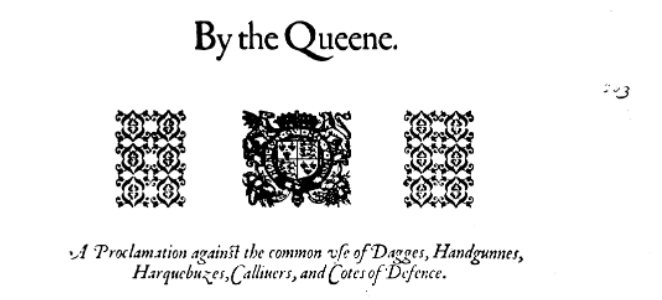
The problem had evidently not subsided by 1594, when another proclamation was issued which lamented the failure of the previous proclamations and once again stressed the danger to life posed by firearms, the possession of which was unjustifiable ‘in places and times not allowable for [military] service.’ It is this proclamation which singles out ‘pocket Dags’, which were small Dags that were made to be small enough to fit inside one’s pocket and thus could be carried secretly. Interestingly, Elizabeth I’s proviso that ‘persons appointed to come to Musters’ and ‘her Majesties ministers’ could continue to carry pistols makes it clear that ‘the carriage of such Dags be in open sort, to be manifestly seene to all persons’—it was not so much the presence of small firearms which was a danger, but the ability to easily conceal them from view.
Ultimately, the handgun problem just would not go away. A proclamation of 1600, just three years before Elizabeth’s death, once again decried the ‘great disorders, outrages, and hainous mischiefs’ caused by them. Nor was it simply the rural villages, towns, or highways which were home to this villainy, but also the ‘streetes […] of London itselfe’.
A proclamation of 1613 saw James I alarmed that the practice of ‘bearing of Weapons covertly’ had ‘suddenly growen very common’. Some people, questioned as to why they required such weapons, claimed that ‘fearing continually to be Arrested [for debt], they weare the same for their defence against such Arrests.’ Perhaps not the best indicator of civil obedience.
It was once again the fact that these small, covert firearms were ‘utterly unserviceable for defence, Military practise, or other lawfull use’ that a subsequent proclamation stressed in 1616. This time, it is not simply crimes which are denounced but also ‘that audacious custome of Duelles and Challenges’, no longer the sole domain of rapiers but a cultural practice into which firearms had invaded as a modern technology. The number of duels in England had steadily risen during the early sixteenth century, totalling thirty-three between 1610 and 1619.
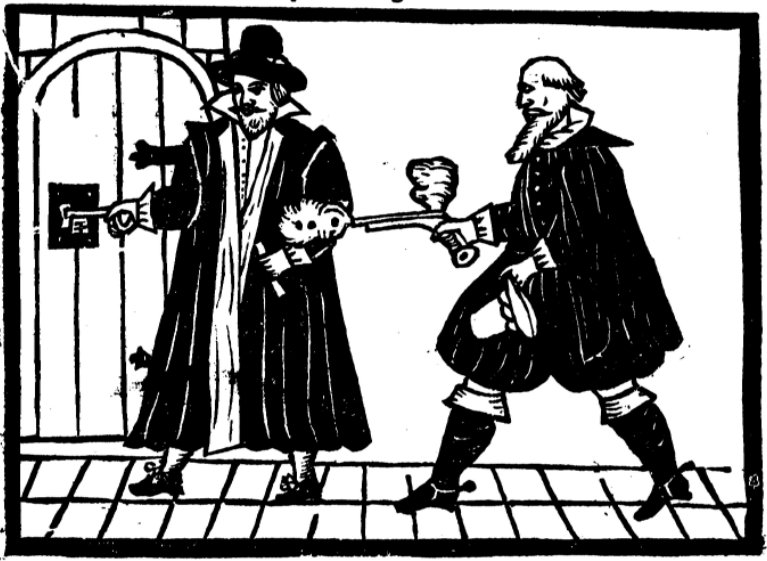
This hints at the primary motive of the authorities: Public order and safety. If the concerns of England’s most godly are to be believed, this was a time when the alehouses were as full as ever, the churches as empty, and England—though London in particular—was home to a villainous underworld which had to be actively resisted. These are (of course) hyperbolic concerns, conjured up by religious fanatics with an agenda to push and budding writers wishing to exploit the anxieties of the ‘middling sort’—but that doesn’t make it any less historically useful.
Concerns of pistol-wielding trouble-makers bent on mischief, robbery, and perhaps even murder may have been blown out of proportion but they were hardly unfounded. Research from historians such as Randolph Roth reveals that homicide rates in parishes adjacent to London had risen ‘dramatically’ from the end of the sixteenth century to the beginning of the seventeenth (15 per 100,000), though this pattern was less clear in London due to parish institutions and strict law enforcement. Bills of mortality nonetheless reflect a city which was far from free of murders, though it is unclear how many of these were the result of concealed handguns.
The highly-publicized murder of lawyer Sir John Tindall in 1616, perpetrated by an unsatisfied client who chose a pistol as his means of revenge, only served as a morbid reminder of the threat of these weapons. The coverage of the crime stressed not simply the malice that was at play, but the implications it held for England’s social order—that a man, of comparatively low rank, might so easily choose to take the law into his own hands and kill a person (who was his social superior) was an unsettling conclusion to draw.
Attitudes towards the proliferation of firearms generally, not simply smaller handguns, shed light on uneasy relationships between groups of different social status. In The Crisis of the Aristocracy (1965), Lawrence Stone uses duels as a lens through which a ‘blurring [of] the distinction between gentry and nobility’ can be observed—no longer were feuds settled by the side with the larger retainer; a lowly gentleman could now challenge a nobleman and expect a fair fight. The protrusion of pocket daggers and possibly of handguns into this domain only furthered this blurring.
Handguns were seen as a threat to the upper class on various grounds; Sir Thomas Elyot feared that they had replaced the practice of hunting game using archery, a practice traditionally reserved to the aristocracy. In a sermon of 1572, Thomas Drant yearned for the ‘simplicitie of olde tymes’ against the ‘mallice & curiositie of new times’, a sentiment which (not too subtly) implied a resentment of increasing social mobility.
In her proclamation of 1600, Elizabeth I does not forget to mention that increasing ownership of ‘fouling pieces, and birding pieces’ had resulted in the hunting of game by people who were not members of ‘the nobility, and other men of quality’, with ‘every meane and base person taking to himselfe that which belongeth to men of the best sort and condition.’
Likewise, in her 1566 proclamation regarding ‘excesse in apparell’, Elizabeth stresses the ‘disorder and confusion of the degrees of all states […] and the subversion of all good order.’ Pistols and daggers carried secretly may have been a threat to public safety, but those flaunted about one’s person were expressions of social status.
Firearms were also heavily gendered. The misogynistic character of Haec-Vir; Or, The Womanish-Man (1620) pleads with a cross-dressing woman that she should make various changes to her garments and appearance, one of which concerns a firearm:
“till you weare innocent white Ruffes, not iealous yellow iaundis’d bands, well shapt, comely and close Gownes, not light skirts and French doublets, for Poniards, Samplers, for Pistols Prayer-bookes, and for ruffled Bootes and Spurres, neate Shooes and cleane-garterd Stockings, you shall neuer lose the title of Basenesse, Vnnaturalnes, Shamelesnesse, and Foolishnesse“
Firearms, then, were perhaps more dangerous (in the eyes of some early modern moralists, at least) in the breakdown of social order that they could signify than in the physical harm that they actually tended to cause. They could be important signifiers of social status, though this was threatened by their proliferation during the late sixteenth century, and women who chose to carry them were fearless transgressors of gender norms. The increasing popularity of ‘pocket dagges’ and other handguns which could be easily concealed, alongside covert body armour, meant that the chivalric illusion of armed combat was rendered even more obsolete.
What is most clear, however, is that the only world in which handguns were ‘unknown in England in 1536’ is one of pure historical fiction.