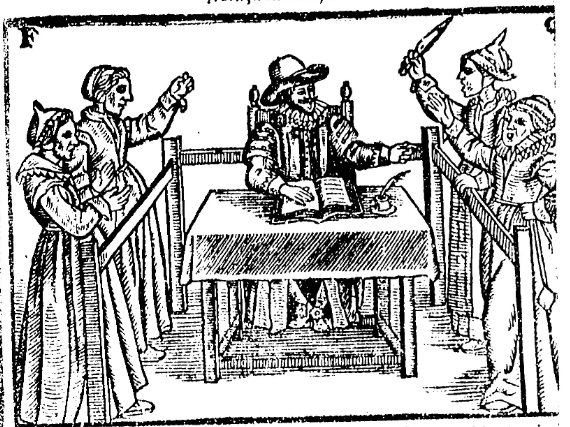
There appeared in 1615 a pamphlet which, though but one among a tumultuous sea of provocative works, proved particularly controversial. Its title pulled no punches—The Araignment of Lewde, idle, froward, and unconstant women—and its author went by the pseudonym ‘Thomas Tel-troth’, a generic guise for writers who affirmed the truth of their message but were wary of its consequences.
The author was, in fact, a man named Joseph Swetnam. Swetnam had no previously published works, nor was he a man of any repute. Swetnam’s identity as the pamphlet’s author was soon revealed and the second edition published in the same year makes explicit reference to his name.

The work was itself part of a wider debate around gender roles, and the transgression of them, which was essentially endemic to cultural and print discourse—but it was also the spark of what was to become a singularly heated pamphlet war. His pamphlet, which essentially decried women as unfaithful, ungrateful, lazy, greedy, and jealous, was met by three direct responses in pamphlet form and another in the form of a play, Swetnam the Woman-Hater Arraigned by Women (1620), which was acted out at the notoriously populist and unruly Red Bull Theatre. It indirectly inspired various other works, two of which—Hic Mulier (1620) and Haec Vir (1620)—I have previously discussed.
For as much as I would love to dismiss Swetnam as an ignorant misogynist whose work was of poor quality, a key line of argument in Rachel Speght’s response of 1617, it is undeniable that Swetnam was at the very least a moderately-skilled polemicist. Swetnam’s word-play will do little to persuade a reader of the 21st century, but a 17th-century reader already predisposed to misogynistic inclinations could be persuaded much more easily.
Moses describeth a Woman thus: At the first beginning (saith hee) a woman was made to be a helper vnto man, & so they are indeed: for she helpeth to spend and consume that which man painefully getteth.
References to biblical figures are commonplace in this work, bestowing it with additional authority. It is The Fall of Man which is identified as the root of women’s evil because Eve ‘procured mans fall’ and all other women ‘follow the line of their first leader.’ Swetnam did not need to demonstrate that it was Eve’s femininity that caused her to eat of the tree of the knowledge of good and evil in the Garden of Even, nor does he have to explain why it would logically follow that all women would therefore seek to undermine men, when it might just as easily be asserted that all humans seek to undermine one another. By 1615, it was a long-established fact that the spirit of Eve—of naivety and recklessness—could be found in all women.
Women were also considered to be dangerous traps for men to fall for and become undone by. In her assessment of Milton’s characterisation of Eve and femininity in Paradise Lost (1667), Shannon Miller argues that Milton’s reference to the ‘Femal snares’ [Book X, Line 897] who entrap men through their beauty ‘comes directly from the anti-feminist tradition, which Swetnam’s language highlights explicitly’, giving this example:
their faces are lures, their beauties are baytes, their looks are netts, and their wordes charmes, and all to bring men to ruine.
In fact, though these words are uttered by Swetnam, they are not his creation. They are present at least as early as Robert Greene’s Greenes Vision: Written at the instant of his death (c. 1592) [sig. C4v]. The phrase may be his, or it may have an earlier origin. In any case, the only alteration made by Swetnam is the decision (inexplicably) to omit the elliptical construction in the third item (which Greene puts as ‘their lookes nets’).
Unabashed plagiarism, over-reliance on proverbs, and occasional grammatical mishaps complement an argument which is confused and self-contradictory. Swetnam invokes the authority of Paul the Apostle, who ‘saith, that they which marry, doe well, but he also saith, that they which marry not, doe better.’ Though there is no accompanying Bible reference, he must be referring to 1 Corinthians 7:38. But the interpretation—that Paul agreed women to be destructive creatures best stayed away from—doesn’t hold water; the advice (and it is explicitly delivered as a recommendation, not a command) needs to be considered within the context of an address to a devout crowd seeking to become more pious—it is not general advice to all people. Moreover, it is preceded by a warning that ‘it is better to marry than to burn with passion’ (1 Corinthians 7:8) so it clearly does not apply to those who would be unable to live a life of complete celibacy.

Another strange argument arises when Swetnam turns to Greek mythology in order to provide examples of women undermining their husbands. ‘Also the wife of Hercules,’ he claims, ‘she gave her husband a poysoned shirt, which was no sooner on his backe, but did sticke so fast that when hee would have plucked it off, it tore the flesh with it.’ He is referencing the Shirt (or Tunic) of Nessus, a poisoned shirt that was given to him by his wife (Deianeira) and subsequently cooked him alive. This is because the shirt was tainted with the blood of the centaur Nessus, who had deceived Deianeira into believing that the stained shirt could be used as a potion to ensure Hercules’ faithfulness to her. Thus, when she heard that Hercules had a lover, she sent the shirt to him in order to guarantee his fidelity, unwittingly killing him. The heartbroken Deianeira subsequently committed suicide.
But what exactly is Swetnam’s point? Hercules’ death was unintentional, so it can hardly be evidence of malice on his wife’s part. But if his accusation is one of jealousy, with unintended consequences, then Swetnam proves himself a hypocrite. He can hardly accuse women of ensnaring men and overpowering them with their looks in one breath and then in the other condemn a woman for fearing that precisely that might take place. In fact, the very next paragraph sees Swetnam advise that ‘If thou wilt avoyd these evils, though must with Ulisses bind thy selfe to the mast of the ship […] for otherwise the Syrenian women would have intised him into the Sea’. Women, then, are siren-like creatures who are masters of seduction but it is also unreasonable jealousy for a woman to fear that her husband may be unfaithful in the face of these same seducers.
Of course, Swetnam doesn’t really care about women demeaning themselves any more than it might taint their husbands: ‘her discredit will be a spotte in thy brow, thou canst not goe in the street with her without mocks, not amongst thy neighbours without frumps’. It is an interesting insight into the workings of seventeenth-century social credit and street reputation (and their relationship with gender norms), though not a particularly inspiring one.
The role of the book trade in the early seventeenth-century gender controversy cannot be overstated. The Araignment of lewd, idle, froward, and unconstant women saw no fewer than thirteen reprints in the seventeenth century. Printers and booksellers knew that heated discussions like this could turn a tremendous profit, so it is no surprise that just as John Trundle sold both Hic Mulier (1620) and Haec Vir (1620) so too did Francis Grove sell three reprints of The Araignment in 1634, 1660, and 1667, alongside distributing The Good Womans Champion (1650) which was its antithesis. Swetnam explicitly caters to an audience of the ‘middling sort’, which is especially apparent when he argues that women are quick to spend their husband’s money and lead them ‘into great poverty’. Swetnam may have genuinely believed his misogynistic musings, but the printers and booksellers who spread his word would have been much more interested in the potential revenue. The bookshop was an ideologically incoherent and inconsistent space.

What is more disconcerting than the sexist content of Swetnam’s pamphlet, which should come as little shock to those familiar with his time, is the support his work might reasonably be expected to enjoy if it were published today, albeit with a little modernization to the spelling and syntax.
It is hard to ignore the inevitable comparison to British-American kickboxer and manosphere personality Andrew Tate. Swetnam wrote a fencing treatise in 1617 (The Schoole of the Noble and Worthy Science of Defence), so both men have a professional background in physical combat. Tate’s online presence has grown exponentially in recent months and although his arguments are often absurd (“I don’t think women are property… but they do belong to men”) he is a proficient polemicist and rhetorician.
Many of Swetnam’s claims are alive and well today. Swetnam claims that women exploit their husbands’ wealth (‘they aime more at thy wealth, then at thy person’)—an accusation many women still face simply for marrying someone wealthy. He also stresses that ‘women doe teach their eies to weepe’, pretending to cry by producing ‘deceitfull teares’—I wonder if any high-profile female celebrity faced similar accusations recently?
The forces of pity and relief from reading works with antiquated standards should be balanced—pity for the people who had to live in such backwards times equalled by a sigh of relief for the progress that society has made since then. If Swetnam’s pamphlet has any modern relevance, however, it is in demonstrating that many of his misogynistic beliefs are not quite as extinct as we might like to believe.


