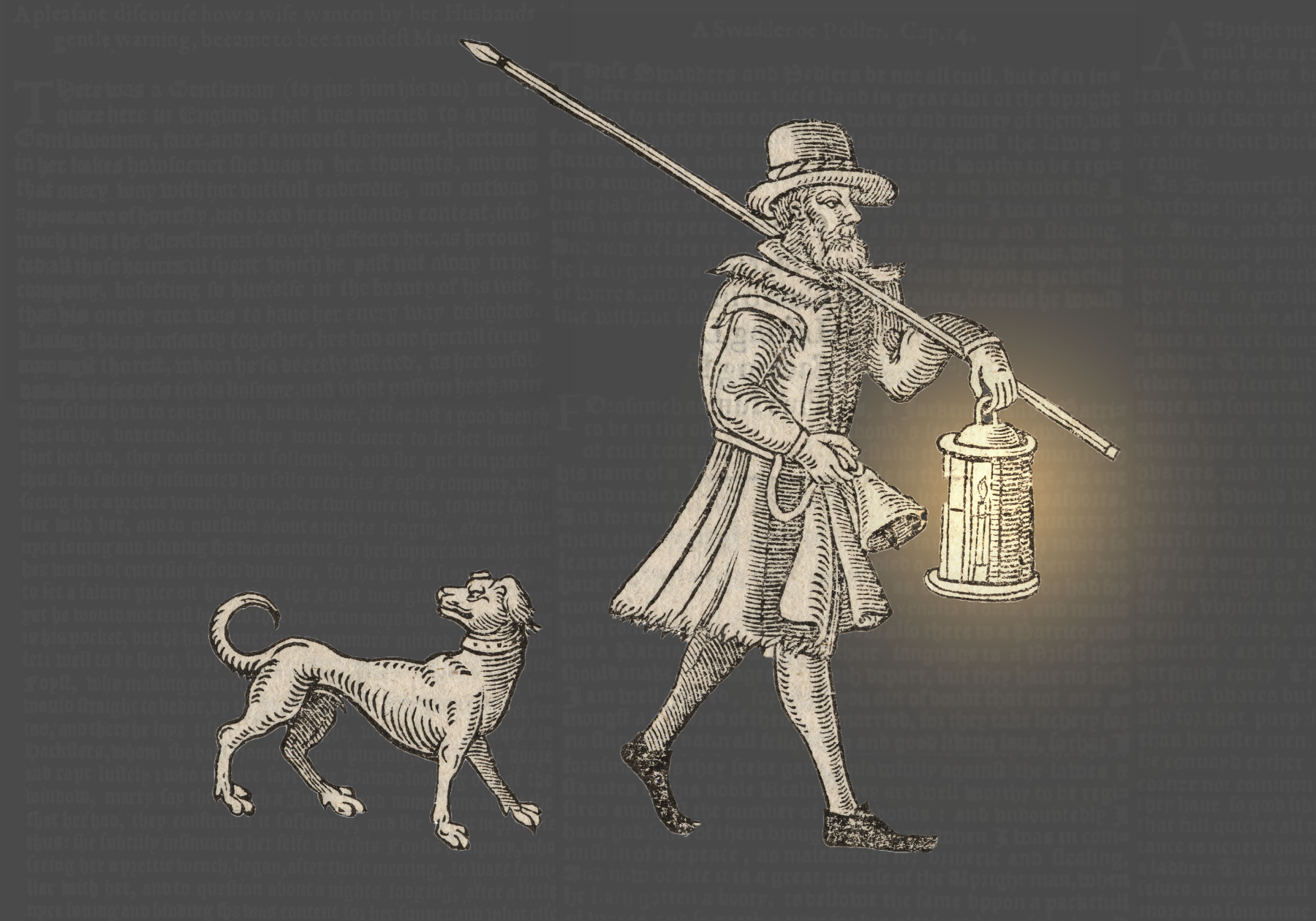
Have you ever prigged a prauncer to a bowsing ken at darkemans? Or gathered some cassan and yannam for a hearty meal, but your bufe filched the pek while your glasyers were averted? Perhaps you’ve opened your boung to purchase a togman, only to towre it has been nypped and all your lowre is gone?
The good news, if these questions read like gibberish to you, is that you’re not having a stroke. Fifteen words in that paragraph come in the form of Thieves’ Cant — a secret language allegedly used by criminals in Tudor England. Its purpose was to allow these delinquents to plot, conspire, and carry out crimes without fear of being overheard and found out. (A translated version of the three questions can be found at the bottom of this article.)
These particular words could be found at the end of a lengthy pamphlet entitled A Caveat For Commen Cursetors Vulgarly Called Vagabones, which was probably first printed in 1566 but only survives in a few rare copies produced in four subsequent editions in 1567, 1573, and 1592.
It was penned by Thomas Harman, a former Justice of the Peace, who hoped that a comprehensive taxonomy of the lawbreaking vagrants who wandered England could spur constables, bailiffs, and magistrates to take decisive action against them, “setting aside all feare, slouth, and pitie”.
Who were vagabonds, and what did they do?
Vagabonds were itinerant beggars, of no fixed abode or permanent employment, who travelled the country. Harman’s problem was not with honest vagrants who, through injury or unfortunate circumstance, relied on the charity of others, but with those who “most idly and wickedly” took advantage of Tudor poor laws when they were perfectly able to work. The consequence of this was that the genuinely needy received fewer alms.
Worse yet, a great number of this “rablement of rascales” committed offences ranging from pickpocketing and horse stealing to burglary and highway robbery. These were not victimless crimes and spread fear and distrust throughout the country. If these criminal beggars were suppressed, Harman argued, more charity would be given to the poor and “God’s wrath [would] be much the more pacified towards us” — meaning fewer instances of divine punishment, including the plague.

The situation was bleak, if Harman is to be believed. A community of mischievous rogues was abounding in England. It had its own hierarchy and cryptic dialect, infested every county of the realm, and was supported by a network of conniving publicans who used their alehouses to fence stolen goods and offer lodgings to criminals.
What were the ranks of lawless beggars?
Rufflars were at the lowest rung of the ladder. These were former soldiers or servants who often pretended to have been injured at war in order to solicit out the meagre charity of ordinary citizens. If they sought a juicier income, they would turn to patrolling the highways frequented by those travelling to and from London’s busy markets, robbing them under threat of violence.
Upright men carried staffs and commanded the respect of other lawless beggars, from whom they might demand money. A rufflar might become one after a few years, if they are not “prevented by twinde hempe” (i.e. hanged). They were often accompanied by doxes and mortes — female rogues who assisted their male companions and, Harman says, lived in “lewde loathsome lechery”. Upright men were also responsible for introducing new beggars into the “fellowship” of vagabonds.
Hokers, also called Anglers, carried staffs of up to six feet in length with iron hooks attached which allowed them to reach through open windows and steal clothing, linen, and other goods. They would scout potential targets by day, knocking door-to-door as innocent beggars, before returning after nightfall.
Demanders for glymmar were usually women and carried counterfeit documents stating that they were the victims of devastating fires which had destroyed their goods and property. It was not uncommon for them to travel in the company of upright men and, like other female vagabonds, to harness their good looks and femininity to seduce wealthy young men in the hopes of defrauding them.
Abraham men were beggars who pretended to be mad. They claimed to be former inmates at Bedlam, London’s notorious asylum, or of other prisons in the city. Sometimes they would dance strangely or begin shaking to convince onlookers of their insanity.
Rogues (somewhat confusingly named because Harman uses the term also as a generic reference to criminal beggars) were “neither so stout or hardy as the upright man” and so employed cunning, wily tricks in order to enrich themselves. This included carrying false passports (permitting their wandering under a magistrate’s forged signature) and other phoney documentation.

Harman gives an anecdote of two rogues who visited a tavern in Kent and, espying the local parson, feigned to the alewife that they were his nephews. Having duped her into giving them the location of his house, the two rogues quickly devised a wicked plan. At about midnight, one began to wail piteously for alms outside the vicar’s window, waking the man up. But when he extended his arm towards the beggar to give him a few pence, the other rogue put a horse lock around his arm and, threatening to cut the limb off, demanded three pounds.
The moral of the story was clear: vagabonds will target even the most pious, exploit the charity and good nature of others to pilfer as much money as possible, and happily threaten violence.
The counterfeit crank and the honest hat-maker
It was while Thomas Harman was lodging in London to supervise the printing of his criminological tome that he bore witness to one of the most extraordinary and dedicated rogues in all of England: a counterfeit crank.
Early in the morning of 1 November 1566, All Hallows’ Day, there came a great noise from the courtyard adjoining Whitefriars’ cloisters, in the west of the city, where Harman was staying.
A man — naked from the waist up but for a tattered leather jacket, wearing a head cloth, and with rags around his legs — was “lamentably lamenting, and pitifully crying” for the charity of two women. His face was smeared with blood, his body covered in dirt, and he claimed to be afflicted with a “greevous and payneful disease called the falling sickness”.
Hearing the commotion from his chamber and coming down to the courtyard, Harman began interrogating the man about his identity and alleged ailment. A former Justice of the Peace and member of the upper gentry who had held various local offices, Harman was eager to extract as much information as possible from the peculiar man — and have him prosecuted if he be not genuine.
“I was borne at Leycestar, my name is Nicholas Jennings, and I have had this falling sickness [for] eight yeares,” the man told him. He added that he had been an inmate at Bedlam for a year and a half under the supervision of a keeper named John Smith. But when Harman sent a servant to the asylum for confirmation, there was no record either of Jennings as a patient or any keeper by that name.
Harman requested that his printer, William Griffith, task two servant boys under his employ with following the “counterfeit crank” for the day. Sure enough, as Harman had suspected, Jennings was a fraud. After a few hours begging near Middle Temple, the man refreshed his beggarly disguise using a bladder of animal blood and a fresh daub of dirt.
At night, with the printer himself now also in pursuit, Jennings was followed across the river by boat and confronted. A constable was called for, in whose house the vagrant was again interrogated and discovered to have accumulated 13 shillings and three pence from his begging that day — held in three purses hidden about his person. This money was redistributed among the poor of the parish, Harman says.
Jennings escaped the following day after the constable’s (apparently rather gullible) wife let him outside briefly to go to the toilet. But only a matter of weeks later, on New Years’ Day 1567, he was back in London under a new guise, that of a cash-strapped hat-maker in need of work.
The printer chanced to meet him and, remembering him as the counterfeit crank, called for a constable to arrest him. After a brief pursuit down Ludgate Street, the vagrant was apprehended and locked up “for a tyme” at Bridewell Prison.

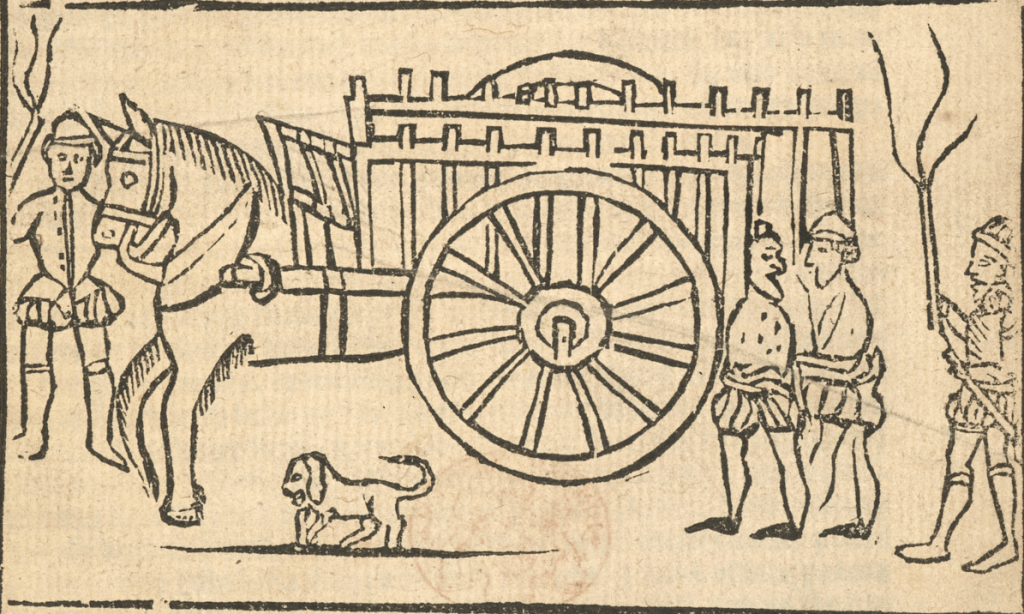
But this was not before the man, whose real name was Nicholas Blunt, was put in the pillory at Cheapside (made to wear “both his ougly and handsome attyre”) and subsequently tied naked to a horse-drawn cart and flogged through the streets of London in an act of extreme public humiliation. It is an illustration of precisely this degrading form of punishment that adorns the title page of Harman’s pamphlet.
Why were the Tudors so afraid of vagabonds?
It was an anxiety almost ubiquitous among the godlier members of Tudor society that there existed within each person the potential, and perhaps even propensity, for acts of extreme evil and perversion.
For this reason, many printed reports of crimes, theatrical depictions of immorality, and religious books straightforwardly asserted that without constant vigilance, any ordinary person might commit rape or murder. The author of a pamphlet concerning a Devonshire gentleman who had killed two people in 1605 warned of humanity’s “proneness to vicious iniquity”. Another, a decade earlier, lamented those who “with a headlong fury follow their owne appetite” but hoped his murder report would act as a corrective.
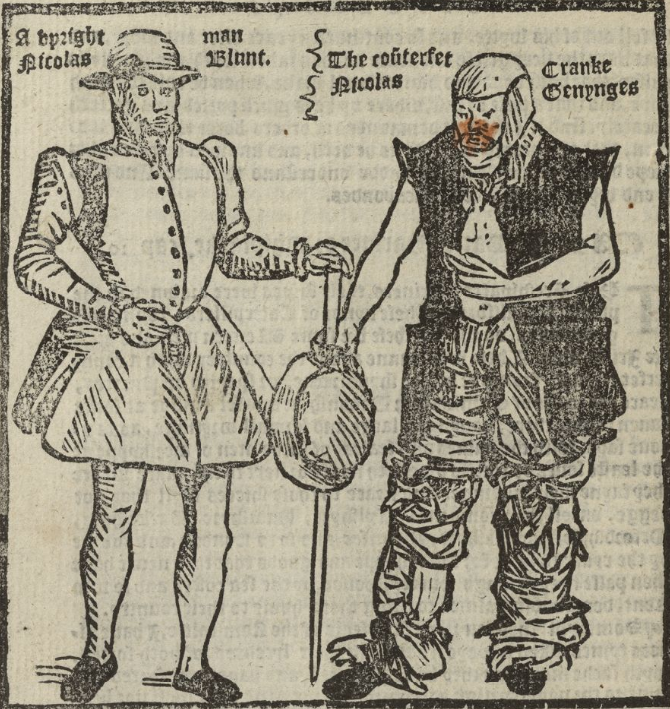
It is no surprise that when Harman had his text put through the printing press a second time in 1567, he included the story of Nicholas Jennings and commissioned a woodcut illustration depicting the man’s two personas — the smartly-dressed hat-maker and the dirty, bloodstained counterfeit crank.
In the minds of readers for whom the corruption of a soul was usually presented in abstract theological terms, the juxtaposition between the two appearances would have been shocking — a Tudor version of Dr Jekyll and Mr Hyde. It must have instilled a genuine conviction that within even the most ordinary appearing people there lay a seed of wickedness waiting to sprout.
Anxieties surrounding criminal vagabonds also overlapped with concerns about “masterless men”, many of them also vagrants, who were thought to number 13,000 across England in 1569, according to a government inquiry. These were men and women who had no fixed employer but travelled across the country to find temporary work. Historian Christopher Hill writes that for many of the “middling sort” and bourgeoisie, masterless men were seen as a “seething mobility of forest squatters, itinerant craftsmen and building labourers”, among others.
According to Harman, it was common for upright men to likewise set up camps in woodlands and lie low for several days after a successful robbery. Additionally, rufflars and other rogues sometimes found short-term or seasonal employment performing honest labour. The line between a masterless man and criminal rogue was a very blurry one indeed.
Was there really a secret society of vagrants?
Historians have long debated the veracity of A Caveat For Commen Cursetors (1566) and other similar works. One scholar wrote in 1930 that Thomas Harman had “all the deftness of the trained sociologist” and described his pamphlet as “genuine and in most particulars correct”. James Sharpe, on the other hand, argued more recently that “the literary image of the Elizabethan vagrant evaporates as soon as court records are examined”. But Paul Griffiths has since then uncovered archival evidence which suggests there was at least some degree of organisation among groups of criminals, including coded language and nicknames.
Some of the details in Harman’s pamphlet can be factually verified, including the identities of some of the vagrants he lists by name at the end of his book and the arrest and punishment of Nicholas Jennings, which is recorded in the Repertory of the Court of Aldermen.
Harman attempted to bolster his credibility, and pre-empt the scepticism readers might have of his claims, by including a litany of personal anecdotes in his work. Alongside his encounter with the counterfeit crank, he claims his “best gelding” (a male horse) was stolen while the first edition of his pamphlet was being printed and a valuable copper cauldron of his had been stolen by a group of rogues, but was ultimately found and returned to him.
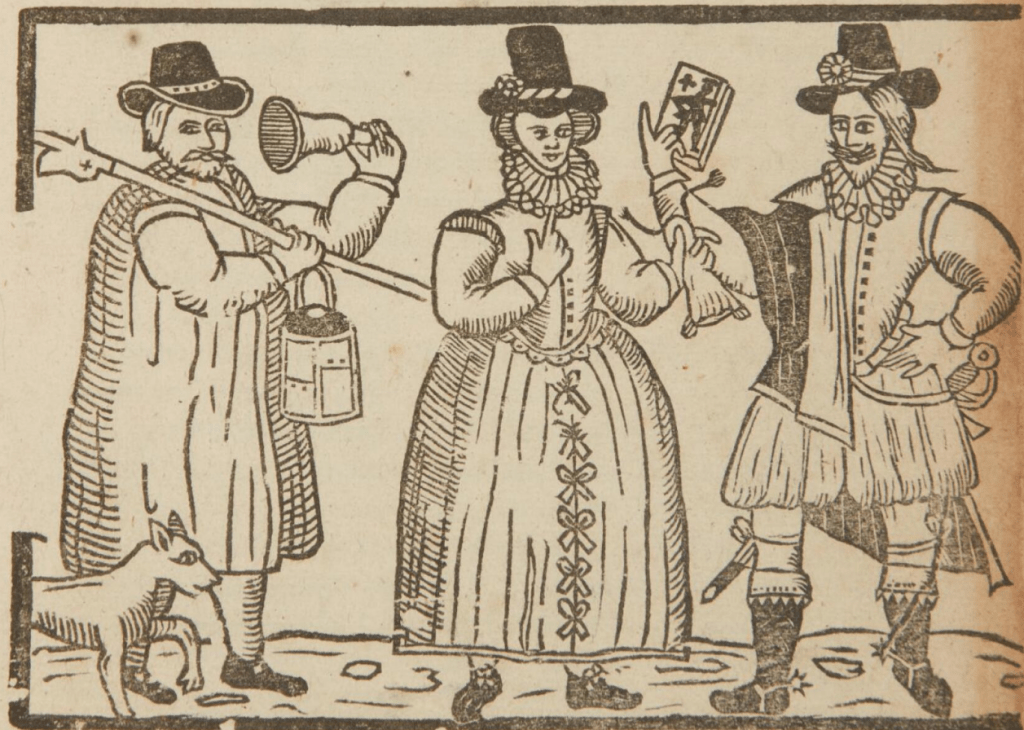
He also records a number of conversations between himself and beggars who had turned up at his house, which was in Kent and lay on the road to London. As a Justice of the Peace, tasked with local law enforcement, Harman describes interrogating a vagrant “with much threatening” after he was caught pretending to be a destitute shipwrecked sailor.
The general consensus is nonetheless that there was not, as Harman suggests, a teeming criminal underworld lurking beneath the surface of Tudor England.
The Tudor craze of coney-catching pamphlets
Crime may have been much more disorganised than Harman suggested — made up primarily of uniquely-motivated individuals and very small groups with no solid structure or unification — but his dystopian vision sold well.
Two booksellers were fined shortly after his pamphlet was first printed for attempting to publish their own pirated versions, and so eagerly did the London readership devour his work that two further editions were quickly put to the presses. Another followed six years later under a new publisher.
Harman was not actually the first to try and map the state of criminal roguery in Tudor England. The printer-publisher John Awdelay released The Fraternitye of Vagabonds (1561) a few years earlier. This work similarly contends the existence of a vast, organised network of criminals and includes many details which Harman repeats — though at 16 pages and fewer than 5,000 words it is rather skeletal in comparison to his hefty tome.
More significant are the derivative works which A Caveat For Commen Cursetors (1566) inspired, most notably six pamphlets written in quick succession by Robert Greene, now best known as the dramatist who branded Shakespeare an “upstart crow” but who was in his own time very famous for his pamphleteering.
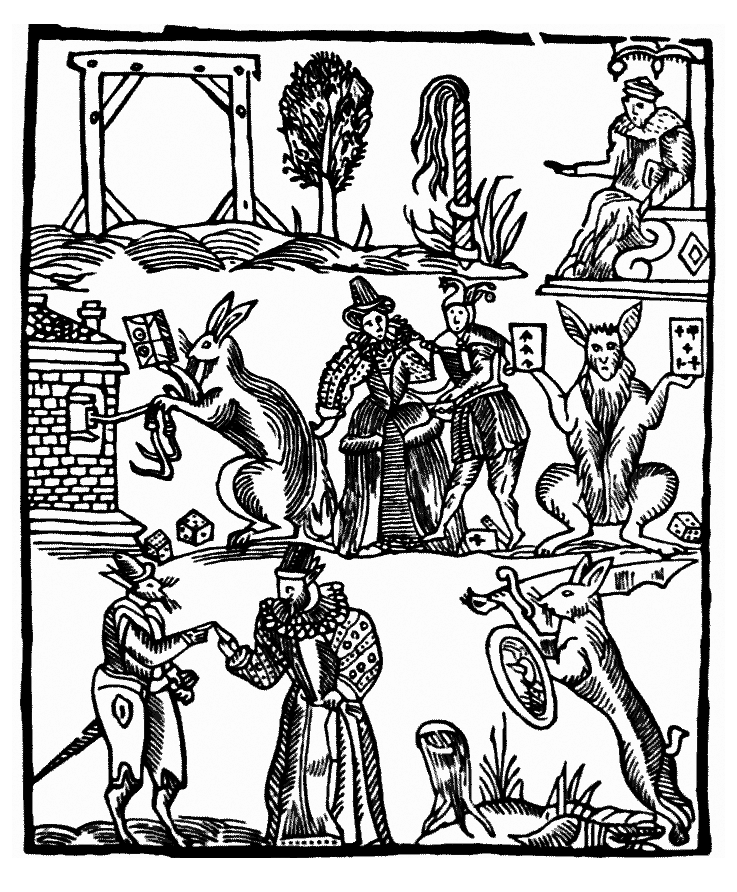
The term “coney-catching” soon emerged as the most popular descriptor of the criminal misdeeds found within these texts. A “coney” was a slang term for someone gullible (and also another word for “rabbit”) and so a “coney-catcher” was a thief or fraudster who duped people. Each of Greene’s pamphlets on rogues, published between 1591 and 1592, included some variation of “coney-catching” in their title.
When Thomas Harman’s pamphlet — now more than 25 years old — was reprinted yet again in 1592 it was re-titled The Groundeworke of Conny-catching to capitalise on the success of Greene’s works, and included a title page woodcut full of rabbits.
Greene borrowed liberally from Harman, but also contributed his own original ideas. A writer by trade, Greene was more eager than his magisterial predecessor to include anecdotes which highlighted the cunning trickery apparently employed by thieves — though for the most part these were probably his own invention.
The coney-catching craze would have quite the longevity. In 1608, more than 40 years after Harman’s initial pamphlet, the dramatist and author Thomas Dekker penned The Bellman of London (1608) which was heavily inspired (and in some parts plagiarised) from Harman and Greene. This popular work saw a sequel published in the same year and was revised throughout the next decade. In about 1608, Dekker collaborated with Thomas Middleton on The Roaring Girl, a play about the cutpurse Mary Frith, who was something of a celebrity in the city despite being a rogue.
Thomas Harman would probably not have approved of this quasi-glorification of a common criminal, nor of the trivialisation of vagabonds’ crimes which came with packing pamphlets full of embellished and cunning tricks. Harman perhaps took more pleasure in writing about the dastardly deeds of the criminal underworld than he would have liked to admit — if his obsession with alliteration is any indication — but he clearly genuinely desired the suppression of these “peevish, perverse and pestilent people”.
Harman would have been disappointed that his work never became a handbook used by magistrates and constables to prosecute and destroy the criminal underworld it sought to survey, but was instead the foundational text of a micro-genre of English literature which would excite, amuse, and enthral generations of readers in search of entertainment.
Here is the normal English version of this article’s first paragraph, with words translated from Thieves’ Cant in bold and underlined:
Have you ever ridden a horse to an alehouse at night? Or gathered some cheese and bread for a hearty meal, but your dog stole the meat while your eyes were averted? Perhaps you’ve opened your purse to purchase a cloak, only to see it has been cut and all your money is gone?