I went to Stratford-upon-Avon recently and, for the first time, visited the Church of Holy Trinity there, which is famous, of course, for being the burial site of William Shakespeare, and also the place of his baptism. Part of this newsletter is about an interesting stained glass window that can be found if you wander briefly from the Bard’s tomb and accompanying effigy.
The rest is about how early modern writers imagined a guilty conscience, and, of course, the introductory featured woodcut.
Please subscribe (for free!) by entering your email address in the box above, if you’d like to be notified of new articles and newsletters.
Featured Woodcut
Credit for this marvellous illustration must first and foremost go the anonymous woodcutter who executed it, but is vanishingly unlikely to ever be identified. It secondly goes to John Kruse, on whose British Fairies blog I stumbled across it while doing some research related to the Elizabethan confidence trickster Judith Phillips who gulled and defrauded people by convincing them the Queen of the Fairies could guide them to hidden riches.
I’ve spent so much time idly (and generally unproductively) scrolling through items on Early English Books Online that I sometimes come close to convincing myself that I’ve seen every woodcut illustration which could possibly draw the eye. But here is one I had not seen before.

It could be found on the title page of John Melton’s Astrologaster, Or, The Figure-Caster (1620) which was sold by Edward Blackmore in St. Paul’s Churchyard from his shop at the sign of the Blazing Star. Somewhat ironic, then, that this book was devoted to the debunking of astrologers, who claimed the relative positions of planets and stars could be used to tell the future or reveal hidden information.
The printer was Bernard Alsop, a prominent figure in the trade for nearly half a century, between 1602 and 1650. The illustration shows an astrologer at his desk, laden with two books, perhaps one being his notebook and the other containing horoscopes. In his left hand he holds an armillary sphere, which modelled the spatial distribution of celestial objects orbiting Earth (or sometimes the Sun). His other grasps what looks like an obelisk-style tool that I have seen in some other depictions of early modern astrology but cannot claim to have yet worked out the name or purpose of.
Next to the table is presumably a client, and his stick may suggest he has suffered some injury for which he is seeking astrological relief. Or perhaps he’s lost his dog and hopes the relative position of the celestial bodies can help him find it.
Edward Blackmore was a bookseller who, according to the bibliographer H. R. Plomer, “dealt chiefly in popular literature” and the book is written in an accessible style, clearly intended for ordinary people who could read. This serves to complicate, perhaps, the societal position of astrology by the conclusion of James I’s reign. It may be that putting an anti-astrology book to the public suggests the credulous multitudes believed in it — and certainly enough people did for various practitioners of the pseudo-science to sustain themselves commercially. But we might also consider whether a publisher like Blackmore would fund such a work if he didn’t believe that a critical mass of London’s readership were already inclined to agree with Melton (and so would buy a book which reinforced their beliefs).
This woodcut illustration is so detailed, necessitating no small monetary investment in its creation, that its apparent absence on any other title page or within any other pamphlet is a surprise. It may have stemmed from a prior visual motif, or have inspired one, because a fair few ballads from the 17th century have woodcuts of astrologers which resemble it. The Coblers New Prophesie (c. 1680) is one such work — wherein the reader is promised “strange and wonderful things [are] foretold, that will certainly come to pass Once or Never“.
And, as if the universe were trying to prove some point with regard to last week’s newsletter where I mentioned how woodcuts could turn up in unrelated works decades after their initial use, it just so happens that this ballad re-uses a 1654 woodcut of a ghostly lawyer supposed to have haunted Interregnum London (more about him here). Except here I think he is supposed to represent a Jesuit (with some liberties taken regarding the ecclesiastical garments). He is, in any case, not an evil spectre and so the horns attached to his cap have been removed and his hooved feet cut out entirely.
Stained glass in Stratford
I was in Stratford last week to see a play and visited, as I felt obliged to do, the church in which Shakespeare was baptised and buried. Below is the, again obligatory, photograph I took of his burial spot and overlooking effigy.
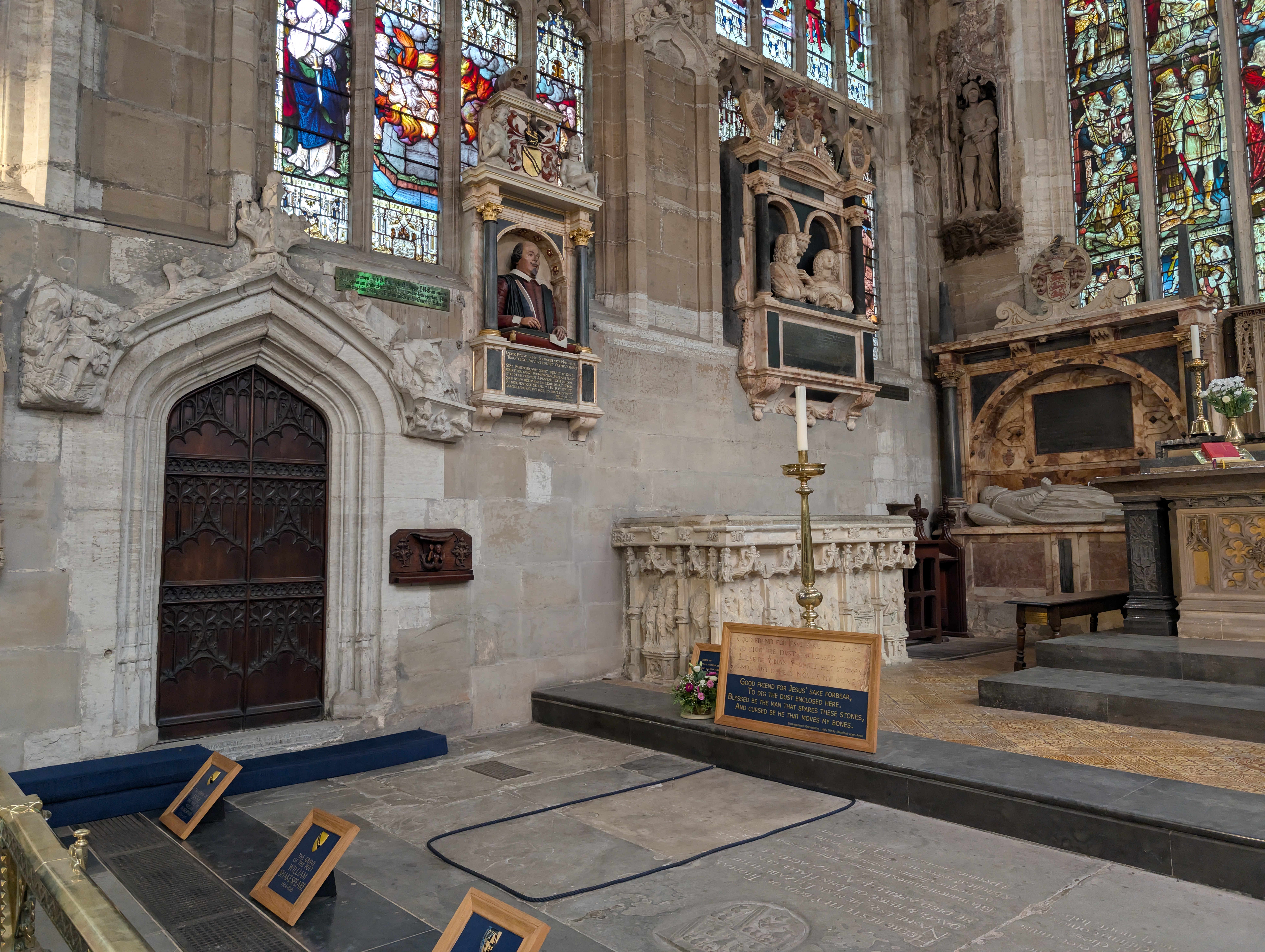
I imagine many tourists only really spend any time in this area, and possibly then only to say that they’ve visited the place. Who cares about the other rooms? Well, for a start, St. Peter’s Chapel (a few feet away) has bible which was printed by the King’s printer Robert Barker in 1611 before being acquired by Holy Trinity Church.
The chapel also has a fascinating stained glass window. Stained glass windows are beautiful and I think an ignorance of the complexities of glass production and decoration (which I and most others are guilty of) probably obscures just how impressive they are as works of art. They are often occupied by biblical scenes with which I am not familiar, so fully appreciating them is difficult. But the stained glass window in St. Peter’s Chapel (below) is very easy to understand.

It was donated by the American ambassador in 1896 as “The Gift of America to Shakespeare’s Church”. The scenes it includes are not all biblical. Second-from-the-left on the bottom row is a depiction of Archbishop William Laud in the moments before his execution in 1645. Above that, he is joined by King Charles I and the Bishop of Worcester.
The Americans are included too — the landing of the Pilgrim Fathers at Plymouth rock in 1620 can be seen near the bottom-right. And above them is Christopher Columbus, joined by fellow explorer Amerigo Vespucci and the Quaker William Penn, who is holding his famous theological work No Cross, No Crown (1699).
Samuel Rowlands on a guilty conscience
Here is what the Stuart poet and pamphleteer Samuel Rowlands had to say about the nature of “an ill (i.e. guilty) Conscience”, from his collections of epigrams and satires The Knaves of Spades (1613):
The wicked wretch whom inward guilt doth sting,
Most trembling hearted fearing euery thing,
He feareth God, for God’s his enemy,
Sathan he feares to be tormented by,
He feares all creatures ‘gainst him will assemble,
He feares himselfe, himselfe doth make him tremble.
Guilty consciences were important for any well-meaning citizens who didn’t want society to fall into disarray, for they were — at least it seemed — the mechanisms by which even the most careful murderers would be undone (either by confessing or because their strange paranoia aroused suspicion) and for fear of which some would-be murderers might be deterred.
Murder pamphlets regularly included allusions to the mental anguish inevitably (and it was important that it was inevitable) suffered by those who killed in cold blood. One 1605 pamphlet about a Devonshire gentleman who had killed two people described the murderer’s guilty conscience while he was on the run as inducing “a desperate kind of lunacie”. This caused him to act, the writer says, like a notorious felon cowering in a country house, who “at every creake of the wind feareth the entrance of some searcher, or at every stir of a rat doubteth the attachement of some officer”.
Thus, though the murderer had, for the time being, outpaced the authorities, he was hotly pursued “by the officers of vengeance, guilt, and terror” who caused him to have strange dreams and visions. And in the killer’s waking delirium, he risked inadvertently announcing their own guilt.