For my money, the most interesting ballads to have survived from the early modern period are those sensational sets of verses laying down supernatural wonders, regaling Londoners with stories of provincial murders (or sometimes, more frighteningly, those closer to home), and dolefully recording the execution of a criminal.
After all, much can be mined from these texts about contemporary attitudes towards crime, religion, social status, gender and class. Plus, they have the advantage of frequently being genuinely interesting and entertaining to read. Consequently, though I have written about ballads many a time (the first ever article on this website concerns crime ballads), this is the first time a romance ditty has been featured.
This despite the fact that such songs were incredibly popular in the 17th century. Indeed, when the average person thought of ballads, it was perhaps to these overly-sentimental and at times garishly mawkish tunes that their brain turned. A not-entirely-unfair comparison may be to today’s pop love songs which are often derided but still regularly top the charts.
Please subscribe (for free!) by entering your email address in the box above, if you’d like to be notified of new articles and newsletters.
Featured Woodcut
The below woodcut comes from a ballad which enjoyed great success in Restoration London. It was titled Advice to the Ladies of LONDON, In the Choice of their Husbands (c. 1687). It was penned by the English dramatist, poet, and songwriter Thomas D’Urfey who composed its melody (described as an “Excellent new Court Tune”), which would go on to accrue immense popularity.
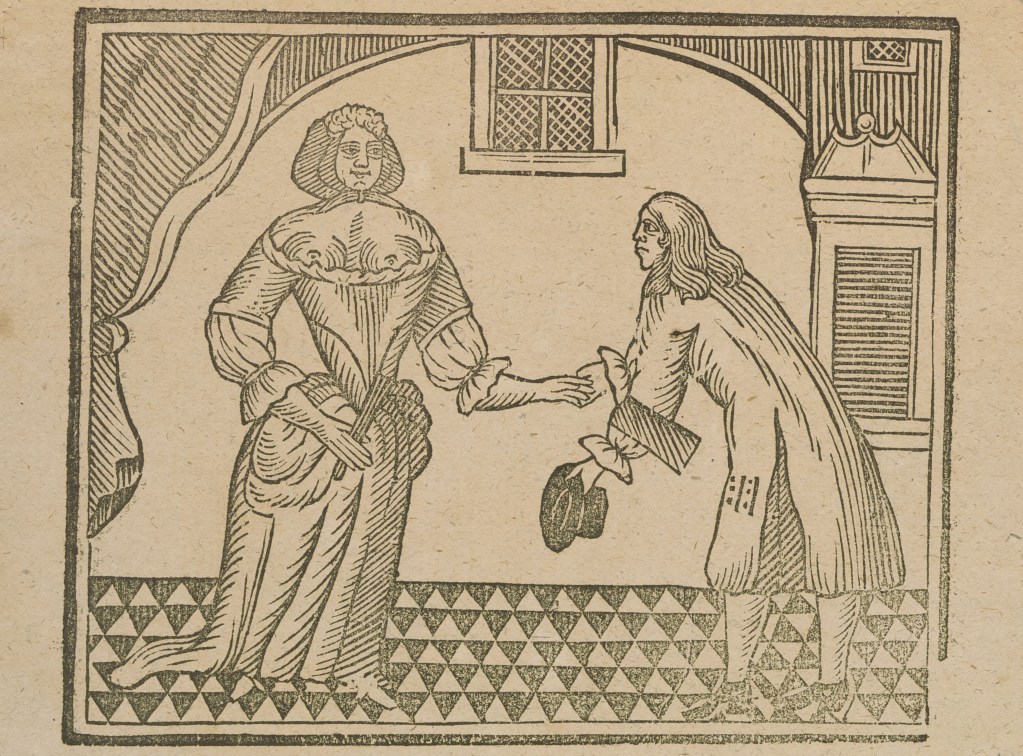
The ditty ranks at #66 on the 100 Ballads‘ ranking of early modern chart-toppers. Its tune was named on 25 surviving black-letter ballads of the 1680s. Its success owes in large part to the fact that it tapped into ongoing debates about courtship and romance, satirically lampooning the utter inadequacy of a great number of male courtiers, from the “dull Country Clown” and the “rank Citizen” to “huffing brave Boys”.
D’Urfey presented these men as underserving and untrustworthy, for “the greatest deceit lies in Wooing”. To this extent the ballad was the antithesis of the great mass of soppy romance ballads which the printing presses spat out in their thousands each year. As the 100 Ballads project notes, this ballad “subverts conventional morality by urging that the best marital partner for a young woman is ‘a doting old Sinner’ who will willingly allow her to have extra-marital sex with ‘lusty Gallants’, provided that she charges them for the pleasure and passes the money on to her husband”.
There was a response in print before long, titled Advice to Young Gentleman, which turned the ballad’s sentiment on its head, warning young bachelors of entering into any marriage — “avoid so heavy a Curse”, the balladeer warns — while offering some advice on how to enjoy, shall we say, more momentary romantic success…
That both of these ballads were published by John Black, who ran a bookshop on London Bridge, is a testament to the man’s commercial-mindedness. He, quite rightly, presumed this was going to be a lucrative controversy.
Samuel Rowlands on excessively sycophantic epistles
It was expected, in the early modern period, that a writer who dedicated his work to some social superior from whom they sought patronage would engage in a form of literary deference which could verge on public self-humiliation.
When, in 1602, the brazen plagiarist Anthony Nixon had finished lightly restructuring Barnabe Googe’s The Shippe of Safegarde (1569), to be republished under his own name as The Christian Navy, he decided that the Archbishop of Canterbury John Whitgift would be a suitable patron. In what would comprise his only original contribution to the book, Nixon wrote that he hoped Whitgift would accept his verses in the same manner that “The stately Eagle in his princely grace,/Permits the Flye to buzze before his face”.
Perhaps this self-debasing introduction was among those which encouraged the popular poet Samuel Rowlands to begin his satire The Knaves of Spades and Diamonds (1613) with a provocative “epistle to any man, but especially to fooles and Mad-men”. Here is a part of it:
For custome sake, and for no other cause,
Seeing ensample Imitation drawes,
I am content to use a Dedication,
Which shall be framed of a new-found fashion,
Not vnto this, or that, great mighty Lord,
To flatter what his bounty will affoord,
Nor vnto such a rare and worthy Knight,
To praise him farre beyond his worships right.
[…]
I will not fawne with Matchlesse, valorous,
Rarely renown’d, divine Ingenious;
Admired wonder, Map of clemency,
Applauded, lauded magnanimity,
[…]
No, I will call men by their owne names thus:
To the prophane and gracelesse impious,
To carelesse creatures brutishly inclynd;
To humane shape, possest with devils mind.
To wretched worldling, either he or shee:
To fooles and mad-men, such as most men bee.
To them that ne’re will thanke me for my paine:
And such of whome I doe expect no gaine.