This week’s newsletter touches on one of the more pressing matters facing public religion in the early modern period. Not doctrinal controversy, political turmoil, or huge intellectual shifts — but people who simply couldn’t stay awake during services.
It perhaps seems trivial on the surface, but for those who believed the pathway to Heaven was founded on adherence to, understanding of, and belief in scripture, nodding off when the Bible was being read from or interpreted could imperil your soul. But preachers really could go on and on, so parishioners were very often bored. In an upcoming article, I look at the flipside: how churches could also provide entertainment and gaiety. The rest of this newsletter is a brief bit about a woodcut making fun of a London vicar whose parishioners had turned against him.
Please subscribe (for free!) by entering your email address in the box above, if you’d like to be notified of new articles and newsletters.
“Church-sleepers” in early modern England’s pews
One Sunday morning in the late 1580s, the Puritan preacher Henry Smith stood behind the pulpit of St Clement Danes Church in London. The congregation gathered in the nave before him comprised the typical crowd of parishioners obliged by law to attend weekly service — some more willingly than others — but was swelled by a throng of jostling onlookers who had travelled from further afield to hear the clergyman speak. Smith’s impassioned sermons, free of the tedium and theatrical artificiality which so plagued many of his colleagues, had earned him the nickname “silver-tongued Smith” and he quickly shot to fame among the city’s godly protestants while he was still in his twenties.
More of Smith’s words have echoed down to our times than most of his contemporaries’ because he spent his final, illness-stricken months editing his sermons for publication in London, where the printing presses turned them into best-sellers. It was both surprising and disheartening, then, for him to discover that a few of those among his attendant crowd on that Sunday morning were engaged in a most disrespectful act, which also endangered their immortal souls. They were asleep.
In a subsequent sermon about the biblical figure Jonah, Smith drew his listeners’ attention to the fact that before the minor prophet was chucked off a ship and famously swallowed by a giant fish, he had been reprimanded by its captain for nodding off in the midst of a violent storm. “Many of you come to hear the word,” he noted to his congregation, “and here you fall asleep when you have the most need to be waking.” The elevated position of Smith’s pulpit meant napping parishioners were a visible affront to his oratory. To sleep in the view of one’s preacher — never mind before the all-seeing eye of God — was remarkably brazen. Jonah had at least the decency to doze off below deck.
“Church-sleepers”, as they were commonly known, were not always snoozing out of deliberate sinfulness. Sometimes an uninspired service really was just that boring. The perpetually spiritually-anxious Puritan Nehemiah Wallington, who once attended 19 sermons in a single week, admitted in his journals that he had “many times sleept at church heering of Gods word”. The London woodturner’s 50 notebooks, written between 1618 and 1654, are filled with the scribbled jottings-down of services he had attended — and yet, even when awake, he confessed to “looking on the houre glasse wishing it were rune out”.
Alongside admonishing those who had fallen asleep, churchwardens were charged with monitoring impious or disruptive behaviour — and the consistory courts regularly disciplined miscreants who chatted, fidgeted, and even farted during worship.
Featured Woodcut
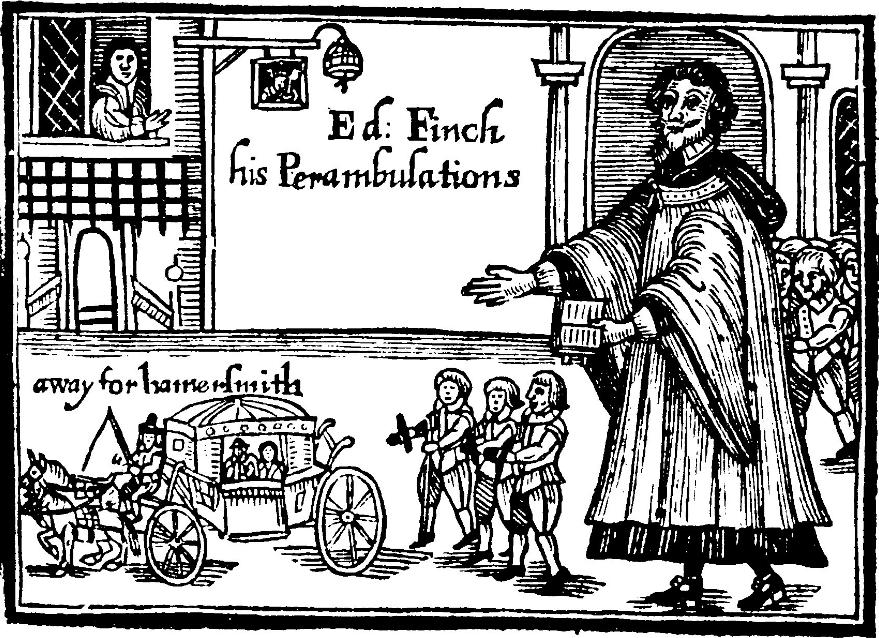
Below is the woodcut illustration which adorned a pamphlet published by Ralph Harford in 1641. It was no original work of prose but rather a copy of a petition brought before Parliament in the same year by a group of London parishioners who had soured on their resident preacher, and which ultimately caused him to be ejected from his benefice at Christ Church in Newgate. That preacher was Edward Finch — most likely the brother of John Finch, Lord Keeper of the Great Seal, who incidentally earned a passing reference in last week’s newsletter — and he can be seen on the right of the image.
The accusations levelled against him by his congregation included “Popish practices” (particularly over the kind of clothes he liked to wear and how he carried out Holy Communion), extortionately charging his parishioners for burials and baptisms, and dipping into the money which had been donated to the poor of the parish. In one particularly unpleasant episode, Finch is alleged to have violently ripped out a piece of a man’s beard out after he complained about the vicar coming and going in the early hours of the morning. This was, supposedly, because he kept company “with divers women suspected of incontinency”.
Finch was also a drinker, according to his detractors. Once, the petition claims, “he was so drunke when he was fetcht from a Taverne to give the Sacrament to a dying woman, that he was fain to be led by the arme to the house, that there he was not able to pronounce the Lords Prayer”. His regular haunt was the Chequers Inn in Hammersmith, and this is the drinking establishment which can be seen on the left of the woodcut, complete with signboard and hanging shrub (find out more about shop signs in this article, if you wish).
Finch was, understandably, not pleased with the petition and associated pamphlet. He penned a response, which was published in the same year and unequivocally (if not always very convincingly) denied the claims made against him. In his address to the reader he decried the prevalence of “envious pamphlets” in England’s book market, which was a common complaint, but also singled out “scurrilous Frontispieces”. He later referred to the pamphlet’s woodcut as “the Frontispeece of this abominably absurde Pamphlet”.