I revisit two of my previous posts in this newsletter, to add a little bit of context to them, and (as always) have picked what I think is a genuinely fascinating featured woodcut. It’s easy to forget that booksellers in Tudor and Stuart England really did need to capture the attention of passers-by if they wished their businesses to prosper. We know that publishers pasted title pages to boards outside of their shops, so woodcuts served a similar purpose to the thumbnail images which compete for your attention as you scroll through YouTube.
I published an article yesterday about a very peculiar lie detection method from 1606, which I teased in an earlier newsletter — so please do read that if you have the time. It involved dressing up as a devil to petrify a young girl into telling the truth in a murder case.
Please enter your email address above if you’d like to be notified every time a new article or newsletter is released!
Featured woodcut
This week’s featured woodcut is one of a few which really serve as a testament to the fact that a title page illustration’s primary purpose was to draw eyes. Here is what people passing by Laurence Lisle’s shop at the Sign of the Tiger’s Head in St. Paul’s Churchyard would have seen in early 1617:
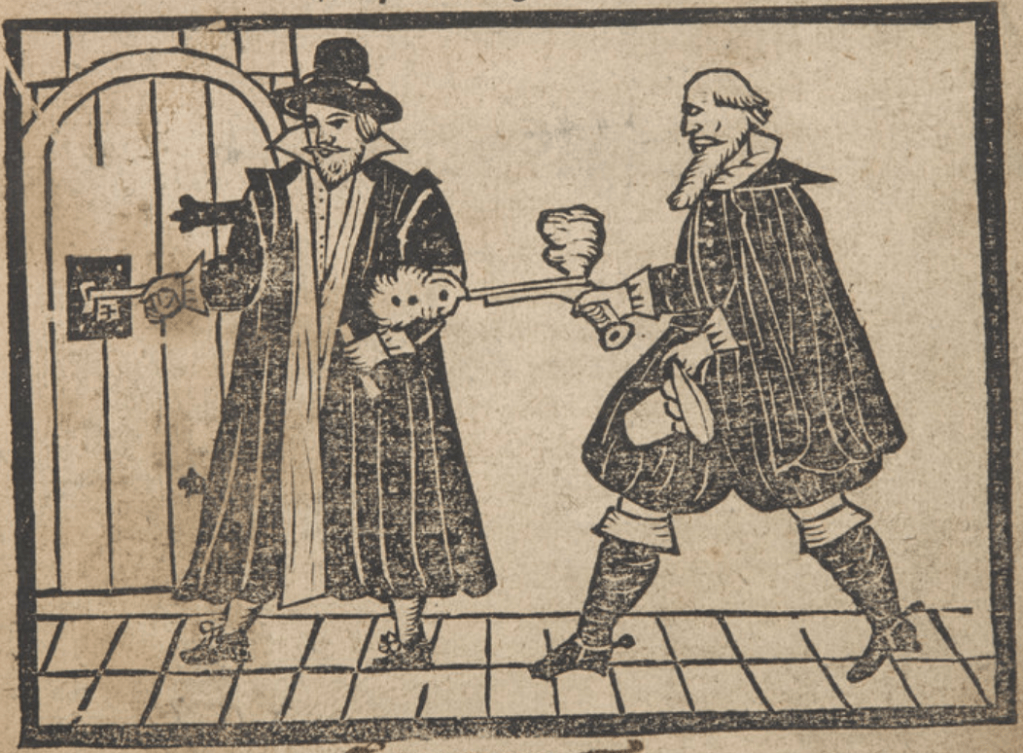
I need not say any more for most readers to ascertain that the scene above is the very moment of a cold-blooded shooting. Those with a keen eye for detail may even have spotted that the victim on the left — wearing smart, gown-like attire and clutching some papers in one hand — is likely to be a lawyer.
And indeed he was — one by the name of Sir John Tindall (or Tyndal). He was Master of Chancery and resided at Lincoln’s Inn, one of London’s four Inns of Court. The gunman was an aggrieved litigant by the name of John Bertram who blamed Tindall for an unsuccessful lawsuit over which he had presided, and had decided to take matters into his own hands. Bertram confronted the lawyer as he was entering his chamber on 12 November 1616 and proceeded to shoot him three times, killing him nearly instantly.
St. Paul’s Churchyard, which was the hub of England’s publishing industry, was less than a mile away from Lincoln’s Inn, and so we can imagine that it must have taken only a matter of hours for the booksellers there to hear about the killing.
Two weeks later, Lisle had gathered enough information to enter his news report on the fatal shooting into the Stationers’ Register, securing his publishing rights. As this entry (and the subsequent pamphlet) tells us, the murderer had gone on to hang himself in his Southwark jail cell before he could be tried.
Lisle’s printed news report would only be available for purchase from his bookshop early in the following year, however. This may have owed to a laborious process of gathering information (Stationers’ Register entries were often early, skeletal manuscripts) — but it is also highly likely it was delayed by the commission of such a specific, eye-catching woodcut illustration.
Lisle’s pamphlet was titled A True Relation of a most desperate Murder (1617), and I wrote about it nearly four years ago. The anonymous author is as condemnatory of the murder as we would naturally suspect and attempts, as was common at the time, to position its narrative within a corrupt (and corrupting) world. In this instance, it is the fact that Bertram had bypassed and contravened the legal system which was outrageous.
“Are there not Reverend Judges? Was all Law, Justice, and Religion, shutt up in the whole Kingdomes bosome, that Barterham (like a mad-man) must runne desperately up and downe, and strike the next hee bare Malice to?”
The fundamental underpinning of crime literature of that time was not simply that God would expose and undo wrongdoers through divine providence but also that they would be dealt with by a well-oiled legal machine which convicted criminals and protected the innocent.
To subvert the legal process, by acting outside of it and murdering a judicial officer responsible for its enforcement, was an existential threat to the integrity of the rule of law. And to hang yourself before you could be tried, convicted, and executed was also to try and cheat the system — even if your soul would be damned nonetheless.
This killing caused quite the stir among London’s legal world. A pamphlet published by John Beale before Lisle’s included a detailed transcript of the murderer’s examination by Sir Henry Yelverton and Sir Francis Bacon. This was an extraordinary scoop from Beale and the result of some deliberate leaking by Bacon and the Duke of Buckingham. Not that the legal community would have minded — the murder of a fellow lawyer represented not just a risk to their safety but also an affront to the country’s social and political order, which was underpinned by its laws.
In a letter to the Duke of Buckingham, written on the same day Bertram hanged himself, Francis Bacon, then Attorney General, described Tindall as “a kind of martyr”. He added that the unfavourable legal report for which Bertram had killed Tindall was entirely fair.
Of Bertram’s suicide, Bacon wrote: “I am sorry, because he is taken from example and public justice.” And it seems the examination was provided to Beale by Bacon himself to make up for this shortcoming, as the statesman goes on to suggest that the “truth of the fact [of Tindall’s murder]” ought to be published publicly “by some printed book of the fact”.
The Duke of Buckingham, George Villiers, replied four days later that he had “set on work a good pen, and myself will overlook it, for making some little pamphlet fit to fly abroad in the country”.
The pamphlet entirely cleared Tindall of accusations of bribery and corruption which Bertram had levelled against him, and describes the latter as a man “whose course and conversation of life was always disordered, and not without touch of the Popish Religion”.
Lisle’s pamphlet is by far the more compelling in terms of narrative and drama, compared to Beale’s sober, solemn, and factual account. But that, I suspect was the point: Lisle’s was a sensational news report written to make money, Beale’s was more like a carefully-written press release.
Beware the wrath of Thomas Wolsey
When I wrote about the fact that Henry VIII and Cardinal Wolsey were among the ghosts conjured up by writers during the English Civil War, I mentioned that the spectral Wolsey confessed to the Archbishop of Canterbury, William Laud, that he was cruel to the common people and held bitter grudges and personal vendettas. Probably the cruellest and most interesting of these concerned a man named Amias Paulet.
Paulet was born in the 1450s or ’60s and partook in the Duke of Buckingham’s failed rebellion in 1483 against King Richard III, for which he was attainted. He regained favour under Henry VII and was knighted after his participation in the Battle of Stoke in 1487, which ended the Wars of the Roses. By 1513, he was commanding a group of 25 men in northern France as part of Henry VIII’s war against the country.
The story goes that before Thomas Wolsey was a significant statesman he came to take possession of the benefice of Limington in Somerset and, quarrelling with Paulet for whatever reason (possibly drunkenly), was put in the stocks.
Years later, in 1521, Paulet became the treasurer of Middle Temple, another London Inn of Court. Wolsey, by now Lord Chancellor and the King’s closest advisor, took revenge for this previous indignity by ordering Paulet not to leave London without his permission.
Paulet resided in his chambers above Middle Temple’s gate for five or six years, virtually a prisoner. In an attempt to placate Wolsey and secure his freedom, Paulet is said to have emblazoned the Great Gate with the cardinal’s arms and other images celebrating him.

This story may well be apocryphal but it was used as a popular example of Thomas Wolsey’s wrath. The anecdote is included in John Speed’s The Theatre of the Empire of Great Britain (1612) and also the polemical 1641 work Canterburies Dreame which included the aforementioned confrontation of William Laud by Thomas Wolsey’s ghost.
Three rhymesters, incendiary verse, and Mercuries Message (1641)
In 1641 there was a pamphlet war between the anonymous author of an inflammatory anti-Laudian pamphlet entitled Mercuries Message and Thomas Herbert, a Welsh seaman and writer who penned a scathing response.
I wrote about this literary battle a few years ago and thought I had included all of the relevant participants — whether authors or printed works — but it appears I missed one, whose involvement has some interesting implications.
This participant was Martin Parker, the prolific writer of ballads (and occasional poetry) who I mentioned in last week’s newsletter. He wrote The Poet’s Blind mans bough in 1641, which is a very lively and quite ferocious attack on “those Dogmaticall, Schismaticall, Aenigmaticall, and nou Gramaticall Authors” who had attacked him and two of his literary associates in print.
One of these associates was Thomas Herbert, who had written a pamphlet in response to Mercuries Message (1641). One of the things Herbert had not addressed was the accusation that Laud was clearly the antichrist because his name can, through some alphabetical computation, be made to give the value 666 — the number of the beast.
As I noted in my article on the pamphlet war, the logic here relies on shortening the Archbishop’s name to “Will”, treating the W as two Vs, and ignoring the A altogether. In other words, Laud’s name is being treated as a chronogram.

Martin Parker spotted this rather flimsy logic as well, writing that “the Arch-Bishop (whom few now applaud)/Must be contented to be called Will Laud.”
In my initial post I noted that Mercuries Message (1641) has been ascribed to John Taylor, but seemingly with no real evidence to back up the claim. I accepted it at the time because the pamphlet does resemble his style and the subsequent use of woodcut illustrations to attack and deride his opponents is very similar to Taylor’s modus operandi. The title page of Mercuries Message Defended (1641) features a woodcut of Thomas Herbert being hanged.
But earlier I mentioned that Parker was friendly with Herbert and one other writer, who he defended in print. That writer was John Taylor.
So would Taylor really be attacking one of his allies, even anonymously? Taylor’s authorship would certainly complicate the literary dynamics of the 1640s, in which scholars have traditionally placed Taylor, Herbert, and Parker as three ideologically-aligned Royalist poets.
Taylor would have been no defender of Laud at this time (the Archbishop was seen as having led the King dangerously astray) but would a Royalist like Taylor really devote his time to attacking him?
It seems more likely to be the work of a staunch anti-episcopalian Puritan like Richard Overton, who Don M. Wolfe suggested as the pamphlet’s author in 1958 (though it seems this attribution has not been widely accepted).
That Overton’s authorship could even remotely be confused for Taylor’s is quite remarkable — given that the two were completely opposed on nearly all matters of religious and political opinion — but both were very skilled polemicists whose styles were not as distinct as their views.