I was recently interviewed by BBC Radio Berkshire about the extraordinary, logic-defying stunt which took place in Lambourn in 1607, which can be listened to online as part of their Secret Berkshire series: ‘The flying ship that stunned the county’.
This newsletter is primarily about that conversation, and I give a few behind-the-scenes details about my initial visit to the village in October 2024, when I wrote my initial piece about the journey, as well as a little bit more information about the event. The featured woodcut for this week can be found at the bottom.
Please subscribe (for free!) by entering your email address into the box above if you’d like to be notified whenever there’s a new post or newsletter.
William Bush’s “Flying Ship” in Lambourn, 1607
A few weeks ago, I had the privilege of speaking to BBC Radio Berkshire’s Phil Mercer about the remarkable feat undertaken by William Bush in 1607 at a Berkshire parish church, where the inventor attached a pinnace to two cable-ropes and hoisted the small ship towards the top of its church tower in front of thousands of onlookers. The interview can be found on BBC Sounds, for anybody interested.
This all stemmed from an article I wrote in October last year about the stunt, in which Bush set off from the village of Lambourn on a 126-mile mission to travel in his boat “by Ayre, Land and Water”. Dangling his ship some 40 feet from the ground at St. Michael and All Angels technically satisfied the airborne requirement and a set of wooden wheels — in combination with a system of pedals and cranks — would subsequently allow him to ride across the Berkshire Downs as if he were on a tricycle. From Reading he would enter the water and (for the most part) sail up the River Thames to London’s Custom House. He was joined by two friends for moral support but single-handedly constructed and commanded the vessel, which was decked out with colourful flags, cannons set to fire blanks sequentially, and fireworks. What a sight it must have been.

It’s a remarkable story, though sadly the certificate he received upon its completion, after only a little over three weeks, has been lost. There is little doubt that the general narrative of the pamphlet published by Nathaniel Butter the following year is accurate, however. It would certainly be daring to name, as the pamphlet’s author did, local members of the gentry who were involved if the entire affair were fabricated. And no subsequent printed works, or any other documents, contradict or challenge it — as we might expect for such a bold lie. Plus, Butter was a much more credible news publisher than many of his contemporaries. (The BBC initially seemed a little wary that the whole ordeal may have been made-up or exaggerated, so I explained this on the day, though I think they made the right decision in not including it, since it’s a little technical.)
I also met the Vicar of the Lambourn Valley Benefice, Revd Julie Mintern, who was very nice and offered a lot of interesting information about the church building. She confirmed something I had suspected but hoped was not true: that the story of William Bush is virtually unknown about in the village despite being a fascinating piece of local history. I had sort of worked this out when I went to Lambourn myself last year and met a kind woman inside the church who said she was unaware of the story, despite proceeding to offer me a guidebook which actually includes a 19th-century historian’s retelling of the event towards its end.

Most of the articles I write are about bits of literary history or historical anecdotes which don’t require me to avert my gaze from the computer screen (one of the more enviable aspects of book history is that it so much has been digitized), so I was keen to visit the village myself, which is only about forty minutes from where I live. There weren’t a ton of high-quality photographs of the church available online so one practical reason for going was to snap some myself. Being there also helped me to gauge the scale of Bush’s undertaking.
Inside the church, there is a tomb to Sir Thomas Essex and his wife, whose effigies are accompanied by a dolphin and a winged horse. Sir Thomas was a mid-16th century ancestor of Sir William Essex, who was the principal benefactor behind William Bush’s endeavour in 1607.
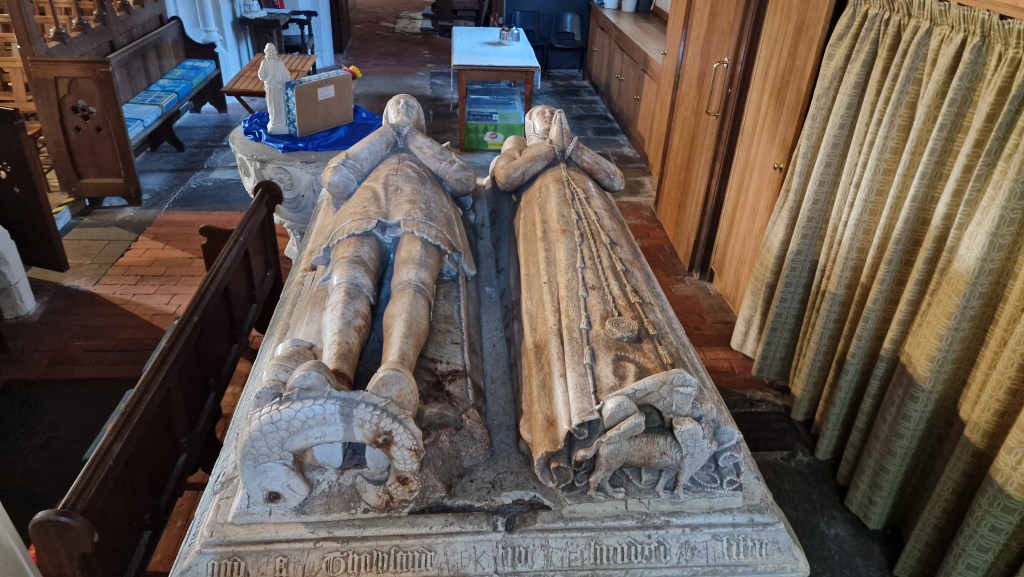
In neither my written article nor radio interview do I touch much on William Essex, because few specifics about his involvement are known, but he must have been a very important force behind the entire journey, since it is he who provided Bush with the required money, materials, and initial lodgings. Two other Oxfordshire gentry families were involved but Essex was clearly the most important and generous patron. He seems to have been incredibly bored by the aristocratic lifestyle bestowed on him by the circumstances of his birth and was apparently so annoyed by the nagging hangers-on that he was forced to endure following his marriage in 1593 that he considered fleeing the country.
Essex was evidently quite incompetent at, and uninterested in, the kind of familial politics and property management required by his position and so squandered his considerable inheritance. He was imprisoned for debt in 1639 and died about 1645, only some three years after suffering the humiliation of serving in a parliamentary regiment at the Battle of Edgehill commanded by his own son — quite the unusual family power dynamic there…
So it’s very tempting to think that Essex either had a hand in organising, or at least excitedly latched on to, William Bush’s eccentric endeavour to travel in a ship by air, land, and water, if for no other reason than because it was something interesting. It is also not at all unlikely that Essex, Bush, or some other participant had rightly pre-empted that this would be a wildly popular journey (which attracted thousands of spectators on the route to London) and so ensured that its details were recorded in writing and could be handed to a publisher in the capital.
Featured Woodcut
If Nathaniel Butter was, as I say, one of the more reputable disseminators of printed information in 17th-century England, John Trundle was perhaps the most infamous. You can almost taste the spite when Matthias Shaaber, in his seminal 1929 work on early English news pamphlets, refers to him as “that busy miracle-monger and father of lies”.
Trundle famously reported that a dragon was roaming the woods of Sussex and burning its inhabitants to death in 1614, for which he (and other news publishers by association) were regularly mocked in print for decades, and employed such morally unscrupulous tricks as re-publishing decades-old news with the dates omitted or obscured in an attempt to generate sales through feigned novelty. But here is a woodcut which accompanied one accurate piece of reportage he put out in 1624:
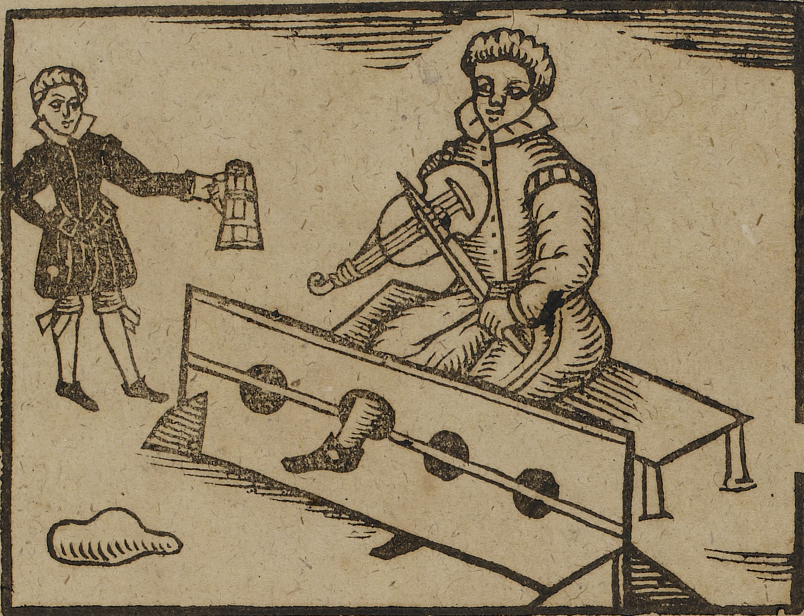
Earlier that year, Parliament had passed a bill dictating punishments for people caught “profanely swearing or cursing”. This might be because they had done so in the presence of a Justice of the Peace or other officer of the law, or because two witnesses had testified against them. Trundle promptly published a ballad warning “swearers and drunkards” to “forsake now your follies”, which contained a vivid woodcut illustration of a young man clamped in the stocks for his transgression. He is playing a fiddle as a boy offers him a flagon of drink — perhaps a taunt?
Given that broadside ballads targeted a fairly low-class audience and were regularly pasted on the walls of alehouses to be sung by their intoxicated patrons, this warning really was well-targeted. Sensing, perhaps, that the ballad might not be taken seriously by those most in need of its admonitions, it concludes with quite a serious reminder of the stakes at play, with which I shall leave you:
You that desire to dwell
In heaven hereafter,
Must not of this device
Make jest or laughter:
But must shake off these crimes,
With much distasting,
If you hope to enjoy
Life everlasting.


