Both of the historical anecdotes in this newsletter involve London’s infamous Newgate Prison. It really is hard to overstate just how notorious and feared this institution was during its heyday, between the 13th and 19th centuries. Stephen Halliday, in the title of his book on the prison, calls it “London’s prototype of Hell”; the London Museum offers a good read-up of its long history here.
So no wonder the two prisoners included in this week’s featured woodcut tried to escape it. When the corrupt informer Griffin Flood was locked up there in 1623, he is said to have suffered from “a fearfull vision” and believed the Devil was going to “teare [him] in pieces”. Only a little bit of its original structure survives today — a part of its wall.
Please enter your email address into the box above if you’d like to subscribe (for free!) and be notified whenever a new newsletter or article comes out.
Featured Woodcut
The below woodcut is from the anonymous pamphlet The Life, Apprehension, Arraignement, and Execution of Charles Courtney (1612), showing two men attempting to escape Newgate Prison. It was sold by Edward Marchant from his bookshop in St. Paul’s Churchyard and clearly benefited from a custom-made illustration on its title page. The scene is crudely presented to be sure (the central building looks almost two-dimensional) but is lively nonetheless.
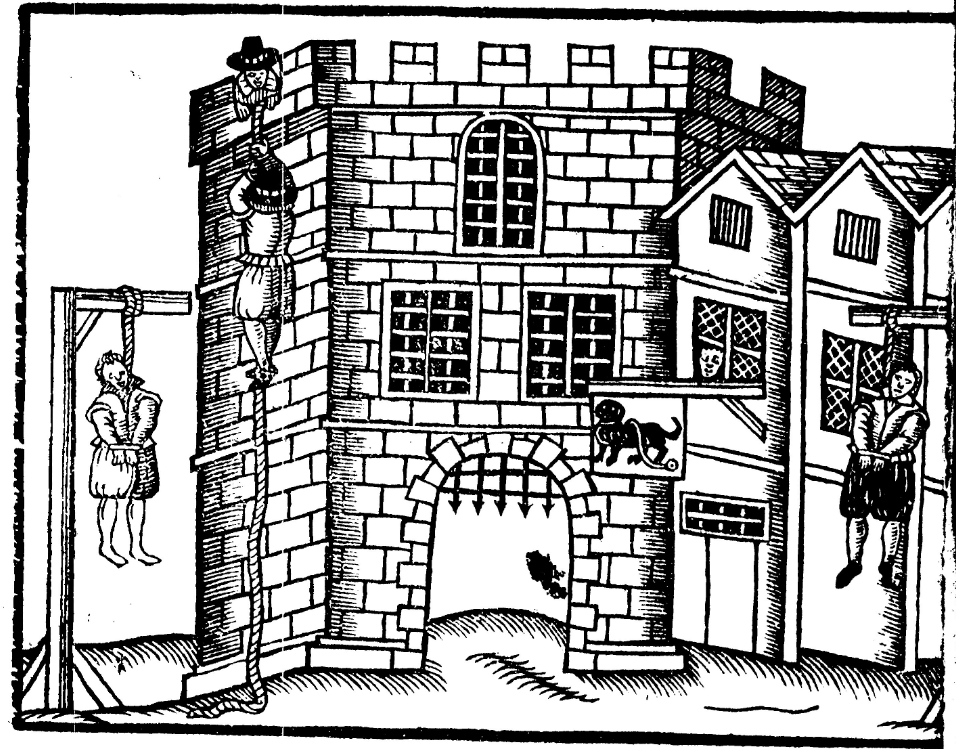
The titular Charles Courtney was a criminal who Eleni Liapi says had a “brief but eventful life as a highway robber, a burglar and a conman”. He reportedly mounted two successful escapes from Newgate Prison, London’s infamous “castle of misery” in which delinquents suffered in squalid conditions.
This second attempt was made in partnership with Clement Slie, a fellow prisoner, though the success was short-lived, for Courtney was captured again after only only a few days and later executed. In the woodcut, one man can be seen descending a rope while another prisoner watches on.
This pamphlet sits firmly within the category of “rogue literature” which flourished at the beginning of the 17th century and was emblematic of the manner in which a text could at once decry a criminal’s deeds while in the same breath catering towards the obvious fascination, and enjoyment, that many readers had for their wiles. With their dramatic escapades, violent encounters, and intriguing personalities, these little books were the guilty pleasure of many a Protestant — and a precursor to the “true crime” media that is still popular today.
The account is purportedly by Courtney himself, but though it may well have been informed by conversations with the career criminal, it strains credulity to believe that he really was the author. It was a common practice for publishers of the time to use criminals as ventriloquists’ dummies and have them “write” detailed accounts of their life, crimes, and repentance ahead of their execution. On the one hand, this might make the text resonate more with a reader, and so better deter them from a similar immoral path. On the other, it also gave the report more credibility (if the authorship could seriously be insisted upon) and was a strong selling point.
The notorious English thief Jack Sheppard escaped Newgate a whopping four times in the 18th century and a book telling his story (marketed as autobiographical) was sold at this execution. It is thought to have been ghost-written by the famous author Daniel Defoe.
Whichever (far inferior) pamphleteer was tasked with writing up this fake-first-person report seems to have cut a few corners. Some of the very first lines are flagrant plagiarism. Here is an initial musing the reader is supposed to believe Courtney makes about the vulnerability of human life:
[A] Spider is able to choake vs, a haire to stifle vs, and a tyle falling on our heads to extinguish vs, euen in that momēt, when we least suspect so suddaine a calamitie.
Our life then so momentarie, that in that minute we breath (if not defended by our Maker) in that minute we are breathlesse. Why should any flesh, endowed with that heauenly reason, which God hath onely giuen to men and Angels, so forget his vncertaintie?
Seemingly aware that even the most gullible of readers might pause to consider how a deplorable man like Courtney — a low-life home invader because of whom two innocent men were falsely convicted and executed — could conjure up such profound wisdom, the writer abruptly has the criminal rhetorically ask: “Who will receiue a homely counsel from that tongue, whose folly hath brought him to be condemned himselfe?”
This little philosophical tangent is actually taken verbatim from the introduction of a 1606 murder pamphlet concerning the killing of a young boy and the mutilation of his sister (about which I have previously written). This may, in turn, have been stolen from somewhere else (and it’s not impossible, though it is unlikely, that the two works shared an author). In any case the sentiment was clearly inspired by a sermon preached by the popular Puritan clergyman Henry Smith in the previous century (and printed in 1593), wherein he warned that “we may well be called earthen vessels, for we are soone broken, a spider is able to choake vs, a pin is able to kill vs: all of vs are borne one way, and die a hundred waies”.
Going back to the woodcut — note that it features a projecting wooden signboard featuring a black dog. This was a visual cue for the would-be customer passing by Edward Marchant’s bookshop that the prison depicted was indeed Newgate, as legend had it that a monstrous canine — the Black Dog of Newgate — haunted the prison.
The Counterfeit Constable
There are a few reasons to set your writing in faraway places. Perhaps, like Shakespeare and other writers of the early modern period, you wish to comment on and critique the goings-on of your own country and its court but (quite rightly) fear censorial rebuke unless the criticism is directed towards a foreign land, which acts as an obvious parallel. Maybe it’s because there is an inherent exotic appeal to the cultures of distant lands. Or maybe it’s because you’re lying.
The latter was the thesis of one anonymous late-17th century writer. When, in 1674, he found himself penning a report about a series of crimes in London, he noted that his story did not involve “turning over Chronicles, or searching the musty Records of Antiquity, or (what is more poor) fobbing the Reader with an idle Romantick Story, where the Scene is laid in some remote and unknown Country, to make it easier to be believed than disproved”. His scene was England’s very own capital, and the crime fresh in living memory.
His pamphlet bore the pleasingly-alliterative title The Counterfeit Constable, Or, The Wicked Watch (1674). If the reader wades through the thick bog of tediously pretentious intellectual musing which makes up its introductory lines (“Sciences may be in the wane, & most good Arts Dwinling away by a Retrograde motion, whilst each modern Author proves only an Eccho to the Ancients”), an interesting news report follows.
Apparently a “jolly Gang of the Town, who lived like birds of prey” were enriching themselves by pretending to be law enforcement. Most dressed up in the necessary garb to imitate watchmen, while one impersonated a constable — complete with gown, cap, and staff. These posers set out at 10 or 11pm and knocked on the door of a house they intended to rob. Presenting a forged a warrant from a Justice of the Peace (complete with a bogus seal), they would pretend to search the property, but were in reality pilfering any money they could find. Informing the inhabitant that the money was counterfeit and had to be requisitioned, they would depart.
After this initial heist, they next raided an alehouse, where they stole many valuable metal plates.
Their next target was “an Eminent Shopkeepers House”, from whose inhabitant they demanded to know the location of “French prohibited goods”. But the incredulous homeowner was suspicious and called for a watchman. Some of the criminals escaped, but others were apprehended.
They were committed to Newgate Prison and sentenced to hang at Tyburn but escaped the gallows after “the Endeavours of Friends” secured them a reprieve from execution.