The contents of this website tend to be a little bleak — because so much of what the printing presses produced during the 16th and 17th centuries was bleak. I’ve written about a manipulative informer who extorted well-meaning Londoners and eventually murdered a man before being torturously pressed to death, the brutal pickaxe murder of a wealthy miller, and how printed bills of mortality meant that reminders of death were everywhere in early modern London.
My first ever post was about “early modern crime thrillers”, and my most recent, though technically about an extravagant and inventive way of detecting lies in the Stuart period, nonetheless revolves around a series of murders. This newsletter is fairly middle-of-the-road; the featured woodcut is a testament to the misogyny which was rampant during the early modern period, but to a modern reader it is also a humorous indictment of the absurdity of those views.
Please enter your email address in the box above if you’d like to be notified every time there’s a new post or newsletter. (I have some slightly more cheerful articles planned!)
Featured woodcut
Cultural fascinations and anxieties tend to come and go quite unpredictably and often prove to be fleeting. In 1620, there was a moment of extreme anxiety about how people in England were performing their gender. Tensions had been simmering for a few years, ever since Joseph Swetnam authored his woman-bashing Arraignement of Lewd, Idle, Froward, and unconstant women (1615). Two pamphlets about which I have previously written — Hic Mulier and Haec Vir — were printed in 1620. The former attacked women who dressed in masculine attire, behaved boisterously, and refused to occupy the inferior position expected of women at that time. The latter responded by defending such cross-dressing and gender transgression, while (hypocritically) attacking effeminate men.
The very detailed illustration below comes from a ballad published in the same year, the full title of which is: Fill Gut, & Pinch belly; One being Fat with eating good Men, the other Leane for want of good Women (1620).
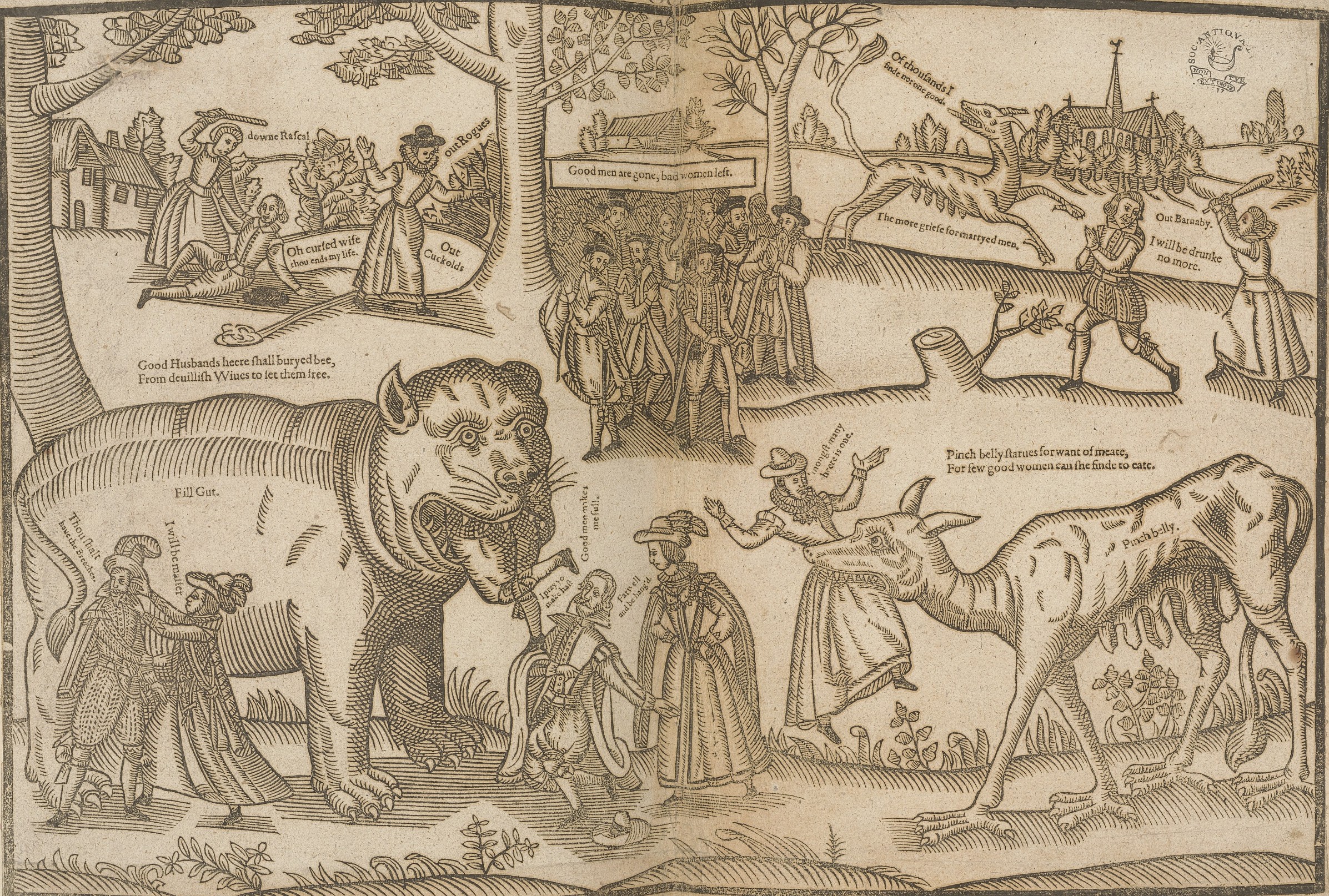
Four stanzas of four-line verse beneath this image tell us that “Pinch belly” is starving because she can find no good women to eat, whereas “Fill gut” has grown fat by devouring honest men who choose to submit themselves to his jaws rather than put up with their wives. The consequence, according to some text on the woodcut itself, is that “Good men are gone, bad women left”.
The two metaphorical monsters come from a narrative which circulated in oral culture during the late Middle Ages and survives in some printed material from the very end of the 15th century, though they often went by other names, such as Chicheface (“lean face”) and Bigorne (literally “two horns”, despite the monster not usually having any). Historian Kate Lavéant has traced the development of the woodcut above, which is a crude copy of a 1611 Dutch engraving published by David de Meyn, who was himself inspired by two French broadsides from about 1600.
Though it is dominated by the figures of Fill gut (left) and Pinch belly (right), who are both munching on their preferred food, the illustration is largely a collage of different instances of gender confusion and transgression.
At the top-left, a wife beats her husband. Below, another informs her husband that “I will be master” as she grapples with him, perhaps attempting to take his clothes for herself; the husband feebly concedes that “Thou shalt have the breeches”. To their right, a man voluntarily offers himself up to Fill Gut, one of many who, the verse below tells us, have come “Heere thus to be eaten, and rid from their Wives”. Near the top-right, a pleading man flees from his spouse — herself in hot pursuit with a cudgel — insisting that “I will be drunke no more.” These scenes of overbearing, demanding wives and pathetic, disempowered husbands embody the crux of Renaissance gender anxieties.
We do not know who penned the lines beneath the woodcut, which are the sole original contribution this print offers. In Pollard and Redgrave’s Short Title Catalogue (1926) the ensuing verses are attributed to John Taylor, the self-proclaimed “Water Poet” and prolific writer of both verse and prose. The Society of Antiquaries of London has since added a note in their collection bluntly clarifying that it is “Prob. not by Taylor”. The attribution presumably stemmed from Taylor’s regular business contact with the ballad’s publisher (Henry Gosson) at that time, in combination with the fact that the verse’s style is not extraordinarily dissimilar to his and expresses a kind of misogyny sometimes founds in Taylor’s writing.
But the verse which was printed below the huge woodcut illustration really does not ring of Taylor’s voice. It is very simplistic, at times even a little clumsy, and pretty much entirely devoid of wit — so although Taylor undoubtedly could have penned it, it seems markedly below the quality of even his more mediocre output. (It also does not bare his name and is nowhere referenced in his future writing, which are small additional points in favour of his non-authorship.)
Stationers behaving naughtily
Booksellers and printers in Tudor and Stuart London very often maintained communication networks within prisons. Many of the most profitable bits of cheap printed news concerned violent crimes and so it made sense for members of the Stationers’ Company to have eyes and ears in the places that these criminals tended to end up while en route to the scaffold.
Not all prisoners had committed terrible crimes, though. Some were guilty of minor infractions for which the authorities deemed a brief period of incarceration to be a salutary measure. Others had committed quite serious crimes, or at least aided those who had, but could not justifiably be executed. Some of the people in both of these categories were stationers themselves.
John Allde, the very first person to take up freedom of the Stationers’ Company after it received a royal charter in 1557, was locked up in the Poultry Compter in 1568 for printing a pro-Catholic tract.
His son Edward was ordered by King James I’s Secretary of State to serve prison time in 1621, alongside the bookseller Thomas Archer, for producing an illegal pamphlet touching on the politics surrounding the Thirty Years’ War.
But often the reasons for imprisonment had nothing to do with what was being printed or sold — and sometimes the punishment was limited to a fine. The pioneering news publisher Nathaniel Butter disgraced himself in 1624 by calling the female bookseller Hannah Barrett a “durtye slutt”. For this he was fined six shillings and eight pence. He was a repeat offender, since he had been forced to pay a fine 15 years earlier for verbally abusing the printer Thomas Purfoot. In 1608, fellow bookseller John Harrison had himself been reprimanded for trying to arrest Butter over a debt he was owed.
The bookseller John Parker had to grovelingly apologise to the company in January 1630 for having assaulted its Master Warden. The Court of the Stationers’ Company must have been in a forgiving mood, for he regained all of his previously-forfeited privileges and was given the profits he had missed out on as a result of his expulsion from the English Stock — a collaborative venture between some of the company’s members which had secured lucrative monopolies over certain types of work.
George Wood was not a member of the English Stock and so got into trouble after he printed a series of almanacs and primers in 1621. His press was seized and destroyed but he was back in business on Grub Street the following year, again operating illegally. Wood’s shop was raided by agents of the Stationers’ Company, who were “violently opposed” by his employees. Once the resistance had been quashed, his press was destroyed and he was imprisoned. Wood petitioned the Archbishop of Canterbury, George Abbot, who persuaded the Stationers’ Company to readmit Wood as a journeyman printer (i.e. not a master printer operating his own presses). Wood never regained his previous status and was found to be operating even more clandestine printing presses in 1624.
It wasn’t always members of the Stationers’ Company who were punished: One of Edward Allde’s journeyman printers was committed to the Wood Street Compter for absconding from his employment without giving two weeks notice.